|
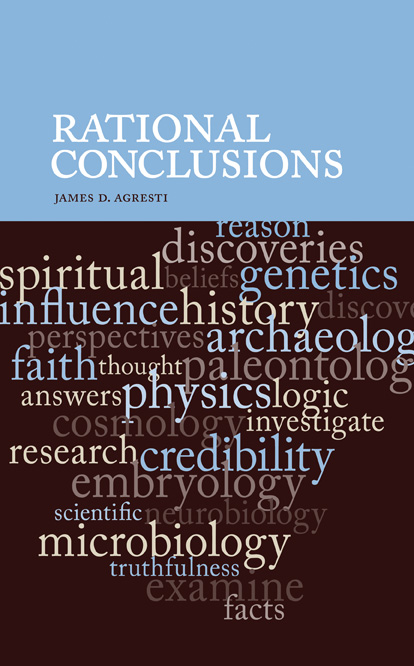
Rational Conclusions is a meticulously researched and scholarly acclaimed book evidencing factual support for the Bible across a broad array of academic disciplines. These range from history, archaeology, and physics—to genetics, microbiology, paleontology, and more.
Although geared to academics, Rational Conclusions has been readily comprehended by audiences with wide-ranging levels of education. Readers with high school degrees to postgraduate scholars have found this book to be stimulating, informative, and often surprising as hundreds of academic source materials reveal compelling evidence for the Bible’s reliability.
Rational Conclusions contains over 2,500 detailed citations to sources such as peer-reviewed journals, authoritative reference works, and books found in the science and history sections of university libraries.
Rational Conclusions was edited by Gina L. Diorio and is published by Documentary Press. The book trailer was created by Steve Mitas, an Emmy Award-winning animation artist.
James D. Agresti is a
former atheist who became a Christian after reading the Bible from
cover to cover and finding objective evidence for its accuracy. Mr.
Agresti holds a Bachelor of Science in Mechanical Engineering from
Introduction
How do we establish our spiritual beliefs? Many follow in the footsteps of their parents or other influential figures in their lives. Some embrace their views on the basis of emotional appeal. Others invest a certain amount of thought into the process but often do so without performing substantive research. If you were to ask the people you know why they believe what they do, how many do you think could give you a rational answer? For many people, spiritual beliefs are a matter of personal preference or blind faith.
The great irony here is most people would agree spiritual beliefs impact our lives in significant ways, and many, including me, think they have eternal importance. Why then would anyone entrust the formation or rejection of such views to whim or speculation? Given what is at stake, shouldn’t careful investigation and serious thought be a part of the process?
The purpose of this book is to examine facts that can be used to arrive at rational conclusions regarding the Bible. Surprisingly, many of these facts proceed from academic disciplines such as:
Genetics History Archaeology Paleontology Physics Cosmology Embryology Neurobiology Microbiology
In the realm of spirituality, one of the easiest things to do is make simplified and unsupported assertions that are accepted by people who share the same mindset. The real test for any work that stakes a claim to truthfulness, however, is whether or not it can withstand the scrutiny of a judicious audience.
Hence, this is not a book for those who uncritically accept what they want to believe and robotically deny what they don’t. It is for people who ask, “How do you know that?” and then follow up by asking, “How do you know that you know that?” Legitimate answers to such questions do not typically make for leisurely reading material, but the alternative of blindly embracing that which appeals to our notions or emotions is woefully inadequate for an issue of such magnitude. Preface
When it comes to reading literature that is supposed to be informative, the only thing more frustrating than finding less information than we need is being swamped with more than we want. To remedy this typical conflict between thoroughness and brevity, this book was written in a special format designed for readers with varied levels of interest.
The main text provides the key points and details, which should be ample enough to satisfy the vast majority of people. The sections of text enclosed by arrows and printed in a contrasting font ►like this◄ offer additional materials for those who would like to explore certain topics in greater depth. These are primarily for academically minded readers and can be skipped without missing crucial information or disrupting the flow of the book.
To establish the accuracy of the hundreds of facts that appear in the forthcoming pages, I have documented them far more thoroughly than standard academic practice requires. Over years of conducting research on diverse subjects, I cannot begin to count the number of times I have looked up a source citation and found it was misrepresented. Therefore, as is possible without infringing upon copyright laws that limit the amount of text I can reproduce from any given source, the citations of this book directly quote the sources so readers can verify they are accurately represented. Instead of printing these comprehensive citations in this book, I have posted them online at rationalconclusions.com to keep the physical size of this book to a minimum (as it would more than double in size if this material were among the pages you are holding) and to offer clickable access to sources available online.
An important point to understand about the sources cited in this book is that they are predominantly technical periodicals, scholarly journals, reference works such as encyclopedias, and books found in the science and history sections of university libraries. One of the principal features that make this book unique is the exhaustive use of highly credible sources. My objective was to document all key facts so thoroughly that no reasonable person would doubt them.
Notwithstanding the academic source materials, this book was written so it could be understood without a specialized education in any of the topics examined. To accomplish this, brackets [--] are used in a slightly unconventional manner to replace technical verbiage with plain language that has the same meaning. For instance, in scholarly literature, the first five books of the Bible are often referred to as “the Pentateuch.” Hence, when quoting from a source that uses this term, I have replaced it with “[the first five books of the Bible].” For those who would like to read the original wording, the online citations display the exact text and the plain language in brackets. Thus, brackets [--] are used to paraphrase; parentheses (--) contain the exact wording of the original sources, and curly brackets {--} are used to enclose my own comments and thoughts. …
|
 About
the Author
About
the Author