Citations
Chapter 9 - The Fossil Record
[1832] Book: Fossils: The Evolution and Extinction of Species. By Niles Eldredge. Harry N. Abrams, 1991.
Page 114: George Gaylord Simpson was "the most influential palaeontologist of the mid-twentieth century...."
[1833] Book: Fossils and the History of Life. By George Gaylord Simpson. Scientific American Books, 1983. Page 125.
[1834] Book: On the Origin of Species by Means of Natural Selection, or the Preservation of Favoured Races in the Struggle for Life. By Charles Darwin. John Murray, 1859. http://www.literature.org/authors/darwin-charles/the-origin-of-species/
Chapter 10: "On The Geological Succession of Organic Beings":
All these causes taken conjointly, must have tended to make the geological record extremely imperfect, and will to a large extent explain why we do not find interminable varieties, connecting together all the extinct and existing forms of life by the finest graduated steps.
He who rejects these views on the nature of the geological record, will rightly reject my whole theory. For he may ask in vain where are the numberless transitional links which must formerly have connected the closely allied or representative species, found in the several stages of the same great formation. He may disbelieve in the enormous intervals of time which have elapsed between our consecutive formations; he may overlook how important a part migration must have played, when the formations of any one great region alone, as that of Europe, are considered; he may urge the apparent, but often falsely apparent, sudden coming in of whole groups of species. He may ask where are the remains of those infinitely numerous organisms which must have existed long before the first bed of the Silurian system was deposited: I can answer this latter question only hypothetically, by saying that as far as we can see, where our oceans now extend they have for an enormous period extended, and where our oscillating continents now stand they have stood ever since the Silurian epoch; but that long before that period, the world may have presented a wholly different aspect; and that the older continents, formed of formations older than any known to us, may now all be in a metamorphosed condition, or may lie buried under the ocean.
Passing from these difficulties, all the other great leading facts in palaeontology seem to me simply to follow on the theory of descent with modification through natural selection. We can thus understand how it is that new species come in slowly and successively; how species of different classes do not necessarily change together, or at the same rate, or in the same degree; yet in the long run that all undergo modification to some extent.
Chapter 14: "Recapitulation and Conclusion":
On this doctrine of the extermination of an infinitude of connecting links, between the living and extinct inhabitants of the world, and at each successive period between the extinct and still older species, why is not every geological formation charged with such links? Why does not every collection of fossil remains afford plain evidence of the gradation and mutation of the forms of life? We meet with no such evidence, and this is the most obvious and forcible of the many objections which may be urged against my theory. Why, again, do whole groups of allied species appear, though certainly they often falsely appear, to have come in suddenly on the several geological stages? Why do we not find great piles of strata beneath the Silurian system, stored with the remains of the progenitors of the Silurian groups of fossils? For certainly on my theory such strata must somewhere have been deposited at these ancient and utterly unknown epochs in the world's history.
I can answer these questions and grave objections only on the supposition that the geological record is far more imperfect than most geologists believe.
[1835] Article: "Who doubts evolution?" By Mark Ridley. New Scientist, June 25, 1981. Pages 830-832.
[1836] Book: Drawing Out Leviathan: Dinosaurs and the Science Wars. By Keith M. Parsons. Indiana University Press, 2001. Page 1:
On a spring morning in a long-vanished world, an enormous creature was dying. Driven by thirst, she trudged toward the slow, muddy waters of a great river. Her massive legs could no longer support her, and she fell into the riverbed to die. Before scavengers could tear and scavenge the carcass, a violent storm washed it downstream. It came to rest on a sandbar in the middle of the meandering river.
As the body decayed, the river shrouded it with sediment. Soon only the bones were left, encased in fine sand and salt. As the ages passed, the sediment over the bones deepened and hardened, turning into rock. Molecule by molecule, the bones themselves were also changed into rock and buried deep in the crust of the earth.
[1837] Book: Essential Science for GCSE. By Susanne Lakin & John Patefield. Nelson Thornes, 1998. Republished in 2002.
Page 144: "Fossils are often found in sedimentary rocks, particularly limestone and shale. They form when animals and plants die and fall to the sea floor where they are squashed into sediments. The soft parts rot away but the hard parts remain and gradually turn into sedimentary rock."
[1838] Article: "Fossil." McGraw-Hill Encyclopedia of Science & Technology. Volume 7. McGraw-Hill, 2007. Pages 454-460. Page 454:
A widespread conception is that a fossil is a shell or skeleton turned into stone. This picture is not false {as the forthcoming citation explains, however, this picture is rare}, but it represents only a few of the ways in which life can leave its trace in Earth's accreting skin of sedimentary rocks. Any part of an organism can get preserved, not only hard parts but also soft tissues, cells, and organelles.
[1839] Book: Life of the Past: An Introduction to Paleontology. By George Gaylord Simpson. Yale University Press, 1953. Pages 13-15:
We used to speak of fossil bone as petrified and still sometimes do in a loose sense. We now know, however, that it is seldom petrified as our ancestors understood that word and most nonpaleontologists still do. Even in the oldest fossils the original bone substance has seldom "turned to rock," or even been replaced by some quite different material. Usually the original hard material of bone and teeth which formed when the animal was alive is still there. Perhaps it is somewhat rearranged in structure but with little or no change in composition, as complex compounds of lime and phosphate.
[1840] Book: Life of the Past: An Introduction to Paleontology. By George Gaylord Simpson. Yale University Press, 1953.
Page 15: "The soft materials that occupy larger or smaller cavities and canals in the hard bone or tooth tissue soon decay and leave empty spaces. Sometimes that is all that occurs. More often these spaces are later filled by some mineral.... It is this filling that makes fossil bone heavier than recent bone and also more brittle."
[1841] Book: Palaeobiology: A Synthesis. Edited by Derek E. G. Briggs & Peter R. Crowther. Blackwell Scientific Publications, 1990. Section 2.1: "Molecular Palaeontology." By G. B. Curry (Department of Geology & Applied Geology, University of Glasgow, UK). Page 95.
[1842] Same as above. Page 97: "Organic compounds have now been isolated and characterized from a diverse taxonomic range of invertebrate and vertebrate fossils spanning the entire history of shelly faunas (i.e. 600 million years)."
[1843] Book: The Changing Earth: Exploring Geology And Evolution. By James S. Monroe & Reed Wicander. Fourth edition. Brooks/Cole, 2006. Page 605:
THE EMERGENCE OF A SHELLY FAUNA
The earliest organisms with hard parts are Proterozoic calcareous tubes found associated with Ediacaran faunas from several locations throughout the world. These are followed by other microscopic skeletonized fossils from the Lower Cambrian ... and the appearance of large skeletonized animals during the Cambrian explosion.
[1844] Book: Life Itself: Its Origin and Nature. By Francis Crick. Simon and Schuster, 1981.
Page 108: "The earliest traces of life we can detect at the present time are found associated with rocks dated to about 3.6 billion years ago. Multicellular organism probably began about 1.4 billion years ago, but the fossil record, formed by simple animals whose hard parts have been preserved, is only 0.6 billion years old."
[1845] Book: Life of the Past: An Introduction to Paleontology. By George Gaylord Simpson. Yale University Press, 1953.
Page 11: "Soft coals formed in ancient bogs may be tens of millions of years old, as in Victoria, Australia, and contain wood that is somewhat darkened but otherwise so unaltered that it can easily be cut with a saw and planed."
[1846] Article: "Bone marrow." Encyclopedia Britannica Ultimate Reference Suite 2004.
This article states that bone marrow is a "soft, gelatinous tissue that fills the cavities of the bones."
[1847] Book: How Cancer Works. By Lauren Sompayrac (Ph.D., Retired Professor of the Department of Molecular, Cellular, and Developmental Biology, University of Colorado.) Jones and Bartlett, 2004. Pages 18-19:
I remember when I first heard about bone marrow transplants. I imagined that a surgeon had to cut a bone out of the donor and graft into a bone of the recipient. ... Fortunately it doesn't work like that. Under a general anesthetic, a surgeon uses a syringe with a large needle to pierce the bones of the donor and to remove a total of about a pint of bone marrow. Marrow has a consistency similar to blood, so it's rather easy to suck this much out of the interior of large bones.
[1848] Book: An Atlas of the Blood and Bone Marrow. By R. Philip Custer (Emeritus Professor of Pathology, The University of Pennsylvania School of Medicine; Senior Member, The Institute for Cancer Research, Fox Chase; Consultant, The Presbyterian-University of Pennsylvania Medical Center). Second edition. W. B. Saunders Company, 1974.
Pages 35-36: "The bone marrow is the most labile tissue in the body, except the blood itself."
[1849] Entry: "labile." Merriam-Webster's Collegiate Dictionary, Encyclopedia Britannica Ultimate Reference Suite 2004.
Definition 1: "readily or continually undergoing chemical, physical, or biological change or breakdown : unstable...."
[1850] Paper: "High-fidelity organic preservation of bone marrow in ca. 10 Ma amphibians." By Maria E. McNamara and others. Geology, August 2006. Pages 641-644. Page 641:
Bone marrow in ca. 10 Ma [about 10 million-year-old] frogs and salamanders from the Miocene of Libros, Spain, represents the first fossilized example of this extremely decay-prone tissue. The bone marrow, preserved in three dimensions as an organic residue, retains the original texture and red and yellow color of hematopoietic and fatty marrow, respectively; moldic osteoclasts and vascular structures are also present.
[1851] Article: "Fossils Yield 10-Million-Year-Old Bone Marrow -- A First." By Richard A. Lovett. National Geographic News, July 25, 2006. http://news.nationalgeographic.com/news/2006/07/060725-fossil-bone.html
The marrow is organically preserved," McNamara said. "The original color of the marrow is preserved." ... The next step, McNamara says, is to determine what the fossilized marrow is made of. "We have started the analysis, but we're not finished," she said.
NOTE: I wrote Dr. McNamara in March 2008 to see if the analysis was complete. She replied that it was not.
[1852] Book: The Chemically Controlled Cosmos: Astronomical Molecules from the Big Bang to Exploding Stars. By T. W. Hartquist & D. A. Williams. Cambridge University Press, 1995.
Page 9: "'Only a million years' – of course, that is an enormous, incomprehensible period of time by human standards."
[1853] Book: Fossils: The Key to the Past. By Richard Fortey. Second edition. Harvard University Press, 1991.
Page 25: "Once the idea of Creation within a few thousand years disappeared, it was obvious that the earth had to be much older. But how much? Millions of years certainly, but ten million, a hundred, or a thousand million? The fact is that it is impossible for the human minds to grasp such lengths of time as these."
[1854] Book: Exploring Earth and Life Through Time. By Steven M. Stanley (Johns Hopkins University). W.H. Freeman and Company, 1993. Page 11:
The deposit most famous for preservation of soft parts is the Eocene Geiseltal of Germany, which is more than 40 million years old. In the nearly impermeable Geiseltal sediments, which are rich in oily plant debris, the skin and blood vessels of long-extinct frogs can still be studied, fossil leaves are still green, and insects retain their iridescent color (Figure 1-12).
[1855] Book: Palaeobiology: A Synthesis. Edited by Derek E. G. Briggs & Peter R. Crowther. Blackwell Scientific Publications, 1990. Section 3.11.7: "Taphonomy of Fossil-Lagerstätten: Solnhofen Lithographic Limestones." By G. Viohl (Jura Museum, Germany).
Pages 285-6: "The Solnhofen Limestones comprise not more than half an amniote zone in the lower part of the Lower Tithonian [≈ 150 million years ago], representing at most 0.5 myr [500,000 years]."
Page 288: "Soft parts are often preserved, e.g. the intestines of fishes (when filled) or the ink sacs of coleoid cephalopods. The ink, consisting of very stable proteins, may survive diagenesis and, dissolved in water, can still be used for drawing (Barthel 1978*).
NOTE:
* This source is in the German language
[1856] Book: Palaeobiology: A Synthesis. Edited by Derek E. G. Briggs & Peter R. Crowther. Blackwell Scientific Publications, 1990. Section 2.1: "Molecular Palaeontology." By G. B. Curry (Department of Geology & Applied Geology, University of Glasgow, UK). Page 98:
[A]ntibodies recognize their target molecule by detecting a small diagnostic region or regions known as determinants. Antibodies prepared against living tissues or a particular fundamental molecule such as collagen, can therefore detect the presence of that molecule in fossils, provided that fragments containing the determinants have survived. As determinants are much smaller than intact molecules, their survival potential is much greater. Antigenetic determinants are known to survive for at least 70 million years (De Jong et al. 1974; Lowenstein 1986)."
[1857] Book: Palaeobiology II. Edited by Derek E. G. Briggs & Peter R. Crowther. Blackwell Scientific Publications, 2001. Reprinted in 2003. Section 3.1.1: "Fossilized Materials: Proteins." By M.J. Collins (Postgraduate Institute in Fossil Fuels & Environmental Geochemistry, The University, Newcastle upon Tyne, UK) & A.M. Gernaey (Biosciences Research Institute, University of Salford, UK).
Page 245: "Yet potential for the application of protein geochemistry is questionable, because the survival of informative protein fragments beyond the Pleistocene [≈ 1.8 mya] appears to contradict our understanding of rates of chemical decomposition."
Page 247: "The persistence of recognizable distributions of amino acids into the Ordovician [444-488 mya] is perhaps surprising, but little experimental work has been conducted on their degradation (see Collins et al. in Stankiewicz and van Bergen 1998), with the notable exception of racemization."
[1858] Book: Palaeobiology: A Synthesis. Edited by Derek E. G. Briggs & Peter R. Crowther. Blackwell Scientific Publications, 1990. Section 2.1: "Molecular Palaeontology." By G. B. Curry (Department of Geology & Applied Geology, University of Glasgow, UK).
Page 97: "The consistency of amino acid profiles over geological time is remarkable, for example in nautiloids spanning almost 400 million years."
[1859] Book: Life of the Past: An Introduction to Paleontology. By George Gaylord Simpson. Yale University Press, 1953.
Pages 9-10: "Plants and animals die around us today, and we usually find no recognizable trace of them a few years, a few months, sometimes even a few hours later."
[1860] Book: The Natural History of Fossils. By Chris Paul (Lecturer in Geology, University of Liverpool). Weidenfeld and Nicolson, 1980.
Page 6: "Soft tissue decays very rapidly after death, usually in a few days, weeks at most. Hard durable parts of an organism, like the skeleton or shell, survive better and are more likely to be preserved, but even so, bones and shells last only a few years if exposed to the weather."
[1861] Book: Palaeobiology: A Synthesis. Edited by Derek E. G. Briggs & Peter R. Crowther. Blackwell Scientific Publications, 1990. Section 3.11.1: "Taphonomy of Fossil-Lagerstätten: Introduction." By A. Seilacher (Institut und Museum für Geologie und Paläontologie, Universität Tübingen, Germany). Page 268:
Preservation processes. Normally, carcasses quickly decompose through the activities of scavengers and microbes. As a result, soft parts are lost and composite skeletons disarticulate. But also the organic compounds of the skeletal parts (bone collagen, periostracal coating of mollusk shells, chitin of arthropod cuticles; lignin and cellulose in plants) will eventually be consumed by microbes.
[1862] Article: "Taphonomy: Sedimentological Implications of Fossil Preservation." By Carlton E. Brett (Department of Geology, University of Cincinnati). Encyclopedia of Sediments and Sedimentary Rocks. Edited by Gerard V. Middleton. Kluwer Academic Publishers, 2003. Pages 723-729.
Page 723: "Field and experimental studies indicate that degradation of muscle tissue occurs within hours to days after death, while destruction of collagenous ligaments ensues very rapidly, such that most skeletons are completely disarticulated within days to months...."
[1863] Textbook: The Evolution and Extinction of the Dinosaurs. By David E. Fastovsky (University of Rhode Island) & David B. Weishample (Johns Hopkins University). Cambridge University Press, 1996.
Page 7: "Figure 1.1 Bones. A wildebeest carcass, partly submerged in mud and water and on its way to becoming permanently buried and fossilized. If the bones are not protected from scavengers, air, and sunlight, they decompose rapidly and are gone in 10-15 years."
[1864] Book: Palaeobiology: A Synthesis. Edited by Derek E. G. Briggs & Peter R. Crowther. Blackwell Scientific Publications, 1990. Section 3.11.1: "Taphonomy of Fossil-Lagerstätten: Introduction." By A. Seilacher (Institut und Museum für Geologie und Paläontologie, Universität Tübingen, Germany). Page 268:
The incompleteness of this biological recycling (necrolysis; Section 3.1) is what makes for unusual preservation. Causes vary from case to case, but they encompass all the methods that humans use to keep their food from decomposing: in the Pleistocene, mammoth carcasses were deep-frozen in clefts in the glacial permafrost of Siberia, while a contemporary woolly rhinoceros in Galacia became pickled in a salty oil swamp, and ground sloths in South American desert caves were mummified by desiccation.
[1865] Article: "Sedimentary, rock." Contributor: Maria Luisa Crawford (Ph.D., Professor of Geology, Bryn Mawr College.) World Book Encyclopedia, 2007 Deluxe Edition.
"Most fossils are found in sedimentary rock."
[1866] Book: Exploring Earth and Life Through Time. By Steven M. Stanley (Johns Hopkins University). W.H. Freeman and Company, 1993.
Page 9: "Because few fossils can survive the high temperatures at which igneous and metamorphic rocks form, almost all fossils are found in sediments and sedimentary rocks."
[1867] Book: Galileo's Finger: The Ten Great Ideas of Science. By Peter Atkins. Oxford University Press, 2003. Page 12:
Fossils are found in sedimentary rocks, rocks that have been formed as minerals have been deposited and compressed such as limestone. Igneous rocks, rocks that have oozed out onto the surface from deep below, are never populated by fossils. Some fossils are found in metamorphic rocks, which are sedimentary or igneous rocks that have been modified by high temperatures and pressures.
[1868] Article: "Sedimentary, rock." Contributor: Maria Luisa Crawford (Ph.D., Professor of Geology, Bryn Mawr College.) World Book Encyclopedia, 2007 Deluxe Edition.
"Most sedimentary rock starts forming when grains of clay, silt, or sand settle in river valleys or on the bottoms of lakes and oceans."
[1869] Article: "Cements and Cementation." By Peter A. Scholle (New Mexico Bureau of Mines and Mineral Resources, New Mexico Institute of Mining and Technology) and Dana Ulmer-Scholle (Department of Earth and Environmental Sciences, New Mexico Institute of Mining and Technology). Encyclopedia of Sediments and Sedimentary Rocks. Edited by Gerard V. Middleton. Kluwer Academic Publishers, 2003. Pages 100-119. Page 110:
Cementation is the process of precipitation of mineral matter (cements) in pores within sediments or rocks. It is one of several processes, including mechanical and chemical compaction and mineral replacement, that constitute diagenesis and, taken collectively, produce progressive porosity reduction and lithification of sedimentary strata with increasing age and/or depth of burial.
Page 114: "Although physical and chemical compaction account for some of the porosity reduction, much of the loss (especially in grainstones) results from carbonate cementation."
[1870] Encyclopedia of Sediments and Sedimentary Rocks. Edited by Gerard V. Middleton. Kluwer Academic Publishers, 2003.
Pages 111, 161-162, 166-167, 214, & 216-217 explain some of the diverse factors that contribute to the formation of sedimentary rocks.
[1871] Article: "Fossil." McGraw-Hill Encyclopedia of Science & Technology. Volume 7. McGraw-Hill, 2007. Pages 454-460. Page 454:
The biosphere normally recycles all organic and inorganic matter produced by organisms; fossils represent dead individuals that to some degree escaped that process. Most decomposition is by aerobic scavengers, fungi, and bacteria, and so a prerequisite for fossilization is that the dead body is quickly and permanently subjected to an environment in which decomposers cannot be active.
[1872] Article: "Taphonomy: Sedimentological Implications of Fossil Preservation." By Carlton E. Brett (Department of Geology, University of Cincinnati). Encyclopedia of Sediments and Sedimentary Rocks. Edited by Gerard V. Middleton. Kluwer Academic Publishers, 2003. Pages 723-729. Page 723:
Field and experimental studies indicate that degradation of muscle tissue occurs within hours to days after death, while destruction of collagenous ligaments ensues very rapidly, such that most skeletons are completely disarticulated within days to months.... [E]ven under conditions of anaerobiosis, bacterial decay of ligaments is rapid and the slightest currents will serve will serve to disarray pieces (Allison 1988), implying that burial is a critical prerequisite to articulated preservation. ... [E]ven a single intact specimen of a trilobite, crinoid crown or vertebrate skeleton, provides unambiguous evidence that the enclosing sediment accumulated rapidly and was not subsequently disturbed.
[1873] Book: Palaeontology: An Introduction. By E.W. Nield (formerly of Poroperm Laboratories, U.K.) & V.C.T. Tucker (formerly of Yale Sixth Form College, U.K.). Pergamon Press, 1985. Page 2:
[T]he possession of hard parts vastly increases an animal's chances of being successfully fossilized. ... But even hard parts are not indestructible, and need to be buried fairly quickly to prevent damage. Rapid sedimentation therefore encourages good preservation. Fine-grained sediments are also good for preserving fossils, on account of their low oxygen content and the fine detail which may be traced.
[1874] Book: The Elements of Palaeontology. By Rhona M. Black. Second edition. Cambridge University Press, 1988.
Page 11: "Factors favorable for fossilization include an abundance of organisms, minimum physical disturbance, rapid entombment in sediment, and subsequent exclusion of oxygen and percolating water."
[1875] Book: Palaeobiology II. Edited by Derek E. G. Briggs & Peter R. Crowther. Blackwell Scientific Publications, 2001. Reprinted in 2003. Section 3.2.1: "Fossilization Processes: Decay." By P.A. Allison (Huxley School for Environment, Earth Science & Engineering, Imperial College of Science, Technology & Medicine, UK).
Page 270: "[I]n the presence of oxygen, decay is usually rapid. The principal by-products of this reaction are water and carbon dioxide. Once oxygen has been depleted, decay does not cease but proceeds through a series of reactions broadly termed anaerobic."
[1876] Book: Sedimentology. By Isabelle Cojan (Senior Researcher at Paris School of Mines) & Maurice Renard (Professor at Pierre-et-Marie-Curie University). A.A. Balkema Publishers, 2002. (Translation of Sédimentologie, 1999.)
Pages 223-224: "Preservation Processes of Organic Matter in Marine Environment. ... Disintegration of organic matter may continue even in anoxic [oxygen-free] conditions due to anaerobic bacterial fermentation from nitrates and sulfates (P 262-262)."
[1877] Article: "Biomolecules in fossil remains: Multidisciplinary approach to endurance." By Christina Nielsen-Marsh (University of Newcastle upon Tyne). The Biochemist, June 2002. Pages 12-14. http://www.biochemist.org/bio/02403/0012/024030012.pdf
Page 13: "In environments where the bone mineral phase is stable and where microbial attack is limited, the degradation of biomolecules is governed by 'slow' chemical processes (pathway 1, Figure 1), the rates of which are believed to be controlled by temperature and pH 3,4,7."
[1878] Book: The Elements of Palaeontology. By Rhona M. Black. Second edition. Cambridge University Press, 1988. Page 16.
[1879] Textbook: The Science of Evolution. By William D. Stansfield (Professor of Biological Sciences at California Polytechnic State University). Macmillan, 1977. Page 72.
[1880] Book: Old Fourlegs: The Story of the Coelacanth. By J. L. B. Smith. Longman's, Green and Co, 1956. Page 18.
[1881] Textbook: Evolution of Sedimentary Rocks. By Robert M. Garrels (Scripps Institution of Oceanography) & Fred T. Mackenzie (Northwestern University). W. W. Norton & Company, 1971. Page 225.
[1882] Book: Earth Science and the Environment. By Graham R. Thompson (University of Montana) & Jonathan Turk. Third edition. Brookes/Cole, 2005.
Page 45: "The top of Mount Everest is limestone containing clamshells and the remains of other small marine animals. The marine fossils of Mount Everest tell us that this limestone formed in the sea. What forces lifted the rock to the highest point of the Himalayas?"
[1883] Book: An Essay towards a Natural History of the Earth, and Terrestrial Bodyes, Especialy Minerals: As also of the Sea, Rivers, and Springs. With an Account of the Universal Deluge: and of the Effects that it had upon the Earth. By John Woodward (M.D., Professor of Physics, Gresham College). Third edition. M. Bettesworth & W. Taylor, 1723. First published in 1695. Pages 77-83:
[T]hat the Earth, all round the globe, appears, wherever it is laid open, to be wholly composed of strata, lying on each other, in form of so many sediments, fallen down, successively, from water. That, accordingly, those Strata that lie deepest, are ordinarily the thickest: and those that lie above, gradually thinner, quite up to the surface. That there are sea-shells, and teeth and bones of fishes, found deposited in these several Strata; not only in the more lax, chalk, clay, and marl, but even in the most solid, stone, and the rest. ...
That these marine productions are thus deposited as well in the lowest strata, as in the uppermost: at the bottoms of the deepest mines, as to the very tops of the highest mountains....
That, in all parts of the earth, as well as in Asia, Africa, and America, as in Europe, as well in countries the most distant from any seas, as those that by nearer to them, the strata are compiled, and the marine bodies disposed in them, everywhere after the very same method....
That these marine bodies were born forth of the Sea by the universal deluge: and that, upon the return of the water back again from off the earth, they were left behind at land.
Pages 174-175:
In the precedent section I consider the present and natural state of the fluids of the globe. I ransack the several caverns of the earth: and search into the storehouses of water and this principally in order to find out where that mighty mass of water, which overflowed the whole earth in the days of Noah, is now bestowed and concealed.... Such a deluge as that which Moses represents, whereby "All the high hills that were under the whole Heaven were covered" (Genesis 7:19), would require a portentous quantity of water; and men of curiosity, in all Ages, have been very much to seek what was become of it, or where it could ever find a reservatory capable of containing it.
NOTE: I modernized the spelling and grammar above.
[1884] Book: Principles of Geology, or, The Modern Changes of the Earth and its Inhabitants, Considered as Illustrative of Geology. By Charles Lyell. Sixth English Edition, Volume 1. Hilliard, Gray & Company, 1842. First edition published in 1830.
Page 8: "If such statements cannot be resolved into mere conjectures, we have no right to refer to mere chance the prevailing notion, that the earth and its inhabitants had formerly undergone a succession of revolutions and catastrophes interrupted by long intervals of tranquility."
[1885] Book: The Life and Letters of Charles Darwin. Edited by Francis Darwin. Volume 1. http://www.gutenberg.org/etext/2087
The letter was written to Charles Lyell on September 30, 1859: "I look at you as my Lord High Chancellor in Natural Science, and therefore I request you, after you have finished, just to RERUN over the heads in the Recapitulation-part of last chapter."
[1886] Book: The Life and Letters of Charles Darwin. Edited by Francis Darwin. Volume 2. http://www.gutenberg.org/etext/2087
The letter was written to Miss Buckley (Darwin's secretary) on February 23, 1875 upon hearing of Lyell's death: "I never forget that almost everything which I have done in science I owe to the study of his great works."
[1887] Textbook: Evolution of Sedimentary Rocks. By Robert M. Garrels (Scripps Institution of Oceanography) & Fred T. Mackenzie (Northwestern University). W. W. Norton & Company, 1971. Page 64:
Even as late as the 1820s, speculation concerning the age of the earth as deduced from the rock record was tied closely to religious and philosophic beliefs. For example, one of the prevailing geologic doctrines at this time and in the late eighteenth century was that all rocks, including those we now call igneous, were deposited from an ancient ocean that once covered the whole earth and upon recession of the sea were left in their present state. This idea is called the "Neptunist" concept and was championed by Abraham Werner of Freiburg, Saxony. Of course, because of the Biblical record of the flood, the concept had substantial religious appeal, which probably accounted for its widespread acceptance.
[1888] Book: New Theory of the Formation of Veins; With Its Application to the Art of Working Mines. By Abraham Gottlob Werner. First published in 1791. English translation with notes by Charles Anderson. Encyclopedia Britannica Press, 1809. Page 101:
All the flöetz mountains, as well as all the others which resemble them in their stratified structure, and in the nature of their integrant parts; all such mountains, I say, are formed by an assemblage of sediments and precipitates proceeding from the waters which covered the globe. Each of these depositions has formed a particular bed; and all these beds, as we now see them accumulated on one another, are, beginning from below, a succession of precipitates which have been formed after each other, or rather deposited upon one another.
[1889] Book: Fossils: The Key to the Past. By Richard Fortey. Second edition. Harvard University Press, 1991. Page 12:
As knowledge increased, so the explanation of the shaping of the earth by a series of catastrophes came to seem excessively arbitrary. James Hutton's ideas of interpreting the past by observation of present-day processes were more persuasive, and received cogent and sweeping support from the works of Charles Lyell, especially his Principles of Geology....
[1890] Article: "Hutton, James." Encyclopedia Britannica Ultimate Reference Suite 2004.
His chief contribution to scientific knowledge, the uniformitarian principle, was put forward in his papers presented to the Royal Society of Edinburgh in 1785. ... Hutton's view as stated in these papers was that the world's geologic phenomena can be explained in terms of observable processes, and that those processes now at work on and within the Earth have operated with general uniformity over immensely long periods of time. These two papers marked a turning point for geology; from that time on, geology became a science founded upon the principle of uniformitarianism. ... The world's sedimentary rocks were believed by some geologists to have been formed when immense quantities of minerals precipitated out of the waters of the biblical flood.
[1891] Paper: "Theory of the Earth; or an Investigation of the Laws Observable in the Composition, Dissolution, and Restoration of Land Upon the Globe." By James Hutton. Transactions of the Royal Society of Edinburgh, Volume 1, Part 2, 1788. Pages 209-304. http://www.uwmc.uwc.edu/geography/hutton/hutton.htm
Page 226:
With regard again to the effect of time. Though the continuance of time may do much in those operations which are extremely slow, where no changes, to our observation, had appeared to take place; yet, where it is not in the nature of things to produce the change in question, the unlimited course of time would be no more effectual, than the moment by which we measure events in our observations.
Page 301:
To sum up the argument, we are certain, that all the coasts of the present continents are wasted by the sea, and constantly wearing away upon the whole; but this operation is so extremely slow, that we cannot find a measure of the quantity in order to form an estimate. Therefore, the present continents of the earth, which we consider as in a state of perfection, would, in the natural operations of the globe, require a time indefinite for their destruction.
But, in order to produce the present continents, the destruction of a former vegetable world was necessary; consequently, the production of our present continents must have required a time which is indefinite. In like manner, if the former continents were of the same nature as the present, it must have required another space of time, which also is indefinite, before they had come to their perfection as a vegetable world.
Page 304: "The result, therefore, of our present enquiry is, that we find no vestige of a beginning,--no prospect of an end."
[1892] Book: Principles of Geology, or, The Modern Changes of the Earth and its Inhabitants, Considered as Illustrative of Geology. By Charles Lyell. Sixth English Edition, Volume 1. Hilliard, Gray & Company, 1842. First edition published in 1830. Page ix:
In those essays I have endeavored to give a full explanation of all the facts and arguments which incline me to believe that the forces now operating upon and beneath the earth's surface, may be the same both in kind and degree with those which at remote epochs have worked out geological revolutions; or, in other words, that we may dispense with sudden, violent, and general catastrophes, and regard the ancient and present fluctuations of the organic and inorganic world as belonging to one continuous and uniform series of events.
Pages 323-326:
Concluding remarks on the identity of the ancient and present system of terrestrial changes. — I shall now conclude the discussion of a question with which we have been occupied since the beginning of the fifth chapter; namely, whether there has been any interruption, from the remotest periods, of one uniform system of change in the animate and inanimate world. We were induced to enter into that inquiry by reflecting how much the progress of opinion in Geology had been influenced by the assumption that the analogy was slight in kind, and still more slight in degree, between the causes which produced the former revolutions of the globe, and those now in every day operation. ...
Never was there a dogma more calculated to foster indolence, and to blunt the keen edge of curiosity, than this assumption of the discordance between the ancient and existing causes of change. It produced a state of mind unfavorable in the highest degree to the candid reception of the evidence of those minute but incessant alterations which every part of the earth's surface is undergoing, and by which the condition of its living inhabitants is continually made to vary. The student, instead of being encouraged with the hope of interpreting the enigmas presented to him in the earth's structure, — instead of being prompted to undertake laborious inquiries into the natural history of the organic world, and the complicated effects of the igneous and aqueous causes now in operation, was taught to despond from the first. ...
The course directly opposed to this method of philosophizing consists in an earnest and patient inquiry how far geological appearances are reconcilable with the effect of changes now in progress, or which may be in progress in regions inaccessible to us, and of which the reality is attested by volcanoes and subterranean movements. It also endeavors to estimate the aggregate result of ordinary operations multiplied by time, and cherishes a sanguine hope that the resources to be derived from observation and experiment, or from the study of nature such as she now is, are very far from being exhausted. For this reason all theories are rejected which involve the assumption of sudden and violent catastrophes and revolutions of the whole earth, and its inhabitants, — theories which are restrained by no reference to existing analogies, and in which a desire is manifested to cut, rather than patiently to untie, the Gordian knot.
[1893] Article: "Hutton, James." Encyclopedia Britannica Ultimate Reference Suite 2004.
NOTE: The word "uniformitarianism" is used in this article in the sense that Hutton and Lyell used it – not in the new redefined sense that some evolutionists have been pushing. The absurdity of this redefinition is discussed on pages 245-246 of Rational Conclusions.
[1894] Book: Fossils: The Key to the Past. By Richard Fortey. Second edition. Harvard University Press, 1991. Page 12.
[1895] Book: Science of Earth Systems. By Stephen Butz. Delmar Learning, 2004.
Page 169: "Sedimentary rocks also usually contain horizontally arranged parallel layers called strata.... These mark the different layers of accumulated sediments that formed the rock."
[1896] Article: "Sedimentary, rock." Contributor: Maria Luisa Crawford (Ph.D., Professor of Geology, Bryn Mawr College.) World Book Encyclopedia, 2007 Deluxe Edition.
"Year after year, these minerals collect and form broad, flat layers called beds or strata. The layers, which differ from one another in composition or texture, distinguish sedimentary from most igneous and metamorphic rock."
[1897] Book: Herbert Spencer. By J. Arthur Thomson. E. P. Dutton & Co., 1906. Page vii:
This volume attempts to give a short account of Herbert Spencer's life, an appreciation of his characteristics, and a statement of some of the services he rendered to science. Prominence has been given to his Autobiography, to his Principles of Biology, and to his position as a cosmic evolutionist; but little has been said of his psychology and sociology, which require another volume, or of his ethics and politics, or of his agnosticism — the whetstone of so many critics.
Page viii:
In 1894, Prof. Henry Sidgwick [sic] spoke of Herbert Spencer as "our most eminent living philosopher," and in the same sentence described him as "an impressive survival of the drift of thought in the first half of the nineteenth century."
Page 93:
If there is any book that will save a naturalist from being easy-going it is Spencer's Principles of Biology. It is a biological classic, which, in its range and intensity, finds no parallel except in Haeckel's greatest and least known work, the Generelle Morphologie, which was published in 1860 about the same time as the Principles.
[1898] Book: The Origin of Species by Means of Natural Selection, or the Preservation of Favoured Races in the Struggle for Life. By Charles Darwin. Sixth edition. John Murray, 1872. http://www.gutenberg.org/etext/2009
Chapter 3: "Struggle for Existence":
I have called this principle, by which each slight variation, if useful, is preserved, by the term natural selection, in order to mark its relation to man's power of selection. But the expression often used by Mr. Herbert Spencer, of the Survival of the Fittest, is more accurate, and is sometimes equally convenient.
[1899] Book: The Richness of Life: The Essential Stephen Jay Gould. By Stephen Jay Gould. Edited by Paul McGarr & Steven Rose. W. W. Norton & Company, 2006.
Page 554: "Ironically, the word evolution, as a description for the genealogical history of life, entered our language through Spencer's urgings, not from Darwin."
[1900] Book: Essays, Scientific, Political, and Speculative. By Herbert Spencer. Volume 1. D. Appleton & Company, 1892. Essay: "Illogical Geology." Published in the Universal Review, July 1859. Pages 192-240. Pages 194-195:
And seeing, from the laminated structure of many formations and the organic remains contained in others, that they were sedimentary; he [Werner] further inferred that these universal strata had been in succession precipitated from a chaotic menstruum [solvent] which once covered our planet. Thus, on a very incomplete acquaintance with a thousandth part of the Earth's crust, he based a sweeping generalization applying to the whole of it. This Neptunist hypothesis, mark, borne out though it seemed to be by the most conspicuous surrounding facts, was quite untenable if analyzed. That a universal chaotic menstruum should deposit a series of numerous sharply-defined strata, differing from one another in composition, is incomprehensible.
[1901] Paper: "Flood Deposits, Bijou Creek, Colorado, June 1965." By E. D. McKee & others. Journal of Sedimentary Petrology, September 1967. Pages 829-851. http://search.datapages.com/data/doi/10.1306/...
Pages 829-831 contain details about the rainfall and a map of the area. These pages also explain the process of site selection.
| Locality | # of trenches |
Page with pictures of sedimentary structures in each trench |
| I | 23 | 834 |
| II | 10 | 839 |
| III | 17 | 843 |
| IV | 7 | 848 |
[1902] Book: Flood Geomorphology. Edited by Victor R. Baker, R. Craig Kochel, Peter C. Patton. John Wiley & Sons, 1988. Chapter 7: "Rheologic, Geomorphic, and Sedimentological Differentiation of Water Floods, Hyperconcentrated Flows, and Debris Flows." By John E. Costa (U.S. Geological Survey, Cascades Volcano Observatory). Pages 113-122. Page 120:
Water floods are Newtonian fluids with turbulent flow, nonuniform sediment concentration profiles, sediment concentrations less than about 40% by weight (20% by volume), and shear strengths less than 100 dynes/cm2. Landforms diagnostic of water floods include various types of bars formed on the inside of meander bends and at points of flow separation, and sheets and splays of coarse sediments. These flood deposits usually contain primary sedimentary structures such as stratification, cross-bedding, cut-and-fill structures, and imbrication, and overlie relatively fine-grained floodplain surfaces.
[1903] Article: "From Cinderella's dilemma to rock slides." By Jay Fineberg (Racah Institute of Physics). Nature, March 27, 1997. Pages 323–324. http://www.phys.huji.ac.il/~jay/publications/...
The picture is on page 323.
[1904] Paper: "Spontaneous stratification in granular mixtures." By Hernán A. Makse & others. Nature, March 27, 1997. Pages 379–382. Page 379:
Moreover, mixtures of grain of different sizes can also spontaneously segregate in the absence of external perturbations: when such a mixture is simply poured onto a pile, the large grains are more likely to be found near the base.... Here we report another size-separation effect, which arises when we pour a granular mixture between two vertical plates: the mixture spontaneously stratifies into alternating layers of small and large grains whenever the large grains have a larger angle of repose than the small grains.*
Page 323: "These results suggest that the phenomenon of segregation is always expected when pouring a granular mixture of grains of different sizes, no matter what are the values of the angle of repose of the species."
NOTE:
* This amounts to a 50-50 likelihood.
[1905] Article: "From Cinderella's dilemma to rock slides." By Jay Fineberg (Racah Institute of Physics). Nature, March 27, 1997. Pages 323–324. http://www.phys.huji.ac.il/~jay/publications/...
[1906] Paper: "Granular solids, liquids, and gases." By Heinrich M. Jaeger & others. Reviews of Modern Physics, October 1996. Pages 1259-1273.
These points are substantiated on pages 1259, 1266, 1270.
[1907] Article: "Varves." By Robert Gilbert (Department of Geography, Queens University). Encyclopedia of Sediments and Sedimentary Rocks. Edited by Gerard V. Middleton. Kluwer Academic Publishers, 2003. Pages 764-766. Page 764:
A varve is a demonstrably annual sedimentary deposit. Implied is rhythmicity in one or more observable characteristics occurring as a response to seasonal fluctuations of physical, chemical, or biological processes. ... The value of varves depends on demonstrating that the observed cyclicity is annual. This may be done from independent evidence, including radiometric dating, correlation to other time series proxies such as tree-ring records.... However, many accounts of varves depend only on the inference that strong, regular cyclicity must be annual. Where the annual character cannot be established, cyclic deposits should be refereed to as rhythmites.
[1908] Article: "Planar and Parallel Lamination" By John S. Bridge (Department of Geological Sciences, State University of New York). Encyclopedia of Sediments and Sedimentary Rocks. Edited by Gerard V. Middleton. Kluwer Academic Publishers, 2003. Pages 534-537.
Page 534: "Laminae are defined as sedimentary strata that are less than 10 mm thick...."
Page 536: In the surf zone of sandy beaches, the swash and backwash associated with the waves breaking gives rise to planar laminae with characteristic concentrations of heavy minerals (Figure P11(B)."
Page 535: Figure P11(B): "Modern beach laminae from Virginia USA."
[1909] Article: "Turbidites." By Ben C. Kneller (Institute for Crustal Studies, University of California, Santa Barbara). Encyclopedia of Sediments and Sedimentary Rocks. Edited by Gerard V. Middleton. Kluwer Academic Publishers, 2003. Pages 757-760. Page 757:
Turbidites are the deposits of turbidity currents, which are gravity-driven turbid suspensions of fluid (usually water) and sediment. They form a class of subaqueous sediment gravity flow (see Gravity-Driven Mass Flows) in which the suspended sediment is supported during transport largely or wholly by fluid turbulence. Turbidites range in grain-size from mud to gravel and may be of any composition... Turbidite beds range in thickness from millimeters to tens of meters, and individual events can, in extreme cases, involve the resedimentation of hundreds of cubic kilometers of sediment. They are amongst the most common of sedimentary deposits, and turbidite depositional systems form the largest individual sedimentary accumulations on earth. Thick sequences of synorogenic turbidites (flysch) are common in the ancient record. ...
Turbidity currents move by virtue of gravity acting upon the density excess due to the presence of suspended sediment, and flow down-slope, or spread by collapse over low-gradient basin floors. ... Deposition of sediment from the current occurs when fluid turbulence decays.... [D]eposition—especially of courser grained sediment—may also occur on the slope. ...
Turbidity currents are commonly initiated by the failure of unstable material on subaqueous slopes, the failure being triggered by earthquakes, pore fluid pressure imbalance....
Page 758:
On their passage down submarine canyons and channels, turbidity currents may erode substantial amounts of sediment from the seafloor, increasing their momentum and erosive power in a positive feedback loop.... In this way, course sediment introduced into canyons between turbidity current events is flushed out, significantly increasing the volume and altering the grain-size mix of the resulting current....
Turbidites commonly show graded bedding (q.v.) and a sequence of sedimentary structures indicative of waning flow during passage of the turbidity current, and progressively declining bed shear stress during deposition of the bed. The rather common occurrence of these structures in a particular order led Bouma (1962) to propose an idealized vertical sequence for graded sand-to-mud turbidites (Figure T18) that remains the standard for comparison in normally-graded sand turbidites. ... Complete Bouma sequences are rather uncommon. ... The Bouma sequence describes some of the features associated with deposits of currents of low to moderate density. ...
Figure T19 The idealized sequence of sedimentary structures formed by turbidity currents of high density (after Lowe, 1982, reproduced with permission).
Page 759:
Comparable models for fine grained turbidites have been developed.... Facies classifications of turbidities attests to the wide diversity of depositional facies ... most of which do not conform to the idealized models, and reflect the range of variables that affect deposition (Kneller, 1995). ...
Considerable debate exists about what constitutes a turbidity current, and thus what may or may not be correctly interpreted as a turbidite.... Much uncertainty arises from the lack of direct observations from large natural currents, and from the difficulty in producing in the laboratory nondepositional sand-bearing currents of even moderate density. This renders the debate largely speculative.
[1910] Paper: "Analysis of Main Principles of Stratigraphy on the Basis of Experimental Data." By G. Berthault. Lithology and Mineral Resources (a journal of the Russian Academy of Science), September 2002. Pages 442-446. http://www.springerlink.com/content/q32204753l518373/
Page 2:
Observing that the layers were less than 1 mm thick, he [Nicolas Steno] considered that each one was laid down annually. At this rate, the 230-m-thick deposit would have taken hundreds of thousands of years to form. In the next section I show that these layers, which are laminae, do not always corresponded to annual deposits and may be generated in a time interval much less that the modern geological time-scale indicates.
Page 3: "These laminae are the result of a spontaneous periodic and continuous grading process, which takes place immediately, following the deposition of the heterogranular mixture."
[1911] Video: "Drama in the Rocks." In four segments shown at http://www.youtube.com/results?search_query=...
[1912] Press release: "As waters clear, scientists seek to end a muddy debate." Indiana University Media Relations, December 10, 2007. http://newsinfo.iu.edu/news/page/normal/6980.html
Previously geologists had thought that constant, rapid water flow prevented mud's constituents -- silts and clays -- from coalescing and gathering at the bottoms of rivers, lakes and oceans. This has led to a bias, Schieber explains, that wherever mudstones are encountered in the sedimentary rock record, they are generally interpreted as quiet water deposits.
[1913] Paper: "Accretion of Mudstone Beds from Migrating Floccule Ripples." By Juergen Schieber & others. Science, December 14, 2007. Pages 1760-1763. http://www.sciencemag.org/cgi/content/abstract/318/5857/1760
Page 1760: "Mudstones make up the majority of the geological record. ... The notion is widely held that slow-moving currents or still water are a prerequisite for substantial mud deposition.... Mudstones constitute up to two-thirds of the sedimentary record and are arguably the most poorly understood type of sedimentary rocks...."
[1914] Paper: "On the Accumulation of Mud." By Joe H. S. Macquaker and Kevin M. Bohacs. Science, December 14, 2007. Pages 1734-1735. http://www.sciencemag.org/cgi/content/summary/318/5857/1734
Page 1734: "Mudstones can be deposited under more energetic conditions than widely assumed, requiring a reappraisal of many geologic records."
[1915] Press release: "As waters clear, scientists seek to end a muddy debate." Indiana University Media Relations, December 10, 2007. http://newsinfo.iu.edu/news/page/normal/6980.html
[Quoting Juergen Schieber:] "We found that mud beds accumulate at flow velocities that are much higher than what anyone would have expected."
[1916] Paper: "Accretion of Mudstone Beds from Migrating Floccule Ripples." By Juergen Schieber & others. Science, December 14, 2007. Pages 1760-1763. http://www.sciencemag.org/cgi/content/abstract/318/5857/1760
Page 1760:
[F]locculation enhances the deposition rate of fine-grained sediments, and its understanding is critical for modeling the behavior of mud in sedimentary environments. ... In past experimental studies, centrifugal pumps were used to recirculate mud suspensions (18-20), destroying the clay floccules that are of such key importance in mud transport and deposition.
[1917] Paper: "Accretion of Mudstone Beds from Migrating Floccule Ripples." By Juergen Schieber & others. Science, December 14, 2007. Pages 1760-1763. http://www.sciencemag.org/cgi/content/abstract/318/5857/1760
Page 1762: "Many ancient shale units, once examined carefully, may thus reveal that they accumulated in the manner illustrated here, rather than having largely settled from slow-moving or still suspensions. This, in turn, will most likely necessitate the reevaluation of the sedimentary history of large portions of the geologic record."
[1918] Paper: "On the Accumulation of Mud." By Joe H. S. Macquaker and Kevin M. Bohacs. Science, December 14, 2007. Pages 1734-1735. http://www.sciencemag.org/cgi/content/summary/318/5857/1734
Page 1734: "Geoscientists tend to assume that ... mudstones containing closely spaced, parallel laminae represent continuous deposition.... Thus, a layer of muddy sediment can be eroded and transported laterally without showing obvious signs of such disturbance...."
Page 1735: "The floccule ripples ... deposit nonparallel inclined laminae that could easily be misinterpreted as parallel-laminated."
[1919] Paper: "Accretion of Mudstone Beds from Migrating Floccule Ripples." By Juergen Schieber & others. Science, December 14, 2007. Pages 1760-1763. http://www.sciencemag.org/cgi/content/abstract/318/5857/1760
Page 1761:
Whereas the clay beds formed in our experiments consist of downcurrent-inclined laminae, they appear to be parallel laminated once fully compacted (Fig 4A). Because floccule ripples are spaced 30-40 cm apart, ancient sediments of this origin are likely to appear parallel-laminated (Fig. 4C) as well. Detection of ripple-accreted muds in the rock record will require carefully defined, and yet to be developed, criteria.
[1920] Press release: "As waters clear, scientists seek to end a muddy debate." Indiana University Media Relations, December 10, 2007. http://newsinfo.iu.edu/news/page/normal/6980.html
[Quoting Juergen Schieber:] "One thing we are very certain of is that our findings will influence how geologists and paleontologists reconstruct Earth's past."
[1921] Paper: "On the Accumulation of Mud." By Joe H. S. Macquaker and Kevin M. Bohacs. Science, December 14, 2007. Pages 1734-1735. http://www.sciencemag.org/cgi/content/summary/318/5857/1734
Page 1735: "Together, these studies indicate that many of our preconceptions about fine-grained rocks are naïve."
Page 1734: "The results call for critical reappraisal of all mudstones previously interpreted as having been continuously deposited under still waters."
[1922] Book: The Basics of Earth Science. By Robert E. Krebs. Greenwood Press, 2003.
Page 302: "Particles that settle according to size, shape, weight and density form a great variety of types of sedimentary rocks, but all such rock structures are formed in layers under great pressures and over long periods of time."
[1923] Book: Essential Science for GCSE. By Susanne Lakin & John Patefield. Nelson Thornes, 1998. Republished in 2002.
Page 144: "The weight of the layers squeezes out the water. The particles of sediment are cemented together as salts crystallize out of the water. Eventually, after millions of years, sedimentary rocks are formed."
[1924] Article: "Sedimentary, rock." Contributor: Maria Luisa Crawford (Ph.D., Professor of Geology, Bryn Mawr College.) World Book Encyclopedia, 2007 Deluxe Edition.
"After thousands of years, the beds of fine silt and clay are squeezed into compact rock layers by the weight of other layers above them. Water that trickles slowly through layers of coarse sand and gravel, deposits mineral cement around these particles, cementing the layers together to form rock."
[1925] Article: "Cements and Cementation." By Peter A. Scholle (New Mexico Bureau of Mines and Mineral Resources, New Mexico Institute of Mining and Technology) and Dana Ulmer-Scholle (Department of Earth and Environmental Sciences, New Mexico Institute of Mining and Technology). Encyclopedia of Sediments and Sedimentary Rocks. Edited by Gerard V. Middleton. Kluwer Academic Publishers, 2003. Pages 100-119.
Pages 111-112: "Synsedimentary carbonate sediments are widespread in modern oceans.... Many tropical carbonate beaches, for example, are armored by lithified carbonate sand, termed beachrock (q.v.) that forms in years to tens of years, based on the presence of incorporated modern artifacts such as coins (Scoffin and Stottart, 1983)."
[1926] Book: Chemical Sediments and Geomorphology: Precipitates and Residua in the Near-Surface Environment. Edited by A. S. Goudie & Kenneth Pye. Academic Press, 1983. Chapter 14: "Beachrock and intertidal cements." By T. P. Scoffin (Department of Geology, University of Edinburgh) & D. R. Stoddart (Department of Geography, University of Cambridge). Pages 401-425.
Page 401: "Beachrock is the consolidated deposit that results from lithification by calcium carbonate of sediment in the intertidal and spray zones of mainly tropical coasts."
Page 409: "[T]he matrix between slabs contains coke bottle fragments."
Page 421:
Beachrock cementation can be exceedingly rapid by geological standards of diagenesis. Beachrocks observed on Pacific atolls in 1951 (Emery et al., 1954) contained artifacts during military action seven years earlier. Many beachrocks contain bottle fragments (e.g. Bimini's west coast, Scoffin 1970) and indeed some beachrocks have been dated on the style of bottles incorporated in them.
[1927] Encyclopedia of Sediments and Sedimentary Rocks. Edited by Gerard V. Middleton. Kluwer Academic Publishers, 2003.
Pages 111, 161-162, 166-167, 214, & 216-217 explain some of the diverse factors that contribute to the formation of sedimentary rocks.
[1928] Article: "Compaction (Consolidation) of Sediments." By Gerard V. Middleton (School of Geography and Geology, McMaster University). Encyclopedia of Sediments and Sedimentary Rocks. Edited by Gerard V. Middleton. Kluwer Academic Publishers, 2003. Pages 161-168.
Page 161: "Porosity ... is the volume fraction of fluids in the sediment."
[1929] Article: "Cements and Cementation." By Peter A. Scholle (New Mexico Bureau of Mines and Mineral Resources, New Mexico Institute of Mining and Technology) and Dana Ulmer-Scholle (Department of Earth and Environmental Sciences, New Mexico Institute of Mining and Technology). Encyclopedia of Sediments and Sedimentary Rocks. Edited by Gerard V. Middleton. Kluwer Academic Publishers, 2003. Pages 100-119. Page 110:
Cementation is the process of precipitation of mineral matter (cements) in pores within sediments or rocks. It is one of several processes, including mechanical and chemical compaction and mineral replacement, that constitute diagenesis and, taken collectively, produce progressive porosity reduction and lithification of sedimentary strata with increasing age and/or depth of burial.
Page 114: "Although physical and chemical compaction account for some of the porosity reduction, much of the loss (especially in grainstones) results from carbonate cementation."
[1930] Article: "Sedimentary, rock." Contributor: Maria Luisa Crawford (Ph.D., Professor of Geology, Bryn Mawr College.) World Book Encyclopedia, 2007 Deluxe Edition.
"Cement is made of limestone with a little shale mixed in."
[1931] Article: "Cements and Cementation." By Peter A. Scholle (New Mexico Bureau of Mines and Mineral Resources, New Mexico Institute of Mining and Technology) and Dana Ulmer-Scholle (Department of Earth and Environmental Sciences, New Mexico Institute of Mining and Technology). Encyclopedia of Sediments and Sedimentary Rocks. Edited by Gerard V. Middleton. Kluwer Academic Publishers, 2003. Pages 100-119. Page 110.
[1932] Encyclopedia of Sediments and Sedimentary Rocks. Edited by Gerard V. Middleton. Kluwer Academic Publishers, 2003.
Pages 111, 161-162, 166-167, 214, & 216-217 explain some of the diverse factors that contribute to the formation of sedimentary rocks.
[1933] Article: "Cements and Cementation." By Peter A. Scholle (New Mexico Bureau of Mines and Mineral Resources, New Mexico Institute of Mining and Technology) and Dana Ulmer-Scholle (Department of Earth and Environmental Sciences, New Mexico Institute of Mining and Technology). Encyclopedia of Sediments and Sedimentary Rocks. Edited by Gerard V. Middleton. Kluwer Academic Publishers, 2003. Pages 100-119. Page 111:
Some strata are completely cemented in as little as a few years after deposition; others retain as much as 40-50 percent porosity after tens to hundreds of millions of years and hundreds to thousands to thousands of meters of burial. An enormous body of research has focused on the factors that promote or inhibit cementation as well as controls on rates of precipitation....
[1934] Textbook: Evolution of Sedimentary Rocks. By Robert M. Garrels (Scripps Institution of Oceanography) & Fred T. Mackenzie (Northwestern University). W. W. Norton & Company, 1971. Page 67:
However, bitter experience has shown that the use of degree of chemical and physical change from original sediments as a criterion of age is an extremely dangerous practice. It is true only as the broadest kind of generalization. In some areas rocks 2 billion years old, by the accident of their geography, are less altered than others that have survived only a few million years.
[1935] Book: Fossils: The Key to the Past. By Richard Fortey. Second edition. Harvard University Press, 1991. Page 12.
NOTE: Observe from the next citation that this rate ("a centimeter or two a year") is high compared to other estimates, but as shown by the ensuing citations, even using these lower rates, the same problems exists.
[1936] Book: The New Catastrophism: The importance of the rare event in geological history. By Derek Ager (Emeritus Professor of Geology, University College of Swansea). Cambridge University Press, 1993.
Page 16: "The average sedimentation rate on the continental shelves is something like 1 cm per 1,000 years. The highest known rate is perhaps that in the Gulf of Mexico, which may reach 1 cm in 100 years."
[1937] 1 centimeter x 1,000,000 years x 1 inch/2.54 centimeters x 1 foot/12 inches x 1 mile/5,280 feet = 6.2 miles
[1938] Book: The New Catastrophism: The importance of the rare event in geological history. By Derek Ager (Emeritus Professor of Geology, University College of Swansea). Cambridge University Press, 1993. Page 17:
If one attempts to calculate rates of sedimentation in the past, the results are usually ludicrous. Thus we may consider my favourite amniote zone, which is the Pleuroceras spinatum Zone of the Upper Pliensbachian (Lower Jurassic) on which I did my Ph.D. many years ago. If one assumes (as most authors do) that the deposition of one amniote zone lasted about a million years, then if my zone is a meter thick (which it often is not), this means that it took 1,000 years to deposit 1 mm of sediment. When it gets even thinner, as on the Dorset coast in south-west England, then the theoretical rate gets even slower and the breaks certainly become more obvious.
[1939] Book: The Nature of the Stratigraphical Record. By Derek V. Ager. Macmillan, 1973. Page 27:
When attempts have been made to calculate rates of sedimentation in what look like continuously deposited sediments, the results look ridiculous. Thus the Globigerina ooze on the floor of the Indian Ocean seems to be accumulating at between a ¼ and 1 centimeter per thousand years. A very conservative estimate for the Upper Crustaceous Chalk in northern Europe would give a figure of something like 30,000 feet as an absolute maximum, before consolidation, and about 30 million years for its deposition. That works out as nearly a thousandth of a foot per year, or 200 years to bury a Micraster! And that is for the most rapidly accumulating chalk.
[1940] Book: The New Catastrophism: The importance of the rare event in geological history. By Derek Ager (Emeritus Professor of Geology, University College of Swansea). Cambridge University Press, 1993.
Page 17: "If one attempts to calculate rates of sedimentation in the past, the results are usually ludicrous."
[1941] Book: The Nature of the Stratigraphical Record. By Derek V. Ager. Macmillan, 1973. Page 28:
These sediments are only slightly compactable, but with others (particularly muds) it must be realized that the thickness of new sediment is not the same thing as the thickness of the rock that results from it. Nevertheless, we are always faced with a contradiction between the rates of deposition and the known thickness of rock for a particular period of geological time.
[1942] Book: The Nature of the Stratigraphical Record. By Derek V. Ager. Macmillan, 1973.
Page 30: "In fact we have an anomaly here in that the areas most commonly cited as those of continuous sedimentation without breaks ... are also those of thinnest sedimentation."
[1943] Book: The New Catastrophism: The importance of the rare event in geological history. By Derek Ager (Emeritus Professor of Geology, University College of Swansea). Cambridge University Press, 1993.
Page 17: "With these kinds of figures one must deduce that these deposits were not continuously deposited, but include enormous gaps, with or without contemporaneous erosion."
NOTE: Although Ager does not inform us in this specific example whether or not the sediments look to be continuously deposited, this is the only excuse he offers for the examples cited in citations 1939, 1942, and 1945.
[1944] Book: The American Cyclopedia: A Popular Dictionary of General Knowledge. Edited by George Ripley & Charles A. Dana. Volume 4. D. Appleton and Company, 1873. Page 733:
In carefully inspecting a piece of coal the observer will in most cases see it formed of thin parallel layers of semi-transparent or crystalline matter, alternating with more opaque, earthy ones of the same thickness. These layers, about the tenth of an inch thick, are distinct enough to be counted like the rings indicating annual growth upon the horizontal section of a tree; and this even upon anthracite as well as bituminous coal.
[1945] Book: The New Catastrophism: The importance of the rare event in geological history. By Derek Ager (Emeritus Professor of Geology, University College of Swansea). Cambridge University Press, 1993. Page 49:
Broadhurst and Loring (1970 and earlier papers by Fred Broadhurst) recorded standing trees up to 10 m high in the Lancashire coalfield of north-west England. They showed that rapid sedimentation had alternated with slow, rather like ballroom dancing—'slow, slow, quick, quick, slow'. Obviously sedimentation had to be very rapid to bury a tree in standing position before it rotted and fell down. ... If one estimates the total thickness of the British Coal Measures as about 1,000 m, laid down in about 10 million years, then, assuming a constant rate of sedimentation, it would have taken 100,000 years to bury a tree 10 m high, which is ridiculous. Alternatively if a 10 m tree were buried in 10 years, that would mean 1,000 km in a million years or 10,000 km in 10 million years (i.e. the duration of the Coals Measures). This is equally ridiculous and we cannot escape the conclusion that sedimentation was at times very rapid indeed and that at other times there were long breaks in sedimentation, though it looks both uniform and continuous.
[1946] Book: The New Catastrophism: The importance of the rare event in geological history. By Derek Ager (Emeritus Professor of Geology, University College of Swansea). Cambridge University Press, 1993. Page 49.
[1947] For another example:
Book: The Nature of the Stratigraphical Record. By Derek V. Ager. Macmillan, 1973.
Page 41: "Similarly, at Gilboa in New York State, within the deposits of the Devonian Catskill delta, a flash-flood (itself an example of a modern catastrophic event) uncovered a whole forest of in situ Devonian tress up to 40 feet high."
[1948] Book: The Museum of Science and Art. Edited by Dionysius Lardner. Volume 11. Walton and Maberly, 1856. Page 125.
[1949] Book: The Museum of Science and Art. Edited by Dionysius Lardner. Volume 11. Walton and Maberly, 1856.
Page 125: "Fig. 87.—Section of the Treuille Mine at St. Etienne."
Pages 126-127:
M. Alexandre Brongniart† describes a coal-pit at Treuille near St. Etienne [France], in the neighborhood of Lyons, which contains enormous stems of Calamites and other trees in erect positions (fig. 87). These and similar effects are considered as proofs that the coal was produced by the submergence of a forest which grew upon the spot. This particular mine is very favorable for observations being in the open air, and presenting a natural succession of the strata of clay, slate, and coal, with four layers of compact iron-ore in flattened nodules, accompanied and even penetrated by vegetable remains.
The upper ten feet of the quarry consist of micaceous sandstone, which is in some instances stratified, and in others has a slaty structure. In this bed are enormous vertical stems traversing all the strata, and appearing like a forest of plants resembling the bamboo or large Equiseta petrified on the spot on which they grew. The stems are of two kinds, one long and thin, from one to four inches in diameter, and nine or ten feet high, consisting of jointed and striated cylinders with a thin coaly lark. The other and less common species consist of hollow cylindrical stems spreading out from the base like a root. ...
† Notice sur les Vegetaux fossils traversants les Couches du Terrain houilleux, par M. A. Brongniart, Paris, 1821.
[1950] Book: The Nature of the Stratigraphical Record. By Derek V. Ager. Macmillan, 1973. Pages 19-20:
It is both easy and tempting (and very much in line with the other ideas expressed in this book) to adopt a neocatastrophist attitude to the fossil record. ... This is a heady wine and has intoxicated palaeontologists since the days when they could blame it all on Noah's flood. In fact, books are still being published by the lunatic fringe with the same explanation. In case this book should be read by some fundamentalist searching for straws to prop up his prejudices, let me state categorically that all my experience (such as it is) has led me to an unqualified acceptance of evolution by natural selection as a sufficient explanation for what I have seen in the fossil record. I find divine creation, or several such creations, a completely unnecessary hypothesis. Nevertheless this is not to deny that there are some very curious features about the fossil record.
[1951] Book: The New Catastrophism: The importance of the rare event in geological history. By Derek Ager. Cambridge University Press, 1993.
Page xix: "This is not the old-fashioned catastrophism of Noah's Flood and huge conflagrations. ... To me The New Catastrophism is mainly a matter of periodic rare events causing local disasters."
Page 130: "It is quite obvious that if we do not accept evolution, then the fossil record shows us quite clearly that we would have to accept many creations, not just the one of Genesis. This to me is just nonsense so I am not going to waste any more time on it."
[1952] Lyrics from the song: "Rush." By Big Audio Dynamite. Album: The Globe, 1991.
[1953] Paper: "Catastrophism and uniformitarianism: logical roots and current relevance in geology." By Victor R. Baker (Department of Hydrology and Water Resources, University of Arizona). In Lyell: the Past is the Key to the Present. Edited by D. J. Blundell & A. C. Scott. Geological Society Special Publication 143, 1998. Pages 171-182. http://sp.lyellcollection.org/cgi/reprint/143/1/171
Page 173:
In their attempts to enshrine fundamental principles for their science, nineteenth century advocates of a 'more scientific' geology confused simplicity of logical expression with intrinsic qualities of nature. The resulting doctrine, named 'uniformitarianism', asserted that the relatively low-intensity, frequently occurring processes in evidence today must be the class of processes generally operating in the past. This dogma sometimes proved an even greater impediment to understanding the past than the religious motivation that it purported to replace. The mistaken need to stipulate attributes for laws, processes and rates actually operative in nature persists in science even to this day.
Page 180: "Fortunately, discoveries like those on Mars continue to reveal the inadequacies of various uniformitarian dogmas, both substantive and methodologic, as applied to geology."
[1954] Book: Sedimentology. By Isabelle Cojan (Senior Researcher at Paris School of Mines) & Maurice Renard (Professor at Pierre-et-Marie-Curie University). A.A. Balkema Publishers, 2002. (Translation of Sédimentologie, 1999.) Pages 43-45:
The principle of uniformitarianism (that the present is the key to the past) forms the basis for most sedimentological studies. This principle, originated by James Hutton (1727-1797) and propagated mainly by Charles Lyell24 (1800-1860), which postulates that geological phenomena can be interpreted as the result of processes which can be observed today. In the evolution of Earth Sciences, uniformitarianism is important because it extricated Geology from catastrophism25, though its practical application is a problem. Numerous studies have shown that the present cannot be the key to the past sensu-stricto [in a strict sense]. Uniformitarianism can at best be a general theory but cannot be used as a technic of geological investigators. In fact, the present epoch provides, relative to the geological past, a number of specific features that make the strict application of the principle ineffective or even a source of errors:
... [Seven examples listed.]
In fact, recent studies have shown that sedimentological (physiochemical or biological phenomena) are not always as gradual as thought by Lyell. One can cite, for example, the emplacement of tempestites, seismites and turbidites or the cosmic origin and duration of the Cretaceous/Paleocene boundary events. It nevertheless remains important that observation and understanding of the present constitutes the base of the work of a sedimentologist.
[1955] Book: The Nature of the Stratigraphical Record. By Derek V. Ager. Macmillan, 1973. Page 26:
I feel that we rely too much on the present state of affairs, too much on uniformitarianism, when interpreting the fossil record.... It may be said of many palaeontologists, as Professor Hugh Trevoe-Roper said recently of 18th century historians: "Their most serious error was to measure the past by the present."
[1956] Book: Exploring Earth and Life Through Time. By Steven M. Stanley (Johns Hopkins University). W.H. Freeman and Company, 1993.
Page 2 asserts that "uniformitarianism" is "actualism," and this simply means "there are inviolable laws of nature that have not changed in the course of time."
[1957] Book: The Changing Earth: Exploring Geology And Evolution. By James S. Monroe & Reed Wicander. Fourth edition. Brooks/Cole, 2006.
Page 23: "What uniformitarianism means is that even though the rates and intensities of geologic processes have varied during the past, the physical and chemical laws of nature have remained the same."
[1958] Book: Flood Geomorphology. Edited by Victor R. Baker, R. Craig Kochel, Peter C. Patton. John Wiley & Sons, 1988. "Overview." By Victor R. Baker (Department of Geosciences, University of Arizona). Pages 1-8. Pages 1, 4:
The study of extraordinary floods follows in a long tradition of somewhat disreputable scientific activity. This lack of respect from other scientists derives from centuries of mistaken views as to what constituted proper scientific pursuits. Through the seventeenth and eighteenth centuries it was common scientific practice to try to reconcile the surface features of the earth with cataclysmic events, such as the Noachian flood. By the nineteenth century, the efforts of James Hutton, John Playfair, and Charles Lyell had replaced the biblical-catastrophist view of world history with a concept [called] gradualism. The new dogma held that fluvial landform development, like science itself, proceeded slowly and with order. Catastrophic views came into disrepute.
A great misconception among many earth scientists is that this transition had something to do with uniformitarianism. ... Uniformitarianism in its twentieth century form has absolutely nothing to do with whether or not a process is catastrophic. Rather, it has everything to do with whether a hypothesized cataclysm obeys the laws of physics and is consistent with the field evidence.
[1959] Article: "Floods and other Catastrophic Events." By Victor R. Baker (Department of Hydrology & Water Resources, University of Arizona). Encyclopedia of Sediments and Sedimentary Rocks. Edited by Gerard V. Middleton. Kluwer Academic Publishers, 2003. Pages 287-293. Page 288:
When the terms were first introduced in 1832 by the polymath William Whewell, there was a clear difference between "catastrophists" and uniformitarians." The former maintained or accepted that certain geological or biological phenomena are caused by sudden and violent disturbances of nature. The latter maintained that phenomena have always been and still are due to causes or forces operating continuously or uniformly in time. (The obvious corollary being that the causes or forces operative in the past are in continuous operation today and therefore accessible to current observation and study.) Thus, both scientific camps, as originally defined, made substantive claims about the world that could presumably be scientifically tested. Unfortunately, the original distinction became confused through advocacy by Sir Charles Lyell, who promoted "uniformitarianism" as a presumed basis for sound methodological reasoning in geology (Baker, 1998).
[1960] Book: History of the Inductive Sciences: From the Earliest to the Present Times. By William Whewell. Volume 3. John W. Parker, 1837. Pages 615-617:
Upon such evidence and such arguments, the doctrine of catastrophes was rejected with some contempt and ridicule; and it was maintained, that the operation of the causes of geological change may properly and philosophically be held to have been uniform through all ages and periods. On this opinion, and the grounds on which it has been urged, we shall make a few concluding remarks.
It must be granted at once, to the advocates of this geological uniformity, that we are not arbitrarily to assume the existence of catastrophes. The degree of uniformity and continuity with which terremotive forces have acted, must be collected, not from any gratuitous hypothesis, but from the facts of the case. We must suppose the causes which have produced geological phenomena, to have been as similar to existing causes, and as dissimilar, as the effects teach us. We are to avoid all bias in favor of powers deviating in kind and degree from those which act at present; a bias, which Mr. Lyell asserts, has extensively prevailed among geologists.
But when Mr. Lyell goes further, and considers it a merit in a course of geological speculation that it rejects any difference between the intensity of existing and of past causes, we conceive that he errs no less than those whom he censures. "An earnest and patient endeavor to reconcile the former indications of change10," with any restricted class of causes,—a habit which he enjoins,—is not, we may suggest, the temper in which science ought to be pursued. The effects must themselves teach us the nature and intensity of the causes which have operated; and we are in danger of error, if we seek for slow and shun violent agencies further than the facts naturally direct us, no less than if we were parsimonious of time and prodigal of violence. Time, inexhaustible and ever accumulating his efficacy, can undoubtedly do much for the theorist in geology; but Force, whose limits we cannot measure, and whose nature we cannot fathom, is also a power never to be slighted: and to call in the one to protect us from the other, is equally presumptuous, to whichever of the two our superstition leans. To invoke Time, with ten thousand earthquakes, to overturn and set on edge a mountain-chain, should the phenomena indicate the change to have been sudden and not successive, would be ill excused by pleading the obligation of first appealing to known causes.
In truth, we know causes only by their effects; and in order to learn the nature of the causes which modify the earth, we must study them through all ages of their action, and not select arbitrarily the period in which we live as the standard for all other epochs. ...
10 Lyell, B. iv. c. i. p. 328.
Page 620: "Thus we find, in the analogy of the sciences, no confirmation of the doctrine of uniformity, as it has been maintained in geology."
[1961] Book: Life, Letters and Journals of Sir Charles Lyell, Bart. Edited by his sister-in-law, Mrs. Lyell. Volume 1. John Murray, 1881. Page 234: Letter from Charles Lyell to Roderick Murchison, January 15, 1829:
My work is in part written, and all planned. It will not pretend to give even an abstract of all that is known in geology, but it will endeavor to establish the principle of reasoning in the science; and all my geology will come in as illustration of my views of those principles, and as evidence strengthening the system necessarily arising out of the admission of such principles, which, as you know, are neither more nor less than that no causes whatever have from the earliest time to which we can look back, to the present, ever acted, but those now acting; and that they never acted with different degrees of energy from that which they now exert.
[1962] Book: Principles of Geology, or, The Modern Changes of the Earth and its Inhabitants, Considered as Illustrative of Geology. By Charles Lyell. Sixth English Edition, Volume 1. Hilliard, Gray & Company, 1842. First edition published in 1830. Page ix:
In those essays I have endeavored to give a full explanation of all the facts and arguments which incline me to believe that the forces now operating upon and beneath the earth's surface, may be the same both in kind and degree with those which at remote epochs have worked out geological revolutions; or, in other words, that we may dispense with sudden, violent, and general catastrophes, and regard the ancient and present fluctuations of the organic and inorganic world as belonging to one continuous and uniform series of events.
[1963] Article: "Floods and other Catastrophic Events." By Victor R. Baker (Department of Hydrology & Water Resources, University of Arizona). Encyclopedia of Sediments and Sedimentary Rocks. Edited by Gerard V. Middleton. Kluwer Academic Publishers, 2003. Pages 287-293.
Page 288: "The substantive notion of past catastrophic events of casual character not readily observable in operation today has been thoroughly confirmed by scientific study subsequent to Whewell's original definition of the problem."
[1964] Of course, this is also proved by numerous citations above.
[1965] Book: Grand Canyon: Solving Earth's Grandest Puzzle. By James Lawrence Powell. Pearson Education, 2005.
Page 34: "Werner's theory ignored the interior of the earth and did not say where the disappearing waters went, still a problem for those who espouse 'flood geology'."
[1966] Genesis 7:11-12: "In the six hundredth year of Noah's life, in the second month, the seventeenth day of the month, the same day were all the fountains of the great deep broken up, and the windows of heaven were opened. And the rain was upon the earth forty days and forty nights."
[1967] Textbook: Evolution of Sedimentary Rocks. By Robert M. Garrels (Scripps Institution of Oceanography) & Fred T. Mackenzie (Northwestern University). W. W. Norton & Company, 1971. Page 114:
Thus the ocean basins today are an effective trap for the materials derived from the continents.... At the present rate, the mass of dissolved and suspended materials carried by streams, and left dissolved in the oceans or sedimented on to their floors, would be equal to the mass of the oceans in about 1 billion years. However, the rate is such that if it continued undiminished (which it presumably could not), the continents would be reduced close to sea level in about 10 million years or so. Yet we are sure that continents have existed for billions of years.
[1968] Book: The Concepts of Science: From Newton to Einstein. By Lloyd Motz & Jefferson Hane Weaver. Basic Books, 1988. Page 162:
Since erosion and weathering processes of this sort have been going on continuously since the Paleozoic era (about 500 million years ago) a layer about 17 km thick must have worn off the continental shelf of North America (taken as a typical continent). There must be some compensating process that keeps the crust of the earth as wrinkled as it is today. If this were not so, the earth would have been worn quite smooth by this time and there would be no dry land at all. However, the constant shifting of the earth's crust has prevented the planet's surface from approximating a billiard ball.
[1969] Book: Physiography. By Rollin D. Salisbury. Third edition. Henry Holt & Company, 1919. Page 625:
The average depth and the area of the oceans being known, the volume of water which they contain may be calculated. It is found to be nearly fifteen times the volume of land above sea level. If all the material of the land were carried to the sea and deposited in its basin, it would raise the level of the water about 650 feet. If the surface of the lithosphere were brought to a common level by planing down the higher parts and building up the lower, the ocean water would cover the whole of the earth to a depth of about 9000 feet, or nearly two miles.
NOTE: I have read several different sources that cite figures for the ratio of earth's surface water volume to land above sea level, ranging from 14:1 to 22:1. I have cited the lower end of this range because it is the most conservative for the point I am making.
[1970] Book: Mount St. Helens: The Eruption and Recovery of a Volcano. By Rob Carson. Sasquatch Books, 2002. Page 66:
By carbon dating plant life buried in old debris flows, Mullineaux and Crandall found evidence of 23 major explosive eruptions of Mount St. Helens in the past 4,500 years – more than any other volcano in the coterminous United States. During one of Mount St. Helens past eruptive periods, 3,000 to 4,000 years ago, the volcano had tossed out quantities of ash that today are distinguishable as a sedimentary layer in Alberta, Canada, 580 miles away.
[1971] "International Stratigraphic Chart." International Commission on Stratigraphy, 2008. http://www.stratigraphy.org/
[1972] Textbook: Principles of Stratigraphy. By Carl O. Dunbar (Professor of Paleontology and Stratigraphy, Yale University) & John Rodgers (Associate Professor of Geology, Yale University). John Wiley & Sons, 1957.
Page 294: "Phanerozoic (evident life)"
[1973] Entry: "Phanerozoic." American Heritage Science Dictionary. Houghton Mifflin, 2005. http://www.thefreedictionary.com/Phanerozoic
The period of geologic time from about 540 million years ago to the present, including the Paleozoic, Mesozoic, and Cenozoic Eras. When this period of time was first defined, it was thought to coincide with the first appearance of life in the fossil record. It is now known that bacterial and other forms of life were present in the Precambrian Eon, and the Phanerozoic is understood to coincide with the appearance of life forms that evolved external skeletons.
[1974] Entry: "Phanerozoic." American Heritage Dictionary of Science. Edited by Robert K. Barnhart. Houghton Mifflin, 1986.
"During the 19th century a detailed stratigraphical scheme developed for those rocks with obvious fossils — that is, the Phanerozoic systems beginning with the sudden record of animal life at the base of the Cambrian. System (New Scientist)."
[1975] Article: "Prehistoric Animal." Contributor: Hans-Dieter Sues (Ph.D., Associate Director for Science and Collections and Curator of Vertebrate Paleontology, Carnegie Museum of Natural History). World Book Encyclopedia, 2007 Deluxe Edition.
"Most animals have developed during a time in Earth's history that scientists call the Phanerozoic Eon, which means 'time of visible animal life'. It began about 544 million years ago and continues to the present day."
[1976] Article: "Fossil." McGraw-Hill Encyclopedia of Science & Technology. Volume 7. McGraw-Hill, 2007. Pages 454-460.
Page 457: "The vast majority of fossils have been obtained from Phanerozoic rocks, 0-545 million years in age. Archean rocks, 2.5-3.8 billion years in age, have so far yielded fewer than 10 deposits with verifiable fossils."
[1977] Book: On Methuselah's Trail: Living Fossils and the Great Extinctions. By Peter Douglas Ward (Professor of Geological Sciences and Curator of Invertebrates, Thomas Burke Museum, University of Washington, Seattle). W. H. Freeman and Company, 1992. Pages 16-17:
The oldest, the Precambrian ... is mainly devoid of fossils, for throughout this long interval life consisted mainly of single-celled organisms and scum at the bottom of shallow lakes and seas. Such soft-bodied creatures are rarely preserved as fossils, so they left only the sparsest record of their existence on earth. Only at the end of this long interval did multicellular creatures begin to emerge.
[1978] Book: The Lesson of Evolution. By Frederick Wollaston Hutton. Duckworth & Co., 1902. Page 101.
[1979] Book: The Ancient Life-History of the Earth. By Henry Alleyne Nicholson. D. Appleton and Company, 1878.
Page 42: We have therefore, by a comparison of many different areas, an established order of succession of the stratified formations, as shown in the subjoined ideal section of the crust of the earth (fig. 17).
Page 43:
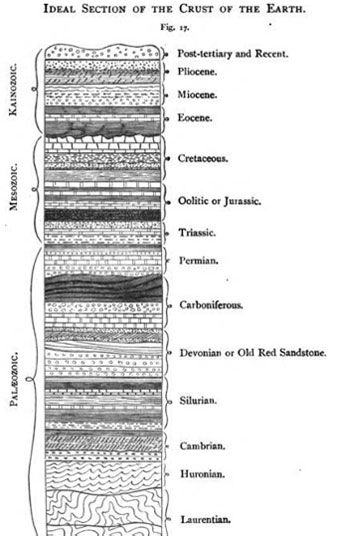
[1980] Book: The New Catastrophism: The importance of the rare event in geological history. By Derek Ager (Emeritus Professor of Geology, University College of Swansea). Cambridge University Press, 1993. Page 14:
[1981] Book: The Nature of the Stratigraphical Record. By Derek V. Ager. Macmillan, 1973. Page 31.
[1982] Textbook: Principles of Stratigraphy. By Carl O. Dunbar (Professor of Paleontology and Stratigraphy, Yale University) & John Rodgers (Associate Professor of Geology, Yale University). John Wiley & Sons, 1957. Page 257.
[1983] Book: Genetics, Paleontology, and Macroevolution. By Jeffrey Levinton (State University of New York at Stony Brook). Cambridge University Press, 1988.
[1984] Textbook: The Science of Evolution. By William D. Stansfield (Professor of Biological Sciences at California Polytechnic State University). Macmillan, 1977. Page 80.
[1985] Textbook: Introduction to Geology. By Howard E. Brown, Victor E. Monnett, and Willis Stovall. Ginn & Company, 1958. Page 11.
[1986] Book: Controversy in Victorian Geology: The Cambrian-Silurian Dispute. By James A. Secord. Princeton University Press, 1986. Pages 4-5.
[1987] Geological Table of British Organized Fossils, Which Identify the Courses and Continuity in their Order of Superposition; as Originally Discovered by W. Smith, Civil Engineer; with reference to his Geological Map of England and Wales. By William Smith, 1816. http://www.unh.edu/esci/table.html
NOTE: "London Clay" (the uppermost layer) contains "Crabs Teeth and Bones." "Mountain Limestone" (layer 31) contains trilobites. Beneath the table is a listing of the layers that appear in each British county.
[1988] Web page: "William Smith's 'Geological Map of England and Wales and Part of Scotland, 1815-1817'." By Cecil J. Schneer (Professor Emeritus of Geology and the History of Science, University of New Hampshire). Accessed June 17, 2008 at http://www.unh.edu/esci/wmsmith.html
The territory mapped in detail encompasses tens of thousands of square miles. It is well over 500 miles from Lands End to the Firth of Tay. ...
To emphasize what Smith considered his greatest achievement--he was the first to discover that the strata of England were in a definite order and the first to show that their fossil contents were in the same order--he published a similar column of colored tablets as a Geological Table of Organized Fossils in 1816 while copies of the map were still printing.
[1989] Map: A Delineation of the Strata of England and Wales, With Part of Scotland: Exhibiting the Collieries and Mines, the Marshes and Fen Lands Originally Overflowed by the Sea, and the Varieties of Soil according to the Variations in the Substrata. By William Smith, August 1, 1815. http://www.unh.edu/esci/greatmap.html
[1990] Book: Strata Identified by Organized Fossils, Containing Prints on Colored Paper of the Most Characteristic Specimens in Each Strata. By William Smith. W. Arding, Part 1 (Introduction–page 8) June 1816; Part 2 (pages 9-16) October 1816; Part 3 (pages 17-24) September 1817; Part 4 (pages 25-32) June 1818. {Three more parts were planned but never completed.} http://www.unh.edu/esci/wmsmith.html
Introduction:
The method of knowing the Substrata from each other by their various substances imbedded, will consequently shew the difference in their soils.—All this is attainable by rules the most correct, and easily learnt, and also the simplest and most extensive that can well be devised; for by the help of organized Fossils alone, a science is established with characters on which all must agree, as to the extent of the Strata in which they are imbedded, those characters are universal; and a knowledge of them opens the most extensive sources of information, without the necessity of deep reading, or the previous acquirement of difficult arts.
{Note that the following passage on page 6 does not imply universality, but relative prevalence:}
Oysters, of various sorts, found plentifully in the Strata over Chalk, seem to define the course of Crag at the following places:—Headley, Reading, Woolwich, Blackheath, and in stone at Stifford, in a valley one mile south of Hertford, at Beckingham and Damerham, and in stone at New Cross, and Addington Hills, near Croydon.
Crabs and Lobsters are more numerous in these than in any of the inferior Strata.
[1991] Book: Finding Darwin's God. By Kenneth R. Miller. Cliff Street Books, 1999. Pages 33-34:
When the Somerset Canal was finished in 1799, Smith set out to produce a complete geological map of England and Wales, a work that was published in 1851 only with the help of hundreds of subscribers. By that time, Smith's use of fossils to trace geologic history had found wide application in France and Germany, and the message was clear. In the most recent fossils, ones recovered from the uppermost layers of sedimentary rocks, naturalists could recognize organisms nearly identical to those of the present day. But as they went deeper, they found differences, some slight, some profound. They even discovered the remains of organisms so unusual that they clearly had long since vanished from the face of the earth. This fossil record, for all of its imperfections told an unmistakable story—life had changed over time, changed dramatically.
[1992] Book: Strata Identified by Organized Fossils, Containing Prints on Colored Paper of the Most Characteristic Specimens in Each Strata. By William Smith. W. Arding, Part 1 (Introduction–page 8) June 1816; Part 2 (pages 9-16) October 1816; Part 3 (pages 17-24) September 1817; Part 4 (pages 25-32) June 1818. {Three more parts were planned but never completed.} http://www.unh.edu/esci/wmsmith.html
[1993] Geological Table of British Organized Fossils, Which Identify the Courses and Continuity in their Order of Superposition; as Originally Discovered by W. Smith, Civil Engineer; with reference to his Geological Map of England and Wales. By William Smith, 1816. http://www.unh.edu/esci/table.html
[1994] Book: Finding Darwin's God. By Kenneth R. Miller. Cliff Street Books, 1999. Pages 33-34:
When the Somerset Canal was finished in 1799, Smith set out to produce a complete geological map of England and Wales, a work that was published in 1851 only with the help of hundreds of subscribers. By that time, Smith's use of fossils to trace geologic history had found wide application in France and Germany, and the message was clear. In the most recent fossils, ones recovered from the uppermost layers of sedimentary rocks, naturalists could recognize organisms nearly identical to those of the present day. But as they went deeper, they found differences, some slight, some profound. They even discovered the remains of organisms so unusual that they clearly had long since vanished from the face of the earth. This fossil record, for all of its imperfections told an unmistakable story—life had changed over time, changed dramatically.
[1995] Web page: "William Smith's 'Strata Identified by Organized Fossils'." By Cecil J. Schneer (Professor Emeritus of Geology and the History of Science, University of New Hampshire). Accessed June 17, 2008 at http://www.unh.edu/esci/wmsmith.html
"Unlike other putative fathers of geology such as Abraham Werner and James Hutton, Smith offered no grand theories of the earth."
[1996] Web page: "William Smith's Geological Map of England and Wales and Part of Scotland, 1815-1817." By Cecil J. Schneer (Professor Emeritus of Geology and the History of Science, University of New Hampshire). Accessed June 17, 2008 at http://www.unh.edu/esci/wmsmith.html
"Jean-Baptiste, Chevalier de Lamarck had drawn the obvious explanation of evolution as early as 1800... Where Smith's text, always practical, dealt with the soils, drainage, and uses of the strata--the applications--of his strata...."
[1997] Book: On the Origin of Species by Means of Natural Selection, or the Preservation of Favoured Races in the Struggle for Life. By Charles Darwin. John Murray, 1859. http://www.literature.org/authors/darwin-charles/the-origin-of-species/
Preface: "Lamarck was the first man whose conclusions on the subject excited much attention. This justly-celebrated naturalist first published his views in 1801...."
[1998] Book: Zoological Philosophy: An Exposition with Regard to the Natural History of Animals. By J. B. Lamarck. Published in 1809. Translated and introduced by Hugh Elliot. Macmillan and Co, 1914. Reprinted in 1963 by Hafner Publishing.
[1999] Web Page: "The contradictory and hypocritical geology of Tasman Walker." By John Stear and others. No Answers in Genesis, June 2006. http://www.noanswersingenesis.org.au/CMI_walker_thesis2.htm
"In other words, if geologists want to know the "Truth" about the Earth's history, they must first abandon 200 years of soundly developed and effective field methods (including a geologic time scale that is very effective in finding petroleum and ore deposits)...."
[2000] Book: Concepts and Methods of Biostratigraphy. Edited by Erle G. Kauffman and Joseph E. Hazel. Dowden, Hutchinson & Ross, 1977. Chapter: "The Chronologic, Ecologic, and Evolutionary Significance of the Phylum Brachiopoda." By J. B. Waterhouse (University of Queensland). Pages 497-518. Page 497:
In paleontology the hazard of correlation arises from the practice of ascribing the presence or absence of fossil species to ecological constraints, on the one hand, and temporal constraints, on the other. To many workers, especially those not actively engaged in correlative paleontology, the theoretical difficulties against disentangling these two constraints are so overwhelming, as well exemplified by Huxley (1862), who was so overawed by time and correlation that he, no paleontologist, asserted that the thoughtful geologist would not consider the Lias (Middle Jurassic) of England synchronous with the Lias of Germany, and would not be prepared to guess whether it was deposited in 100 years or 10 million years. This destructive skepticism based on unsubstantiated theorizing is still widespread, and prevails even among paleontologists who are more biologically than geologically orientated. It is as well to recall that Western oil companies employ numerous paleontologists for one purpose, to ensure good correlation essential to their industry. No amount of theoretical objection can deny the fact that correlation works, and pays.
[2001] Book: Criteria in Correlation: Relevant Principles of Science. By Robert M. Kleinpell. Pacific Section of The American Association of Petroleum Geologists, 1979. Page 25:
A zonule is defined as the strata or stratum which contains a fanule, its thickness, and area being limited by the vertical and horizontal range of that fanule (Fentons, 1928). A zonule, then, is a basic descriptive unit in biostratigraphy that is stratigraphically distributed in one or more sequences but carries ecologic rather than chronological significance. Used for chronological purposes, a zonule can be perfidious; it should not be considered a chronologic subdivision of the Oppelian Zone.
... [E]xamples of failure to distinguish between correlation by Oppelian zones and correlation by zonules mistakenly called zones are all too numerous and reflect a lack of understanding of the above principles of chorology.
Perhaps 90 percent of industrial surface and subsurface correlations are based on "sample matching" of fanule assemblages occurring stratigraphically as zonules. Thus more than two dozen zonules [strata of fossils] can be used for correlation in and around the Ventura Avenue Oil Field, yet are worthless twenty miles away. Correlating time relationships through ecological relationships that are not unique in time presents difficulties. It is the professional, as distinguished from the pure empiricist or naive charlatan who must always strive to recognize the distinction between unsynthesized fact-and-theory on the one hand and the principled discipline on the other.
[2002] Book: The Life and Letters of Charles Darwin. Edited by Francis Darwin. Volume 1. http://www.gutenberg.org/etext/2087
Chapter 1.II. "Autobiography":
The voyage of the "Beagle" has been by far the most important event in my life....
... I had brought with me the first volume of Lyell's 'Principles of Geology,' which I studied attentively; and the book was of the highest service to me in many ways. The very first place which I examined, namely St. Jago in the Cape de Verde islands, showed me clearly the wonderful superiority of Lyell's manner of treating geology, compared with that of any other author, whose works I had with me or ever afterwards read.
[2003] See next citation.
[2004] Book: Principles of Geology, or, The Modern Changes of the Earth and its Inhabitants, Considered as Illustrative of Geology. By Charles Lyell. Sixth English Edition, Volume 1. Hilliard, Gray & Company, 1842. First edition published in 1830. Pages 280-281:
First, in regard to the vicissitudes of the living creation, all are agreed that the sedimentary strata found in the earth's crust are divisible into a variety of groups, more or less dissimilar in their organic remains and mineral composition. The conclusion universally drawn from the study and comparison of these fossiliferous groups is this, that at successive periods, distinct tribes of animals and plants have inhabited the land and waters, and that the organic types of the newer formations are more analogous to species now existing, than those of more ancient rocks.
Page 283:
The comparatively modern introduction of the human race is proved by the absence of the remains of man and his works, not only from all strata containing a certain proportion of fossils of extinct species, but even from a large part of the newest strata, in which all the fossil individuals are referable to species still living.
To enable the reader to appreciate the full force of this evidence, I shall give a slight sketch of the information which we have obtained from the more modern strata, respecting the fluctuations of the animate world in times immediately antecedent to the appearance of man.
In tracing the series of fossiliferous formations from the most ancient to the more modern, the first deposits in which we meet with assemblages of organic remains, having a near analogy to the fauna of certain parts of the globe in our own time, are those commonly called tertiary. Even in the Eocene, or oldest subdivision of these tertiary formations, some few of the testacea [shellfish] belong to existing species, although almost all of them, and apparently all the associated vertebrata, are now extinct. These Eocene strata are succeeded by a great number of more modern deposits, which depart gradually in the character of their fossils from the Eocene type, and approach more and more to that of the living creation. In the present state of science, it is chiefly by the aid of shells that we are enabled to arrive at these results, for of all classes the testacea [shellfish] are the most generally diffused in a fossil state, and may be called the medals principally employed by nature in recording the chronology of past events.
Pages 286-287:
To conclude, it appears to going back from the recent to the Eocene period, we are carried by many successive steps from the fauna, now contemporary with man to an assemblage of fossil species wholly different from those now living. In this retrospect we have not yet succeeded in tracing back a perfect transition from recent to an extinct fauna; but there are so many species in common to the groups which stand next in succession as to show that there is no great chasm, no signs of a crisis when one class of organic beings, was annihilated, to give place suddenly to another. This analogy, therefore, derived from a period of the earth's history which can best be compared with the present state of things, and more thoroughly investigated than any other, leads to the conclusion that the extinction and creation of species has been and is the result of a slow and gradual change in the organic world.
[2005] Book: Sediments, Diagenesis, and Sedimentary Rocks. Edited by Fred T. Mackenzie. Elsevier, 2005. Chapter 13: "Chronometry of Sediments and Sedimentary Rocks." By W. B. M. Berry (University of California, Berkeley). Pages 325-349.
Page 330: "[Lyell made divisions in Tertiary time based upon the] percentage of still-living marine-mollusk species.... [This] came to be widely used across Europe."
[2006] Book: Studies on Fermentation: The Diseases of Beer, Their Causes, and The Means of Preventing Them. By Louis Pasteur. Translated with the author's sanction by Frank Faulkner & D. Constable Robb. Macmillan & Co., 1879. Kraus Reprint Co., 1969. Pages 41-42:
We should be guided by facts, whichever side of the question we espouse, and by facts alone should we test the truth of doubtful discoveries. We are but on the threshold of the exploration of our subject, and we should strive to discover new facts in connection with it, and should deduce from these, whatever they may be, only such conclusions as they may strictly warrant. Unfortunately, there is amongst physicians a tendency to generalize by anticipation. Many of them are men of rare natural or acquired talent, endowed with keen powers of intellect, and the art of expressing themselves fluently and persuasively; but the more eminent they are, the more they are occupied by the duties of their profession, and the less leisure they have for the work of investigation. Urged on by that thirst for knowledge which belongs to superior minds, and perhaps, in measure, through associating with the upper classes of society, which are becoming more and more interested in science, they eagerly seize upon easy and plausible theories, readily adapted for statement which is general and vague just in proportion to the unsoundness of the facts on which they are based. When we see beer and wine undergo radical changes, in consequence of the harbor which those liquids afford to microscopic organisms that introduce themselves invisibly and unsought into it, and swarm subsequently therein, how can we help imagining that similar changes may and do take place in the case of man and animals? Should we, however, be disposed to think that such a thing must hold true, because it seems both probable and possible, we must, before asserting our belief, recall to mind the epigraph of this work: the greatest aberration of the mind is to believe a thing to be, because we desire it.
[2007] Book: Principles of Geology, or, The Modern Changes of the Earth and its Inhabitants, Considered as Illustrative of Geology. By Charles Lyell. Sixth English Edition, Volume 1. Hilliard, Gray & Company, 1842. First edition published in 1830. Pages 269-271:
In regard to the imagined universality of particular rocks of ancient date, it was almost unavoidable that this notion, when once embraced, should be perpetuated; for the same kinds of rock have occasionally been reproduced at successive epochs: and when once the agreement or disagreement in mineral character alone was relied on as the test of age, it followed that similar rocks, if found even at the antipodes, were referred to the same era, until the contrary could be shown.
Now it is usually impossible to combat such an assumption on geological grounds, so long as we are imperfectly acquainted with the order of superposition and the organic remains of these same formations. Thus, for example, a group of red marl and red sandstone, containing salt and gypsum, being interposed in England between the Lias and the Coal, all other red marls and sandstones, associated some of them with salt, and others with gypsum, and occurring not only in different parts of Europe, but in Peru, India, the salt deserts of Asia, those of Africa — in a word, in every quarter of the globe, were referred to one and the same period. The burden of proof was not supposed to rest with those who insisted on the identity in age of all these groups — their identity in mineral composition was thought sufficient. It was in vain to urge as an objection the improbability of the hypothesis which implies that all the moving waters on the globe were once simultaneously charged with sediment of a red color.
But the rashness of pretending to identify, in age, all the red sandstones and marls in question, has at length been sufficiently exposed, by the discovery that, even in Europe, they belong decidedly to many different epochs. It is already ascertained, that the red sandstone and red marl containing the rock-salt of Cardona in Catalonia, may be referred to the period of our Chalk and Green Sand. It is also known that certain red marls and variegated sandstones, in Auvergne, which are undistinguishable in mineral composition from the New Red Sandstone of English geologists, belong, nevertheless, to the Eocene period: and, lastly, the gypseous red marl of Aix, in Provence, formerly supposed to be a marine secondary group, is now acknowledged to be a tertiary freshwater formation.
Nor was the nomenclature commonly adopted in geology without its influence in perpetuating the erroneous doctrine of universal formations. Such names for example, as Chalk, Green Sand, Oolite, Red Marl, Coal, and others, were given to some of the principal fossiliferous groups in consequence of mineral peculiarities which happened to characterize them in the countries where they were first studied. When geologists had at length shown, by means of fossils and the order of superposition, that other strata, entirely dissimilar in color, texture, and composition, were of contemporaneous date, it was thought convenient still to retain the old names. That these were often inappropriate was admitted, but the student was taught to understand them in no other than a chronological sense, so that the Chalk might not be a white cretaceous rock, but a hard dolomitic limestone, as in the Pyrenees, or a black slate, as at Glaris and the Lake of Thun, in Switzerland. In like manner the Green Sand, it was said, might in some places be represented by red sandstone, red marl, salt, and gypsum, as in the north of Spain. So the oolitic texture was declared to be rather an exception than otherwise to the general rule in rocks of the Oolitic period; and it often became necessary to affirm that no particle of carbonaceous matter could be detected in districts where the true Coal series abounded. In spite of every precaution the habitual use of this language could scarcely fail to instill into the mind of the pupil an idea that chalk, coal, salt, red marl, or the oolitic structure were far more widely characteristic of the rocks of a given age than was really the case.
[2008] Book: Principles of Geology, or, The Modern Changes of the Earth and its Inhabitants, Considered as Illustrative of Geology. By Charles Lyell. Sixth English Edition, Volume 1. Hilliard, Gray & Company, 1842. First edition published in 1830. Pages 272-273:
In regard, however, to one of the most important characteristics of sedimentary rocks, their organic remains, many naturalists of high authority suspect that the same species of fossils are more uniformly distributed through formations of high antiquity than in those of more modern date, and that distinct zoological and botanical provinces, as they are called, which form so striking a feature in the living creation, were not established at remote eras. Thus the plants of the Coal, the shells and trilobites of the Silurian rocks, and the ammonites of the Oolite, have been supposed to have a wider geographical range than any living species of trees, crustaceans, or mollusks.
It seems by no means unlikely that this opinion will prove, to a certain extent, well founded, but no complete comparison has yet been made of a large assemblage of fossils from two very distant points with sufficient minuteness to entitle us to pronounce on the specific identity of the whole. In the theory of climate proposed in the seventh and eighth chapters, we have seen how the altered position of sea and land might render the temperature of the globe more uniform, in which case the fauna and flora of the earth would be less diversified than now.
[2009] Textbook: Principles of Stratigraphy. By Carl O. Dunbar (Professor of Paleontology and Stratigraphy, Yale University) & John Rodgers (Associate Professor of Geology, Yale University). John Wiley & Sons, 1957.
Page 152: "[T]he Earth at any time such as the present has supported many diverse faunas and floras in different regions."
[2010] Book: Sediments, Diagenesis, and Sedimentary Rocks. Edited by Fred T. Mackenzie. Elsevier, 2005. Chapter 13: "Chronometry of Sediments and Sedimentary Rocks." By W. B. M. Berry (University of California, Berkeley). Pages 325-349. Page 331:
That idea led d'Orbigny to the conclusion that the faunas that characterized each stage were divisions that "nature has delineated with bold strokes across the whole earth." [1842] Comprehensive studies of Jurassic faunas in countries outside France demonstrated that d'Orbigny was overenthusiastic in his assertion that his stage faunas were global in their distribution. Nonetheless, most elements in his faunal aggregates could be recognized relatively widely across some of Western Europe and, therefore, many of d'Orbigny's stage names were used by practicing geologists in many countries.
Pages 335-336:
When d'Orbigny discussed his concept of stage, he thought the faunas that typified each were "global" in distribution. That idea was not consistent with the discoveries made in studies of distribution patterns of modern organisms by Alfred Russell Wallace and many others since the mid 1850s which demonstrated that most organisms are limited in their distribution to certain geographic areas. Modern land and marine organisms are members of faunal or floral aggregates that collectively comprise the fauna or flora of a biogeographic province. Analysis of the distribution of fossil floras and faunas have demonstrated that biogeographic provinces essentially similar to those in the modern world have existed throughout the Phanerozoic.
[2011] See next citation.
[2012] Book: Essays, Scientific, Political, and Speculative. By Herbert Spencer. Volume 1. D. Appleton & Company, 1892. Essay: "Illogical Geology." Published in the Universal Review, July 1859. Pages 192-240. Pages 201-202:
"But," it will perhaps be said, "though individual strata are not continuous over large areas, yet systems of strata are. Though within a few miles the same bed gradually passes from clay into sand, or thins out and disappears, yet the group of strata to which it belongs does not do so; but maintains in remote regions the same relations to other groups."
This is the generally-current belief. On this assumption the received geological classifications appear to be framed. The Silurian system, the Devonian system, the Carboniferous system, etc., are set down in our books as groups of formations which everywhere succeed each other in a given order; and are severally everywhere of the same age.
Though it may not be asserted that these successive systems are universal; yet it seems to be tacitly assumed that they are. In North and South America, in Asia, in Australia, sets of strata are assimilated to one or other of these groups; and their possession of certain mineral characters and a certain order of superposition are among the reasons assigned for so assimilating them. Though, probably, no competent geologist would contend that the European classification of strata is applicable to the globe as a whole; yet most, if not all geologists, write as though it were.
Among readers of works on Geology, nine out of ten carry away the impression that the divisions, Primary, Secondary and Tertiary, are of absolute and uniform application; that these great divisions are separable into subdivisions, each of which is definitely distinguishable from the rest, and is everywhere recognizable by its characters as such or such; and that in all parts of the Earth, these minor systems severally began and ended at the same time. ... Now this belief that geologic "systems" are universal, is no more tenable than the other. It is just as absurd when considered a priori; and it is equally inconsistent with the facts. Though some series of strata classed together as Oolite, may range over a wider district than any one stratum of the series; yet we have but to ask what were the circumstances under which it was deposited, to see that the Oolitic series, like one of its individual strata, must be of local origin; and that there is not likely to be anywhere else, a series which corresponds, either in its characters or in its commencement and termination.
Pages 210-211:
If the Old Red Sandstone series in mid-England, differs wholly in lithological aspect from the equivalent series in South Devon, it is clear that similarities of texture and composition cannot justify us in classing a system of strata in another quarter of the globe with some European system. The test of fossils is the only one that remains; and with how little strictness this test is applied, one case will show. Of forty-six species of British Devonian corals, only six occur in America; and this, notwithstanding the wide range which the Anthozoa are known to have. Similarly of the Mollusca and Crinoidea, it appears that, while there are sundry genera found in America which are found here, there are scarcely any of the same species. And Sir Charles Lyell admits that "the difficulty of deciding on the exact parallelism of the New York subdivisions, as above enumerated, with the members of the European Devonian, is very great, so few are the species in common." Yet it is on the strength of community of fossils, that the whole Devonian series of the United States is assumed to be contemporaneous with the whole Devonian series of England. And it is partly on the ground that the Devonian of the United States corresponds in time with our own Devonian, that Sir Charles Lyell concludes the superjacent coal-measures of the two countries to be of the same age. Is it not, then, as we said, that the evidence in these cases is very suspicious? Should it be replied, as it may fairly be, that this correspondence from which the synchronism of distant formations is inferred, is not a correspondence between particular species or particular genera, but between the general characters of the contained assemblages of fossils—between the facies of the two Faunas; the rejoinder is, that though such correspondence is a stronger evidence of synchronism it is still an insufficient one. To infer synchronism from such correspondence, involves the postulate that throughout each geologic era there has habitually existed a recognizable similarity between the groups of organic forms inhabiting all the different parts of the Earth; and that the causes which have in one part of the Earth changed the organic forms into those which characterize the next era, have simultaneously acted in all other parts of the Earth, in such ways as to produce parallel changes of their organic forms. Now this is not only a large assumption to make; but it is an assumption contrary to probability. The probability is, that the causes which have changed Faunas have been local rather than universal; that hence while the Faunas of some regions have been rapidly changing, those of others have been almost quiescent; and that when those of others have been changed, it has been, not in such ways as to maintain parallelism, but in such ways as to produce divergence.
Page 216:
If, now, the modern fossiliferous deposits of Australia were to be examined by one ignorant of the existing Australian Fauna; and if he were to reason in the usual manner; he would be very unlikely to class these deposits with those of the present time. How, then, can we place confidence in the tacit assumption that certain formations in remote parts of the Earth are referable to the same period, because the organic remains contained in them display a certain community of character? or that certain others are referable to different periods, because the facies of their Faunas are different?
[2013] Article: "Charles Lyell and the Geological Society." By John C. Thackray. Geological Society, London, Special Publications, 1998. Pages 17-20. http://sp.lyellcollection.org/cgi/reprint/143/1/17.pdf
Page 17: "Charles Lyell was elected a Member of the Geological Society on 19 March 1819."
[2014] Book: Fossils: The Evolution and Extinction of Species. By Niles Eldredge. Harry N. Abrams, 1991.
Page 127: "[T]he divisions of geological time (worked out, in larger part, by the middle of the nineteenth century)...."
| System | Year named | Current Alleged Age (Millions of years) |
| Quaternary | 1829 | 0 – 3* |
| Neogene | 1853 | 3 – 23 |
| Paleogene | 1866 | 23 – 66 |
| Cretaceous | 1822 | 66 – 146 |
| Jurassic | 1839 | 146 – 200 |
| Triassic | 1834 | 200 – 251 |
| Permian | 1841 | 251 – 300 |
| Carboniferous | 1822 | 300 – 359 |
| Devonian | 1839 | 359 – 416 |
| Silurian | 1835 | 416 – 444 |
| Ordovician | 1879 | 444 – 488 |
| Cambrian | 1835 | 488 – 542 |
NOTE: The chart above was constructed with data from the following three sources:
a) "International Stratigraphic Chart." International Commission on Stratigraphy, 2008. http://www.stratigraphy.org/
"The status of the Quaternary is not yet decided."
b) Book: Applied Stratigraphy. Edited by Eduardo A. M. Koutsoukos. Springer, 2005. Chapter 1: "Stratigraphy: Evolution of a Concept." By Eduardo A. M. Koutsoukos. Pages 3-20. Page 9 identities the year in which each system was named and the person responsible for all systems except the Quaternary.
c) Web page: "History of the stratigraphical nomenclature of the glacial period." Subcommission on Quaternary Stratigraphy, International Commission on Stratigraphy, August 6, 2005. http://www.quaternary.stratigraphy.org.uk/about/history.html
NOTE: This page is excerpted from the book, A Geologic Time Scale 2004. Edited by Felix M. Gradstein & others. Cambridge University Press, 2005. The chapter entitled "The Quaternary System" by P.L. Gibbard and Th. van Kolfschoten states that the term Quaternary was "proposed in 1829 by Desnoyers for marine sediments in the Seine Basin (Bourdier 1957, p.99) – although the term had been in use from the late 18th century."
[2016] Book: Fossils: The Key to the Past. By Richard Fortey. Second edition. Harvard University Press, 1991.
Page 27: "The divisions of geological time from the Cambrian onwards were established in Europe, and it is a measure of the acumen of the geologists who established them that the original concepts survive in all their essentials today."
[2017] Book: Historical Geology. By A. O. Woodford. W. H. Freeman and Company, 1965. Page 45:
The first local geological columns were worked out in Europe. A synthesis of these local columns then established a generalized geologic column that became the standard for the world. The local column most valuable in the synthesis was that of England and Wales. This area is therefore of first importance. Once the standard column was set up, it became the basis for the geologic time scale, in terms of which geologic history is expressed.
Pages 51-54: "The ... [names of the] principle units of the standard column ... were proposed and generally accepted between 1822 and 1847."
[2018] Textbook: Principles of Stratigraphy. By Carl O. Dunbar (Professor of Paleontology and Stratigraphy, Yale University) & John Rodgers (Associate Professor of Geology, Yale University). John Wiley & Sons, 1957.
Pages 298-299: "D'Orbigny [1802-1857] had the idea to subdivide the systems into stages, and these stages survive, more or less, in their original form to this day."
[2019] Textbook: The Evolution and Extinction of the Dinosaurs. By David E. Fastovsky (University of Rhode Island) & David B. Weishample (Johns Hopkins University). Cambridge University Press, 1996.
Page 7: "Part of our job as paleontologists is to interpret how the bones got the way that we find them, because that may tell us something of how dinosaurs lived. ... When the bones are articulated (connected together), this suggests that they have not been transported far from where the animal died."
[2020] Book: Strata Identified by Organized Fossils, Containing Prints on Colored Paper of the Most Characteristic Specimens in Each Strata. By William Smith. W. Arding, Part 1 (Introduction–page 8) June 1816; Part 2 (pages 9-16) October 1816; Part 3 (pages 17-24) September 1817; Part 4 (pages 25-32) June 1818. {Three more parts were planned but never completed.} http://www.unh.edu/esci/wmsmith.html
Introduction:
Fossil Shells had long been known amongst the curious, collected with care, and preserved in their cabinets, along with other rarities of nature, without any apparent use. That to which I have applied them is new, and my attention was first drawn to them, by a previous discovery of regularity in the direction and dip of the various Strata in the hills around Bath; for it was the nice distinction which those similar rocks required, which led me to the discovery of organic remains peculiar to each Stratum. Their perfect state of preservation, and most tender structure, raised a doubt respecting their diluvian origin, and a close attention to the Gravel Fossils, clearly proved two distinct operations of water.
The Fossils of the former deposit being all finely preserved, while those of the latter, (which are chiefly superficial,) are all greatly rounded by attrition. Those of the first class are never found but in their respective sites in the Strata; — those of the latter, by their promiscuous mixture, superficial situation, and other circumstances, most strongly confirm the previous deposit, and complete induration [hardening] of the Strata which contain the former. Conceiving, therefore, the Gravel Fossils to be the most indubitable effects of a great body of water passing over the surface of the earth, with violence sufficient to tear up fragments of the Strata, round them by attrition, and drive them many miles from their regular beds to the promiscuous situations which they now occupy. These have been called alluvial [river or flowing water] Fossils, and the Gravel which contains them being thus clearly distinguished from the regular Strata beneath, much of the mystery in which Fossil Shells, and other materials of the earth were involved, seemed to be removed by this distinction.
[2021] Book: Palaeobiology: A Synthesis. Edited by Derek E. G. Briggs & Peter R. Crowther. Blackwell Scientific Publications, 1990. Section 3.1: "Decay Processes." By P. A. Allison (Postgraduate Research Institute for Sedimentology, University of Reading, UK). Pages 214-215.
[2022] Book: Palaeontology: An Introduction. By E.W. Nield (formerly of Poroperm Laboratories, U.K.) & V.C.T. Tucker (formerly of Yale Sixth Form College, U.K.). Pergamon Press, 1985. Page 2.
[2023] Book: Palaeobiology: A Synthesis. Edited by Derek E. G. Briggs & Peter R. Crowther. Blackwell Scientific Publications, 1990. Section 3.4.2: "Transport – Hydrodynamics: Plant Material." By R. A. Spicer (Department of Earth Sciences, University of Oxford). Pages 234-235.
[2024] Textbook: Principles of Stratigraphy. By Carl O. Dunbar (Professor of Paleontology and Stratigraphy, Yale University) & John Rodgers (Associate Professor of Geology, Yale University). John Wiley & Sons, 1957. Page 128.
[2025] Book: Principles of Geology, or, The Modern Changes of the Earth and its Inhabitants, Considered as Illustrative of Geology. By Charles Lyell. Sixth English Edition, Volume 1. Hilliard, Gray & Company, 1842. First edition published in 1830.
Page 283: "In the present state of science, it is chiefly by the aid of shells that we are enabled to arrive at these results, for of all classes the testacea are the most generally diffused in a fossil state, and may be called the medals principally employed by nature in recording the chronology of past events."
[2026] Textbook: Principles of Stratigraphy. By Carl O. Dunbar (Professor of Paleontology and Stratigraphy, Yale University) & John Rodgers (Associate Professor of Geology, Yale University). John Wiley & Sons, 1957. Page 154:
[Berry's] study of the restriction of the living benthonic foraminifer to distinct depth zones off the coast of California ... led Natland (1933) to a discovery at once disturbing and significant. ... In Hall Canyon 1 mile north of Ventura, California (and about 75 miles north of where he had studied the living forams), Natland studied a thick section of Pliocene and Pleistocene strata that have that have been upturned and transected by Hall Creek. Here he found essentially the same 5 faunas [of sea creatures] that he had recognized as living in successive depth zones today, but they occur in vertical succession in the rocks, with zone 5 at the base of the sequence and zones 4-1 in regular sequence up to the youngest deposits. As all the species are still living in the region, this sequence in the rocks has no time significance and cannot be used for detailed correlation; instead each fauna records the depth (or at least the bottom temperature) at the time of deposition.
[2027] Textbook: Principles of Stratigraphy. By Carl O. Dunbar (Professor of Paleontology and Stratigraphy, Yale University) & John Rodgers (Associate Professor of Geology, Yale University). John Wiley & Sons, 1957. Page 127:
Unless the faunas differ appreciably in age, however, an abrupt faunal break is no evidence of a hiatus, for it may be due to a change in bottom ecology without interruption of deposition. Such environmental change might be the result of difference between depth or salinity, or in the quality or quantity of sediment being introduced. For example, a cyclothem [≈ repetitive sequence] in the Pennsylvanian rocks of Illinois (Fig. 52, p. 110) normally includes 10 distinct lithologic units most of which have a fauna (or flora) largely distinct from that of any other member, yet the same fossil assemblages largely reappear in corresponding members of the next cyclothem above and below. Obviously these faunal changes are not due to loss of part of the record but to migrations in response to changing environment.
[2028] Book: Principles of Stratigraphy. By Amadeus W. Grabau (Professor of Palaeontology, Columbia University). Second edition. A. G. Seiler, 1924.
Page 1107: "No uniform method of derivation of these names was followed, though the majority of names had a geographic origin. Neither was uniformity of termination considered, though among the later-formed names ian was generally selected."
[2029] Book: Fossils: The Key to the Past. By Richard Fortey. Second edition. Harvard University Press, 1991.
Page 27: "The development of the formation of rocks varied obviously from one area to another, and in some cases provided the name of the geological period: the Jurassic period with the Jura mountains, for example. ... The first four of these (Cambrian, Ordovician, Silurian, Devonian) all take their names from British localities...."
NOTE: This book specifies other geological periods named for localities in Germany and Russia.
[2030] Textbook: Principles of Stratigraphy. By Carl O. Dunbar (Professor of Paleontology and Stratigraphy, Yale University) & John Rodgers (Associate Professor of Geology, Yale University). John Wiley & Sons, 1957. Page 301.
[2031] Article: "Silurian Period." Encyclopedia Britannica Ultimate Reference Suite 2004.
In 1835 R.I. Murchison named a sequence of rocks in Wales and its borderland with England "Silurian" in honour of a native people called the Silures, who had resisted Roman conquest.
[2032] Article: "Geochronology." Encyclopedia Britannica Ultimate Reference Suite 2004. Section entitled "The emergence of modern geologic thought."
[2033] Book: A Geologic Time Scale. By W.B. Harland and others. Cambridge University Press, 1982. Page 1:
By 1878 the early belief that the stratigraphic systems and other divisions being described in any one place were natural chapters of Earth history was fading and the need to agree some convention was widely recognized. Even so, the practice continued of describing stratal divisions largely as biostratigraphic units, and even today it is an article of faith for many that divisions of the developing international stratigraphic scale are defined by the fossil content of the rocks. To follow this through, however, leads to difficulties: boundaries may change with new fossil discoveries; boundaries defined by particular fossils will tend to be diachronous; there will be disagreement as to which taxa shall be definitive. So the traditional stratigraphic scale is of necessity evolving into a new kind of standard stratigraphic scale. ...
At the 1948 ICG [International Geological Congress] one of the first attempts to standardize artificially a stratigraphic boundary (Pliocene-Pleistocene boundary at the Calabrian base in Italy) was made on the basis that such a decision had to be an agreed convention and that is was necessary to standardize divisions at their boundaries only, and only in one locality. The international procedure to standardize such a boundary at a single point in a reference section was worked out by the Silurian-Devonian Boundary Working Group. Their procedure was first to agree the approximate position in the biostratigraphic sequence that would do the least violence to existing usage and then to find a succession anywhere in the world where the Silurian Devonian boundary was represented in fossiliferous rock with the best characters for correlation.
[2034] Book: Palaeobiology II. Edited by Derek E. G. Briggs & Peter R. Crowther. Blackwell Scientific Publications, 2001. Reprinted in 2003. Section 5.4.1: "Fossils in Stratigraphy: Stratigraphic Procedure." By P.F. Rawson (Department of Geological Sciences, University College London). Page 538:
In practice, boundaries are defined at a particular level in a body of rock at a specific locality, and not in abstract terms. The chosen locality and horizon are referred to as a Global Boundary Stratotype Section and Point (GSSP). An imaginary 'golden spike' is placed as the GSSP, symbolizing that it should be valid for all time. (Some researchers would prefer an 'iron spike' which can rust away as knowledge improves!)
[2035] Book: Sediments, Diagenesis, and Sedimentary Rocks. Edited by Fred T. Mackenzie
Elsevier, 2005. Chapter 13: "Chronometry of Sediments and Sedimentary Rocks." By W. B. M. Berry (University of California, Berkeley). Pages 325-349. Page 347:
The many discussions involving the procedures to define the base of the Devonian and, therefore, the Silurian – Devonian boundary ultimately led to widespread acceptance of the procedures in defining boundaries between units in the chronometric scale. Accordingly, studies of sedimentary rocks and their contained flora and fauna were focused on those taxa whose lowest stratigraphic occurrences can be documented as precisely as possible to be used as the base of zones, stages, and systems as well as the stratigraphic sections. That stratigraphic position, once chosen by a vote of a group of stratigraphic paleontologists who are specialists in the study of the fossil organisms and the time interval under analysis, is considered to be unmovable for a number of years. ... The stratigraphic section and point in it chosen for the "golden spike" is referred to as a global stratotype section and point (GSSP). Although the process has been formally codified in international stratigraphic practice (Remaine, 2000), its usefulness and even validity have been challenged (Fortey, 1993; Aubrey et al., 200). ... Fortey (1993) commented on the procedure involved in selecting the GSSPs, both from the viewpoint of understanding the realities of the stratigraphic and fossil record and the fragility of human nature.
[2036] Textbook: Principles of Stratigraphy. By Carl O. Dunbar (Professor of Paleontology and Stratigraphy, Yale University) & John Rodgers (Associate Professor of Geology, Yale University). John Wiley & Sons, 1957. Page 293.
[2037] Book: Manual of Geology: Treating of the Principles of the Science with Special Reference to American Geological History. By James D. Dana (Emeritus Professor of Geology & Mineralogy, Yale University). Fourth edition. American Book Company, 1895. Page 400:
2. Color, texture, and mineral composition. — These characteristics may sometimes be used to advantage, but only within limited districts and always with distrust. There were at one time in geology an "old red sandstone" and a "new red sandstone"; and, whenever a red sandstone was found, it was referred at once to one or the other. But it is now well understood that color is of little consequence, even within a small geographical range.
Mineral composition has more value than color, especially when it is not one of the common kinds. But it is usually to be disregarded.
[2038] Book: Palaeontology: An Introduction. By E.W. Nield (formerly of Poroperm Laboratories, U.K.) & V.C.T. Tucker (formerly of Yale Sixth Form College, U.K.). Pergamon Press, 1985.
Page 5: "We have said that rock type, on the other hand, is a poor indication of age equivalence."
[2039] Textbook: Principles of Stratigraphy. By Carl O. Dunbar (Professor of Paleontology and Stratigraphy, Yale University) & John Rodgers (Associate Professor of Geology, Yale University). John Wiley & Sons, 1957. Page 293:
That it holds for the smaller ones such as zone and perhaps stage is generally recognized; indeed, it was explicit in the original definitions of both those terms (p. 298-9). But because it is known that fossils are not perfect criteria of time (p. 284), many stratigraphers conclude that zone is therefore not a time-stratigraphic unit at all, but a biostratigraphic unit, and a few would transfer stage also. Series and system [i.e., Jurassic], however, are considered to have true time significance and hence to be different from zone, to be defined by time and not by fossils. But series and system are more satisfactory time-stratigraphic units than stage or zone not because they are in fact defined differently but only because they are larger and grosser, so that the errors of paleontological correlation are not so apparent—the "limit of resolution" of the criteria is not approached. Historically, series and system, as they have always been used by stratigraphers, are as dependent on fossils as zone, and if zone is a biostratigraphic term, so are they.
[2040] Book: Principles of Stratigraphy. By Amadeus W. Grabau (Professor of Palaeontology, Columbia University). Second edition. A. G. Seiler, 1924. Page 1123:
Professor Hall was one of the first in America to recognize the importance of naming formations from localities in which they were best exposed. In his report to the New York State legislature in 1839 he urges that neither lithic character [rock type] nor characteristic fossils is a satisfactory source from which to derive the name of a formation, for the first may change while the second is not always ascertainable and may even be absent. He holds it that it "becomes a desideratum [essential] to distinguish rocks by names which cannot be traduced [betrayed], and which, when the attendant circumstances are fully understood, will never prove fallacious." Such names can be derived only from localities.
[2041] Book: Controversy in Victorian Geology: The Cambrian-Silurian Dispute. By James A. Secord. Princeton University Press, 1986.
Page 5: "Almost all the major divisions of the geological column were settled only after long and acrimonious debate."
[2042] Textbook: Principles of Stratigraphy. By Carl O. Dunbar (Professor of Paleontology and Stratigraphy, Yale University) & John Rodgers (Associate Professor of Geology, Yale University). John Wiley & Sons, 1957. Page 301.
[2043] Textbook: Principles of Stratigraphy. By Carl O. Dunbar (Professor of Paleontology and Stratigraphy, Yale University) & John Rodgers (Associate Professor of Geology, Yale University). John Wiley & Sons, 1957.
Page 293: "[A]way from their individual type regions, systems [i.e., Jurassic, Cambrian, etc.], series, and stages can be delimited (defined) only by their fossils."
[2044] Book: Exploring Earth and Life Through Time. By Steven M. Stanley (Johns Hopkins University). W.H. Freeman and Company, 1993. Page 81.
[2045] Book: Grand Canyon: Solving Earth's Grandest Puzzle. By James Lawrence Powell. Pearson Education, 2005.
Pages 237-240: "Geologists began to develop the potassium-argon and the other radiometric methods during the 1950s."
[2046] Book: Structural Geology. By Marland P. Billings (Professor of Geology, Harvard University). Second edition. Prentice-Hall, 1954.
Page 418: "In recent years methods have been devised to map geological contacts on the basis of the varying content of radioactive elements in different rocks."
[2047] Book: Palaeontology: An Introduction. By E.W. Nield (formerly of Poroperm Laboratories, U.K.) & V.C.T. Tucker (formerly of Yale Sixth Form College, U.K.). Pergamon Press, 1985. Page 5:
Lastly, it should be noted that the dating of rocks by contained fossils is relative, not absolute. The method tells the geologist which unit is the younger, which the older, but not how old, or how much younger. That we know the ages in years of the various geological periods (Table 1.1) is a recent innovation brought in by the technique of radioactive dating. Its accuracy, however, is very poor indeed, and it is never used in the correlation of sediments.
NOTE: I don't know how anyone could be so familiar with the literature as to be sure radiometric dating is "never" used in the correlation of sediments, but it is clearly not commonly used and played no basis in establishing the geological column.
[2048] Paper: "Pragmatism versus Materialism in Stratigraphy." By J. E. O'Rourke. American Journal of Science, January 1976. Pages 47-55. http://www.ajsonline.org/cgi/reprint/276/1/47
Page 50: "In fact, the pragmatic basis of stratigraphy is a history of innumerable determinations that one unit is above or below another back to the original work of the eighteenth century."
Page 53:
On the other hand, our knowledge of the sequence was pieced together from many sections. The procession of life was never witnessed, it is inferred. The vertical sequence of fossils is thought to represent a process because the enclosing rocks are interpreted as a process. The rocks do date the fossils, but the fossils date the rocks more accurately. Stratigraphy cannot avoid this kind of reasoning, if it insists on using temporal concepts, because circularity is inherent in the derivation of time scales.
Page 55:
The field man records his sense perceptions on isomorphic maps and sections, abstracts the more diagnostic map features, and arranges them according to their vertical order. He compares this local sequence to the global column obtained from a great many man-years of work by his predecessors. As long as this cognitive process is acknowledged as the pragmatic basis of stratigraphy, both local and global sections can be treated as chronologies without reproach.
[2049] Book: Criteria in Correlation: Relevant Principles of Science. By Robert M. Kleinpell. Pacific Section of The American Association of Petroleum Geologists, 1979. Page 13:
Molluscan species are, as a rule, of small value as zone-fossils, but associations of species may be of value. A long-lived species has as contemporaries in its youth other species that preceded it in extinction, and new species arose to be its contemporaries in old age. Consequently, if the exact time-range of a great number of species were tabulated, it might be found that even small divisions in time were characterized by a particular association or overlap of species, some of which lived no later, others no earlier. Even then, it is not to be supposed that such an overlap was contemporaneous over very wide areas; and, in any case, the method involves working in a circle: you must first fix the age of each fauna before you can determine the range of each species and vice versa. It is a slow process of trial and error and repeated re-adjustment.
[2050] Paper: "Dinosaurs Dined on Grass." By Delores R. Piperno and Hans-Dieter Sues. Science, November 18, 2005. Pages 1126-1128. http://www.sciencemag.org/cgi/content/short/310/5751/1126
Page 1126: "[D]ioramas in museums have long depicted dinosaurs as grazing on conifers, cycads, and ferns in landscapes without grasses."
[2051] Article: "Fossil dung reveals dinosaurs did graze grass." By Jeff Hecht. New Scientist, November 17, 2005. http://www.newscientist.com/
[2052] Book: Palaeobiology: A Synthesis. Edited by Derek E. G. Briggs & Peter R. Crowther. Blackwell Scientific Publications, 1990. Section 1.11: "Grasslands and Grazers." By J. R. Thomasson (Department of Biology and Allied Health, Fort Hays State University, Kansas) & M. R. Voorhies (University of Nebraska State Museum).
Page 84: "[U]ndoubted fossil grasses are more widespread in the fossil record than previously thought, having been reported from most continents and many stratigraphic levels dating from the Oligocene [33.9-23.0 mya]; reports of probable fossil grasses may extend the age of the oldest grasses to the Eocene [55.8-33.9 mya]."
[2053] Book: Exploring Earth and Life Through Time. By Steven M. Stanley (Johns Hopkins University). W.H. Freeman and Company, 1993.
Page 401: "Modern snakes, frogs, and songbirds made their appearance during Cenozoic time [65.5 mya to present], as did grasses and weedy plants."
[2054] Book: Finding Darwin's God. By Kenneth R. Miller. Cliff Street Books, 1999. Page 62.
[2055] Article: "Fossil dung reveals dinosaurs did graze grass." By Jeff Hecht. New Scientist, November 17, 2005. http://www.newscientist.com/
"[A]ll grass pollen looks the same, so researchers thought it came from a very primitive grass or an early relative."
[2056] Article: "Fossil dung reveals dinosaurs did graze grass." By Jeff Hecht. New Scientist, November 17, 2005. http://www.newscientist.com/
"Recognising that some of the phytoliths had distinctive shapes found only in grasses "was a complete shock", says Caroline Strömberg, a phytolith specialist at the Swedish Museum of Natural History in Stockholm."
[2057] Web page: "The Past In Perspective, 3/e — The Neolithic: Roots of a Revolution in Subsistence and Society." McGraw-Hill Higher Education, 2003. http://highered.mcgraw-hill.com/sites/0072549386/...
Phytolith Microscopic, inorganic mineral particles produced by plants. Phytoliths are extremely durable and their morphology is species-specific. Enormous databases have been compiled that allow the researcher to examine individual phytoliths recovered in the soils or adhering to artifacts recovered at archaeological sites and to identify the species from which the phytoliths originated.
[2058] Paper: "Dinosaurs Dined on Grass." By Delores R. Piperno and Hans-Dieter Sues. Science, November 18, 2005. Pages 1126-1128. http://www.sciencemag.org/cgi/content/short/310/5751/1126
Page 1126: "[T]heir analysis of phytoliths—microscopic pieces of silica formed in plant cells—in coprolites that the authors attribute to titanosaurid sauropods that lived in central India about 65 to 71 million years ago. Their data indicate that those dinosaurs ate grasses."
Page 1126: "More recent work has examined in greater detail phytolith characteristics from a large set of grasses comprising taxa representing the entire range of diversification within the family, showing that discriminations at the subfamily, tribe, and genus levels are often possible...."
Page 1127: "[A] much earlier emergence and radiation of the major BEP clade [a particular group of grass types] than had been previously thought on the basis of fossil and molecular clock data, is well supported."
[2059] Paper: "Dinosaur Coprolites and the Early Evolution of Grasses and Grazers." By Vandana Prasad & others. Science, November 18, 2005. Pages 1177-1180. http://www.sciencemag.org/cgi/content/abstract/...
Page 1177: "Silicified plant tissues (phytoliths) preserved in Late Cretaceous coprolites from India show that at least five taxa from extant grass (Poaceae) subclades were present on the Indian subcontinent during the latest Cretaceous."
Page 1178: "The range of grass morphotypes is similar to that found in phytolith assemblages extracted from the leaves of modern grasses."
Page 1180: "Moreover, the phytolith data suggest that silica production in grasses comparable with that observed in extant [existing] taxa appeared to have evolved by the Late Cretaceous."
[2060] Article: "Fossil dung reveals dinosaurs did graze grass." By Jeff Hecht. New Scientist, November 17, 2005. http://www.newscientist.com/
"Phytoliths differ among grasses, and the five types found in the fossil dung came from more highly evolved types, indicating that grasses had diversified significantly before 70 million years ago."
[2061] Paper: "Dinosaurs Dined on Grass." By Delores R. Piperno and Hans-Dieter Sues. Science, November 18, 2005. Pages 1126-1128. http://www.sciencemag.org/cgi/content/short/310/5751/1126
Page 1126.
[2062] Book: Foundations of Modern Cosmology. By John F. Hawley & Katherine A. Holcomb. Oxford University Press, 1998. Page 17.
[2063] Book: Cladistics: Perspectives on the Reconstruction of Evolutionary History. Edited by Thomas Duncan & Tod F. Stuessy. Columbia University Press, 1984. Chapter 1: "Cladistic Theory: Hypotheses that Blur and Grow." By David R. Hull.
Page 19: "Similarly, it is important to be reminded of the limits of phylogenetic [evolutionary] reconstruction. Perhaps claims about past history are falsifiable in principle, but in practice too often they are not."
[2064] Book: Mammal-like reptiles and the origin of mammals. By T.S. Kemp (University Museum and Department of Zoology, Oxford, England). Academic Press, 1982. Page 6.
[2065] Paper: "An Ostracode Crustacean with Soft Parts from the Lower Silurian." By David J. Siveter and others. Science, December 5, 2003. Pages 1749-1751. http://www.sciencemag.org/cgi/reprint/sci;302/5651/1749.pdf
Page 1749: "Ostracodes are ... known from an estimated 33,000 living and extinct marine, nonmarine, and even terrestrial species...."
[2066] Article: "Oldest male fossil bares all: Privates revealed in virtual view of creature dating back 425 million years." By Daniel Kane. MSNBC, December 4, 2003. http://www.msnbc.msn.com/id/3660475/
"Ostracodes, or 'seed shrimp,' are small crustaceans with a hinged pair of shells. ... With many thousands of living and extinct marine and fresh water species, ostracodes are the most abundant arthropods in the fossil record. They are also common today — even in garden ponds."
[2067] Article: "mussel shrimp." Encyclopedia Britannica Ultimate Reference Suite 2004.
"also called seed shrimp, or ostracod.... The 2,000 living species include marine, freshwater, and terrestrial forms. ... Mussel shrimp are about 1 mm (about 0.04 inch) long. The largest ... grows to 23 mm."
[2068] Article: "Fossil Find Hailed as Earliest Recorded Male." By James Gorman. New York Times, December 4, 2003. http://www.nytimes.com/2003/12/04/science/...
"They are common in oceans, shallow seas, rivers and lakes."
[2069] Book: Manual of Paleontology. By Henry Alleyne Nicholson And Richard Lydekker. Third Edition, Volume 1. William Blackwood and Sons, 1889.
Page 504: "Fig. 360.—Recent Ostracoda. A, Cypradina Messinensis, viewed from the side, and greatly enlarged, one-half of the shell being removed. B, Cypris fusca, sea, viewed from the side, and less highly magnified, the shell-valves being retained, but slightly displaced."
[2070] Article: "Oldest male fossil bares all: Privates revealed in virtual view of creature dating back 425 million years." By Daniel Kane. MSNBC, December 4, 2003. http://www.msnbc.msn.com/id/3660475/
"'It has the world's oldest penis. If there is another one, I don't know it', Siveter said."
[2071] Paper: "An Ostracode Crustacean with Soft Parts from the Lower Silurian." By David J. Siveter and others. Science, December 5, 2003. Pages 1749-1751. http://www.sciencemag.org/cgi/reprint/sci;302/5651/1749.pdf
Page 1749: "The fossil has striking similarity to the extant myodocopid family Cylindroleberididae, to which it is assigned, and demonstrates remarkable evolutionary stasis over 425 million years."
Page 1751: "Its morphological similarity to Recent myodocopids (the only notable soft part difference from living cylindroleberidids is its apparent lack of a setose comb [bristles] on the fifth appendage)...."
[2072] Article: "Gutsy Fossil Sets Record for Staying the Course." By Erik Stokstad. Science, December 5, 2003. Page 1645. http://www.sciencemag.org/cgi/content/full/302/5651/1645
"What's most amazing, ostracode experts say, is how eerily similar the soft-tissue anatomy is to that of modern relatives. 'I was flabbergasted,' says Koen Martens, a zoologist at the University of Amsterdam, the Netherlands."
[2073] Article: "Fossil Find Hailed as Earliest Recorded Male." By James Gorman. New York Times, December 4, 2003. http://www.nytimes.com/2003/12/04/...
The new fossil ... has modern descendants that are almost exactly the same, down to two hairs on the end of its swimming appendages. ...
A geologist at the United States Geological Survey in Reston, Va., Thomas M. Cronin, who uses ostracodes in a variety of research, said that it was "unbelievable to see the similarity with the living forms."
[2074] Textbook: Principles of Genetics. By D. Peter Snustad & Michael J. Simmons. John Wiley & Sons, 2006. Fourth edition.
Page 772: "[T]he evolutionary lines that gave rise to humans and mice diverged about 80 million years ago. ... Figure 27.14: "Phylogeny of representative vertebrates constructed from the fossil record."
NOTE: Figure 27.14 shows the human line intersecting with mice 80 mya, chickens 170 mya, newts 350 mya, and carps 400 mya.
[2075] See citations above. Humans and newts allegedly diverged 350 mya, and the mussel-shrimp fossil is supposedly 425 million years old.
[2076] Textbook: The Science of Evolution. By William D. Stansfield (Professor of Biological Sciences at California Polytechnic State University). Macmillan, 1977. Page 80.
[2077] Book: Principles of Paleontology. By Michael Foote & Arnold I. Miller. Third edition. W. H. Freeman, 2007. Pages 150-151.
[2078] Textbook: The Science of Evolution. By William D. Stansfield (Professor of Biological Sciences at California Polytechnic State University). Macmillan, 1977. Page 80.
[2079] Paper: "Multiple molecular evidences for a living mammalian fossil." By Dorothée Huchon & others. Proceedings of the National Academy of Sciences, May 1, 2007. Pages 7495-7499. http://www.pnas.org/content/104/18/7495.full.pdf+html
Page 7496: "Known locally as Kha-nyou, the Laotian rock rat possesses a rat-like head with long whiskers and a furry squirrel-like tail."
[2080] Article: "New rodent is 'living fossil'." By Helen Briggs. BBC News, March 9, 2006. http://news.bbc.co.uk/2/hi/science/nature/4782352.stm
The rodent, Laonastes aenigmamus, was found by scientists at a hunter's market in Laos in early 2005.
Robert Timmins, from the Wildlife Conservation Society, saw it on sale next to some vegetables.
"I knew immediately it was something I had never seen before," he said at the time. ...
After the kha-nyou was discovered, specimens were sent to London's Natural History Museum, to compare with material in its vast research collections. ...
[2081] Article: "'Oddball Rodent' Is Called New to Science." By John Noble Wilford. New York Times, May 12, 2005. http://www.nytimes.com/2005/05/12/science/12rodent.html
And they often show up in Laotian outdoor markets being sold as food.
It was in such markets that visiting scientists came upon the animals, and after long study, determined that they represented a rare find: an entire new family of wildlife. ...
The researchers named the animal Laonastes aenigmamus....
[2082] Paper: "Laonastes and the "Lazarus Effect" in Recent Mammals." By Mary R. Dawson & others. Science, March 10, 2006. Pages 1456 – 1458. http://www.sciencemag.org/cgi/content/abstract/311/5766/1456
Here we show that Laonastes is actually a surviving member of the otherwise extinct rodent family Diatomyidae.... Laonastes is a particularly striking example of the "Lazarus effect" in Recent mammals, whereby a taxon that was formerly thought to be extinct is rediscovered in the extant biota, in this case after a temporal gap of roughly 11 million years. ...
In June 2005, a new and less compressed specimen of D. [Diatomys] shantungensis was discovered.... The new specimen ... clarifies aspects of the cranial and mandibular anatomy of Diatomys that were either missing or obscured by postmortem deformation in previously described specimens of this species. ... Thus, the new specimen demonstrates that the mandibles of Diatomys and Laonastes are virtually identical in sharing the following derived characters....
Other skeletal similarities between extinct diatomyids and Laonastes can be added to those of the mandible and dentition.
[2083] Paper: "Multiple molecular evidences for a living mammalian fossil." By Dorothée Huchon & others. Proceedings of the National Academy of Sciences, May 1, 2007. Pages 7495-7499. http://www.pnas.org/content/104/18/7495.full.pdf+html
Page 7495: "According to the fossil record, Diatomyidae family members were thought to have lived from 33.9 Mya (Early Oligocene) to 11.6 Mya (Late Miocene), and, until now, to have been extinct for 11 million years."
[2084] Article: "New rodent is 'living fossil'." By Helen Briggs. BBC News, March 9, 2006. http://news.bbc.co.uk/2/hi/science/nature/4782352.stm
"They went back through the fossil evidence and found that the kha-nyou's skull, teeth, lower jaw-bone and other skeletal characteristics were a striking match to the fossil."
[2085] Paper: "Laonastes and the "Lazarus Effect" in Recent Mammals." By Mary R. Dawson & others. Science, March 10, 2006. Pages 1456 – 1458. http://www.sciencemag.org/cgi/content/abstract/311/5766/1456
A highly unusual aspect of the dentition that Laonastes shares with fossil diatomyids is the presence of supernumerary roots on the cheek teeth. In Laonastes, the upper cheek teeth each have three roots.... In Diatomys, the upper molars each have four roots, whereas the number of roots supporting the lower dentition is identical to that of Laonastes....
[2086] Book: Compendium of Human Anatomic Variation. By Ronald A. Bergman & others. Urban & Schwarzenberg, 1988. Page V:
We have also observed that students are often frustrated because the bodies they are dissecting do not conform to atlas or textbook descriptions and, as a result, they may either ignore the variations or inadvertently destroy them in an effort to find conformity. ...
... Variations must be considered to be normal and thus must be anticipated and understood. It has been repeatedly stated in the literature that textbook descriptions are accurate or hold in only 50-70% of individuals. From the standpoint of utilization of anatomic information in a clinical setting, textbooks are not only inadequate but may be dangerously misleading as well. We feel, therefore, that this collection of reported human variations may alleviate, to some extent, profound deficiencies now found in many modern anatomy textbooks.
Pages 195-196 contains an index of more than 250 skeletal variations and bones affected by multiple variations. A very brief sampling of these structures includes the vertebrae, cranium, ribs, shoulder, pelvis, sternum, leg, wrist, hand, knee, and foot.
Page 199: "The number of elements of the vertebral column has been reported to vary between 32 and 35."
[2087] Entry: "sabre-toothed cat." Merriam-Webster's Collegiate Dictionary, Encyclopedia Britannica Ultimate Reference Suite 2004.
"They are often called sabre-toothed tigers or sabre-toothed lions.... Sabre-toothed cats existed from the Oligocene through the Pleistocene epochs (36,600,000 to 10,000 years ago)."
[2088] John 11:39-44:
Jesus said, Take ye away the stone. Martha, the sister of him that was dead, saith unto him, Lord, by this time he stinketh: for he hath been dead four days. Jesus saith unto her, Said I not unto thee, that, if thou wouldest believe, thou shouldest see the glory of God? Then they took away the stone from the place where the dead was laid. And Jesus lifted up his eyes, and said, Father, I thank thee that thou hast heard me. And I knew that thou hearest me always: but because of the people which stand by I said it, that they may believe that thou hast sent me. And when he thus had spoken, he cried with a loud voice, Lazarus, come forth. And he that was dead came forth, bound hand and foot with graveclothes: and his face was bound about with a napkin. Jesus saith unto them, Loose him, and let him go.
John 12:1, 17: "Then Jesus six days before the passover came to Bethany, where Lazarus was which had been dead, whom he raised from the dead. ... The people therefore that was with him when he called Lazarus out of his grave, and raised him from the dead, bare record."
[2089] Article: "Bethany." Encyclopedia Britannica Ultimate Reference Suite 2004.
"small village and biblical site on the eastern slopes of the Mount of Olives, just outside Jerusalem. It was under Jordanian control from 1949 to 1967. After the Six-Day War of 1967, it became part of the West Bank (Judaea and Samaria) territory under Israeli administration."
[2090] Paper: "Laonastes and the "Lazarus Effect" in Recent Mammals." By Mary R. Dawson & others. Science, March 10, 2006. Pages 1456 – 1458. http://www.sciencemag.org/cgi/content/abstract/311/5766/1456
"Laonastes is a particularly striking example of the "Lazarus effect" in Recent mammals, whereby a taxon that was formerly thought to be extinct is rediscovered in the extant biota, in this case after a temporal gap of roughly 11 million years."
[2091] Book: Petrifactions and Their Teachings; or a Hand-Book to the Gallery of Organic Remains of the British Museum. By Gideon Algernon Mantell. Henry G. Bohn, 1851.
Page 423: "MACROPOMA MANTELLI .... like the rest of the Celacanths, the rays and processes are hollow, and the cranium is covered with large granulated plates."
Page 436: "Lign. 89. MACROPOMA MANTELLI; FROM THE CHALK,* LEWES. DISCOVERED AND DEVELOPED BY THE AUTHOR IN 1823."
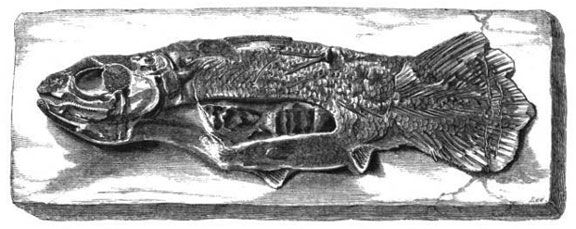
NOTE:
* "Chalk" is a previously used synonym for Cretaceous [146-66mya].
[2092] Book: A Text-Book of Zoology. By T. Jeffery Parker & William A. Haswell. Third edition. Volume 2. Macmillan & Co, 1921.
Page 236: "B, Macropoma mantelli (Cretaceous)...."
[2093] Paper: "Notice of a New Coelacanth Fish from the Iowa Kinderhook." By Charles R. Eastman. Journal of Geology, May-June, 1908.
The family of Coelacanth ("hollow spined") ganoids, first proposed by Agassiz in 1844, and subsequently emended by Huxley in two important memoirs of the Geological Survey of the United Kingdom (Decades X and XII), is at present understood as comprising not more than six satisfactorily known genera, among which Coelacanthus itself, Macropoma, and Undina are of paramount importance. The first-named of these, which is typical of the family and likewise of the group Actinistia, enjoys the truly remarkable geological range from the Upper Devonian [385-359 mya] to the close of the Paleozoic [251 mya], or, if the evidence of certain doubtful indications be accepted, possibly even higher; the remaining genera continue throughout the Mesozoic [251-66 mya], and exhibit such constancy of structural characters as to render the family one of the most compact and well defined in the animal kingdom.
Attention has frequently been called to the extraordinary conservatism and persistency maintained by the group throughout an unusually long life-period.
[2094] Book: Memoirs of the Geological Survey of the United Kingdom; Decade 12: Illustrations of the Structure of the Crossopterygian Ganoids. By Thomas H. Huxley. Longmans, Green, Reader, and Dyer, 1866. Page 43:
Bearing in mind the range of the Coelacanths from the Carboniferous [359-299] to the Chalk* [146-66 mya] formations inclusive, the uniformity of organization of the group appears to be something wonderful.
I have no evidence as to the structure of the base and side walls of the skull in Coelacanthus, but the data collected together in the present Decade show that, in every other particular save the ornamentation of the fin-rays and scales, the organization of the Coelacanths has remained stationary from their first recorded appearance to their exit. They are remarkable examples of what I have elsewhere termed "persistent types"....
NOTE:
* "Chalk" is a previously used synonym for Cretaceous.
[2095] Book: Report of the Geological Survey of Ohio. Volume 1: "Geology and Palaeontology." Part 2: "Palaeontology." Edited by J. S. Newberry & others. Nevins and Myers, 1873. Section 2: "Descriptions of Fossil Fishes." By J. S. Newberry.
Page 339: "In this case we have a form of organization showing an elaborate and complicated structure, which has continued almost unchanged throughout the inconceivable duration of successive geological ages, while all the world of physical circumstance was revolutionized again and again."
[2096] Paper: "Notice of a New Coelacanth Fish from the Iowa Kinderhook." By Charles R. Eastman. Journal of Geology, May-June, 1908.
The family of Coelacanth ("hollow spined") ganoids, first proposed by Agassiz in 1844, and subsequently emended by Huxley in two important memoirs of the Geological Survey of the United Kingdom (Decades X and XII), is at present understood as comprising not more than six satisfactorily known genera, among which Coelacanthus itself, Macropoma, and Undina are of paramount importance. The first-named of these, which is typical of the family and likewise of the group Actinistia, enjoys the truly remarkable geological range from the Upper Devonian [385-359 mya] to the close of the Paleozoic [251 mya], or, if the evidence of certain doubtful indications be accepted, possibly even higher; the remaining genera continue throughout the Mesozoic [251-66 mya], and exhibit such constancy of structural characters as to render the family one of the most compact and well defined in the animal kingdom. ...
The characters serving chiefly to distinguish the present form from other species may be enumerated as follows: (i) The delicate spiniform ornamentation of the operculum and cheek-plates, together with the form and disposition of the latter; (2) the peculiar form of the mandibular ramus; (3) details of superficial scale ornament; and (4) prominence of the lateral line canal. Owing to the defective preservation of most of the fin structures, it is impossible to say in what respects, if any, these differ from the prevailing type. The cranial structure, however, offers a number of interesting points of comparison with other forms, as will be immediately pointed out. Be it noted in passing that the totality of characters by no means indicates a primitive forerunner of the family, but on the contrary bespeaks a typical Coelacanth as completely developed as any subsequent form with which we are acquainted. In this respect the Kinderhook species resembles the only well known British Coelacanth of an age anterior to the Coal Measures, namely C. huxleyi, from the Calciferous sandstones of southern Scotland. ...
A notable peculiarity of the form under discussion consists in the arrangement of cheek-plates immediately in advance of the operculum. In all other Coelacanths, so far as known, two subequal postorbital plates are placed one above the other in the space between the orbit and operculum, their position being such as to exclude from contact with the latter the small triangular plate called "postmaxillary" by Huxley. The present species, however, has all three of these cheek-plates situated in vertical series, one overlapping the other from above downwards, and each of them overlapping the anterior border of the operculum. The lowermost cheek-plate, which corresponds to the so-called "postmaxillary" of Huxley, terminates below at a depth equal to that of the inferior border of the operculum, and its superficies covers the space immediately behind the inflected portion of the articulo-angular element of the lower jaw. Its antero-superior margin is apposed to the strongly arched and apparently semicircular suborbital element, of which only a small segment happens to have been preserved.
[2097] Book: Report of the Geological Survey of Ohio. Volume 1: "Geology and Palaeontology." Part 2: "Palaeontology." Edited by J. S. Newberry & others. Nevins and Myers, 1873. Section 2: "Descriptions of Fossil Fishes." By J. S. Newberry. Page 338:
Until recently, Coelacanthus was without representative in the collections of American fossil fishes ; but when the remarkable fish-deposit of Linton was discovered, species of this genus were found to be more abundant there than in any other known locality. The finding of Coelacanthus at Linton, a place so far removed from those in which it occurs abroad, is not only a fact of much geological interest, but, since the most common species found there is scarcely distinguishable from C. lepturus of the Coal Measures of England, it affords another and interesting illustration of the homogeneity and wide distribution of the Coal Measure fauna, and the remarkable persistence in space, as well as time, of even minute characters in the organization of Coelacanthus.
Page 339: "In this case we have a form of organization showing an elaborate and complicated structure, which has continued almost unchanged throughout the inconceivable duration of successive geological ages, while all the world of physical circumstance was revolutionized again and again."
[2098] Paper: "Notice of a New Coelacanth Fish from the Iowa Kinderhook." By Charles R. Eastman. Journal of Geology, May-June, 1908.
"Be it noted in passing that the totality of characters by no means indicates a primitive forerunner of the family, but on the contrary bespeaks a typical Coelacanth as completely developed as any subsequent form with which we are acquainted."
[2099] Book: Discourses: Biological and Geological. By Thomas H. Huxley. D. Appleton & Co., 1913. Chapter 9: "Geological Contemporaneity and Persistent Types of Life" (Address to the Geological Society on behalf of the President by one of the Secretaries, 1862). Pages 299-300:
The VERTEBRATA. — Among fishes I have referred to the Coelacanthini (comprising the genera Coelacanthus, Holophagus, Undina, and Macropoma) as affording an example of a persistent type; and it is most remarkable to note the smallness of the differences between any of these fishes (affecting at most the proportions of the body and fins, and the character and sculpture of the scales), notwithstanding their enormous range in time. In all the essentials of its very peculiar structure, the Macropoma of the Chalk is identical with the Coelacanthus of the Coal.
[2100] Book: The Cambridge Natural History. Volume 7. Edited by S. F. Harmer & A. E. Shipley. Macmillan & Co., 1904. Chapter 18: "Teleostomi." By G. A. Boulenger. Page 481:
"From their first appearance in the Lower Carboniferous [≈ 359-345 mya] the Coelacanthidae range, practically unchanged, through the intervening formations to the Upper Cretaceous [100-66 mya]."
[2101] Book: Memoirs of the Geological Survey of the United Kingdom; Decade 12: Illustrations of the Structure of the Crossopterygian Ganoids. By Thomas H. Huxley. Longmans, Green, Reader, and Dyer, 1866. Page 43:
I have no evidence as to the structure of the base and side walls of the skull in Coelacanthus, but the data collected together in the present Decade show that, in every other particular save the ornamentation of the fin-rays and scales, the organization of the Coelacanths has remained stationary from their first recorded appearance to their exit. They are remarkable examples of what I have elsewhere termed "persistent types, and, like the Labyrinthodonts, assist in bridging over the gap between the Palaeozoic and the Mesozoic Faunas."
[2102] Book: History of the Coelacanth Fishes. By Peter L. Forey (Department of Palaeontology, Natural History Museum, London). Chapman & Hall, 1998.
Preface: "During that century, many fossils had been discovered and described...."
Page 369: "As a group they are known as far back as the late Middle Devonian (Givetian) [392-385 mya]. About 80 valid species can be recognized (although this is certainly a lower estimate to be increased when better material is known for some of the doubtful species) in a fossil record that extends 305 million years to the mid-Maastrichtian (75 million years ago)."
Page 370: "Certainly, coelacanth morphological evolution has been conservative. There are examples of other fish taxa where some 80 species may be said to show less variation (e.g. species of cyprinids such as Barbus), but very few where such limited variation extends over 300 million years...."
[2103] Book: Fossils: The Evolution and Extinction of Species. By Niles Eldredge. Harry N. Abrams, 1991.
Page 92: "The latest coelacanth yet found in the fossil record is the 70 million year old Crustaceous Macropoma...."
[2104] Book: In Search of Deep Time: Beyond the Fossil Record to a New History of Life. By Henry Gee (doctorate in zoology from Cambridge, chief science writer for the journal Nature). The Free Press, 1999.
Page 49: "The most recent coelacanth known exclusively from fossils died out around 70 million years ago, when dinosaurs still ruled the earth."
[2105] Book: Old Fourlegs: The Story of the Coelacanth. By J. L. B. Smith. Longman's, Green and Co, 1956. Page 233:
As explained in Chapter Two, Coelacanths as such lived over a longer period than any other known type of creature, certainly of vertebrates. They apparently spread over most of the earth, for fossils have been found in very many places. They left apparently one of the most constant and unbroken series of fossils, often almost perfect, that one could desire, covering 250 million years, during which they lived almost unchanged in general form. This fossil record was so good that it apparently gave an index of numbers as well as distribution.
[2106] Article: "Dinosaur." Contributor: David B. Weishampel. World Book Encyclopedia, 2007 Deluxe Edition.
"The first dinosaurs appeared on Earth about 230 million years ago."
[2107] Book: Old Fourlegs: The Story of the Coelacanth. By J. L. B. Smith. Longman's, Green and Co, 1956.
Page 24: "It was therefore with no sense of anything unusual that Miss Latimer received a telephone message from the manager of Irvin and Johnson at East London [South Africa] in the late morning of the 22nd of December 1938, to say that a trawler had brought in a pile of fish for her to examine."
Page 30 (in a letter from Latimer to Smith dated 12/23/1938): "I had the most queer-looking specimen brought to notice yesterday. The Captain of the Trawler told me about it so I immediately set off the see the specimen, which I had removed to our Taxidermist as soon as I could. I however have drawn a very rough sketch...."
[2108] Book: Fossils: The Evolution and Extinction of Species. By Niles Eldredge. Harry N. Abrams, 1991. Page 92:
In 1938, a fisherman off the coast of South Africa landed a large, dark scaly fish unlike any other he'd seen before. (Plate 76) ... [T]his particular fisherman was, thankfully, curious about his catch; in due course the fish came to the attention of Marjory Courtenay-Latimer, a curator at one of the local museums. ... [I]t quickly became obvious that the fish in question (in due course dubbed Latimeria chalumnae) was nothing less than a living member of the coelacanths—a group that had presumably become extinct some 65 million years ago.
[2109] Book: Old Fourlegs: The Story of the Coelacanth. By J. L. B. Smith. Longman's, Green and Co, 1956. Page 49.
[2110] Book: History of the Coelacanth Fishes. By Peter L. Forey (Department of Palaeontology, Natural History Museum, London). Chapman & Hall, 1998.
Page 38 states that 172 live coelacanths have been caught.
[2111] Article: "Fisherman catches 'living fossil'." BBC News, August 1, 2007. http://news.bbc.co.uk/2/hi/science/nature/6925784.stm
"Since then, more than 300 specimens of the modern coelacanth species (Latimeria chalumnae) have been found in the waters around the Comoros Islands, which are situated in the Western Indian Ocean, and the eastern coast of Africa."
[2112] Article: "Fisherman catches 'living fossil'." BBC News, August 1, 2007. http://news.bbc.co.uk/2/hi/science/nature/6925784.stm
[2113] Book: Smith's Sea Fishes. Edited by Margaret M. Smith & Phillip C. Heemstra. Struik, 2003. Page 29:
In 1931, J. L. B. Smith, a trained chemist with a fanatical interest in angling and the fishes he caught, timidly published his first ichthyological paper in the Annals of the Albany Museum. He soon discovered that the eastern Cape Province coast had hardly been collected, and his publications increased in numbers and stature until all the museums of the eastern Province were sending him, as their Honorary Curator of Fishes, their problem fishes.
Thus he came to identify the first living coelacanth, caught by an Irwin & Johnson trawler captained by Captain Goosen....
In 1945 he was asked to write The Sea Fishes of Southern Africa, and it appeared in June 1949. Its effect on the world of ichthyology was considerable....
[2114] Book: Old Fourlegs: The Story of the Coelacanth. By J. L. B. Smith. Longman's, Green and Co, 1956. Pages 235-236:
[2115] Book: Fossils: The Evolution and Extinction of Species. By Niles Eldredge. Harry N. Abrams, 1991.
The dust jacket states that Eldredge is the "Curator of the Department of Invertebrates at the American Museum of Natural History" and is "one of the leading palaeontologists of our day."
Page 92: "The latest coelacanth yet found in the fossil record is the 70 million year old Crustaceous Macropoma, in many ways the spitting image of Latimeria, though at less than a foot in length, only a fraction as long as its four-foot living relative."
[2116] Book: History of the Coelacanth Fishes. By Peter L. Forey (Department of Palaeontology, Natural History Museum, London). Chapman & Hall, 1998.
Page 13: [Latimeria is the] "only living coelacanth."
[2117] Book: The Cambridge Natural History. Volume 7. Edited by S. F. Harmer & A. E. Shipley. Macmillan & Co., 1904. Chapter 18: "Teleostomi." By G. A. Boulenger.
Page 481: "From their first appearance in the Lower Carboniferous [≈ 359-345 mya] the Coelacanthidae range, practically unchanged, through the intervening formations to the Upper Cretaceous [100-66 mya]. ... Macropoma is a well-known form from the Middle and Upper Cretaceous [100-66 mya] beds of England, and other parts of Europe."
[2118] Book: Petrifactions and Their Teachings; or a Hand-Book to the Gallery of Organic Remains of the British Museum. By Gideon Algernon Mantell. Henry G. Bohn, 1851.
Page 436: "Lign. 89. MACROPOMA MANTELLI; FROM THE CHALK, LEWES. DISCOVERED AND DEVELOPED BY THE AUTHOR IN 1823."
Page 437:
In every example of this fossil fish that I have dissected....
The Macropoma when at maturity, was between two and three feet in length; its massive skeleton indicates a powerful frame....
[2119] Article: "World's Tallest Man Meets World's Smallest Man." Associated Press, July 14, 2007. http://www.foxnews.com/story/0,2933,289298,00.html
[2120] Article: "Worlds apart: The moment the tallest man met the shortest." By Claire Bates. London Daily Mail, July 17, 2007. http://www.dailymail.co.uk/news/article-468172/...
"But these two men actually hail from the same region of Inner Mongolia."
[2121] Teaching guide: "Human Genetic Variation." By BSCS and Videodiscovery under a contract from the National Institutes of Health, National Human Genome Research Institute, 1999. http://science.education.nih.gov/supplements/...
Page 8:
Furthermore, genetic variation around the world is distributed in a rather continuous manner; there are no sharp, discontinuous boundaries between human population groups. In fact, research results consistently demonstrate that about 85 percent of all human genetic variation exists within human populations, whereas about only 15 percent of variation exists between populations (Figure 4). That is, research reveals that Homo sapiens is one continuously variable, interbreeding species. Ongoing investigation of human genetic variation has even led biologists and physical anthropologists to rethink traditional notions of human racial groups. The amount of genetic variation between these traditional classifications actually falls below the level that taxonomists use to designate subspecies, the taxonomic category for other species that corresponds to the designation of race in Homo sapiens. This finding has caused some biologists to call the validity of race as a biological construct into serious question.
[2122] Book: Compendium of Human Anatomic Variation. By Ronald A. Bergman & others. Urban & Schwarzenberg, 1988. Page V:
We have also observed that students are often frustrated because the bodies they are dissecting do not conform to atlas or textbook descriptions and, as a result, they may either ignore the variations or inadvertently destroy them in an effort to find conformity. ...
... Variations must be considered to be normal and thus must be anticipated and understood. It has been repeatedly stated in the literature that textbook descriptions are accurate or hold in only 50-70% of individuals. From the standpoint of utilization of anatomic information in a clinical setting, textbooks are not only inadequate but may be dangerously misleading as well. We feel, therefore, that this collection of reported human variations may alleviate, to some extent, profound deficiencies now found in many modern anatomy textbooks.
Page 61: "Another variation is a single aortic arch curving to the right instead of to the left."
Pages 195-196 contains an index of more than 250 skeletal variations and bones affected by multiple variations. A very brief sampling of these structures includes the vertebrae, cranium, ribs, shoulder, pelvis, sternum, leg, wrist, hand, knee, and foot.
Page 199: "The number of elements of the vertebral column has been reported to vary between 32 and 35."
Page 452: "Variations in Fissures of Cerebral Hemisphere...."
Page 453: "Variations in Gyri and Sulci [convolutions in the brain.]."
[2123] Book: The Ancient Life-History of the Earth. By Henry Alleyne Nicholson. D. Appleton and Company, 1878. Page 39:
[T]he mere fact of fossils being found in beds which are known by physical evidence to be of different ages, has commonly led palaeontologists to describe them as different species. Thus, the same fossil, occurring in successive groups of strata, and with the merely trivial and varietal differences due to the gradual change in its environment, has been repeatedly described as a distinct species, with a distinct name, in every bed in which it was found. We know, however, that many fossils range vertically through many groups of strata, and there are some which even pass through several formations. The mere fact of a difference of physical position ought never to be taken into account at all in considering and determining the true affinities of a fossil.
[2124] Paper: "Ecological conservatism in the 'living fossil' Ginkgo." By Dana L. Royer & others. Paleobiology, March 2003. Pages 84-104. http://www.sou.edu/Biology/Courses/Bi432/...
Page 85: "Of particular interest for this study is [Ginkgo] adiantoides ... which is morphologically identical to [Ginkgo] biloba.... These similarities have led some authors to consider [Ginkgo] adiantoides conspecific [the same species as] [Ginkgo] biloba.... Ginkgo adiantoides first appeared in the Early Cretaceous [≈ 145-100 mya]...."
NOTE: Ginkgo biloba is an existing species. More to come on this.
Page 85: "Van Konijnenburg-van Cittert (1971) concluded that the pollen of middle Jurassic [176-161 mya] G. huttoni ... was morphologically identical to G. biloba. Thus, Ginkgo is a highly conservative genus morphologically, with the long-ranging fossil species G. adiantoides indistinguishable from modern G. biloba."
Page 94: "Ginkgo is an extreme example of a geologically long-lived genus, with its one living species arguably having a temporal range of 100 Myr. ... Furthermore, the stability of Ginkgo's sedimentological and floral associations through the time series parallels the morphological identity of the fossil species G. adiantoides and the living G. biloba."
[2125] Book: Living Fossils. Edited by Niles Eldredge and Steven M. Stanley. Springer Verlag, 1984. Chapter 17: "The Coelacanth as a Living Fossil." By Peter Forey (Department of Palaeontology, British Museum of Natural History).
Page 167: "Coelacanths are known by approximately 70 species distributed among 28 genera. As usual the number of species recognized varies according to authority and to whether one is prepared to accept geographically and stratigraphically based species as well as those based on morphology."
[2126] Book: Living Fossils. Edited by Niles Eldredge and Steven M. Stanley. Springer Verlag, 1984. Chapter 22: "The Cretaceous Coral Heliopora...." By Michael W. Colgan (Earth Sciences Board, University of California, Santa Cruz).
Page 269: "The inherent variability of the characteristics of Heliopora may not have been fully appreciated by some previous workers who described and named fossil Heliopora, because many of the attributes particular to a fossil species often overlap with the recent coral."
Page 270: "... Heliopora spans over 100 million years, with only slight morphologic changes. This is particularly evident when the fossil species are compared with the living Heliopora, because many of the variations described for the fossil species find expression in the range of characters seen in living [Heliopora] coerulea...."
[2127] Book: On the Origin of Species by Means of Natural Selection, or the Preservation of Favoured Races in the Struggle for Life. By Charles Darwin. John Murray, 1859. Chapter 9: "On the Imperfection of the Geological Record." http://www.literature.org/authors/darwin-charles/the-origin-of-species/
[2128] Book: Old Fourlegs: The Story of the Coelacanth. By J. L. B. Smith. Longman's, Green and Co, 1956.
Pages 235-236: "The bony structures of our modern Coelacanth are almost exactly the same as those left by Coelacanths of several hundred million years ago."
[2129] Book: Fossils: The Evolution and Extinction of Species. By Niles Eldredge. Harry N. Abrams, 1991. Page 120.
NOTES: The dust jacket states Eldredge is the "Curator of the Department of Invertebrates at the American Museum of Natural History" and is "one of the leading palaeontologists of our day."
Also notice from this quote how the discredited myth that the entire Earth was simultaneously covered with the same types of animals and plants still permeates evolutionary thought. Such ideas are so deeply imbedded that even people who know better give voice to them.
[2130] Paper: "Ecological conservatism in the 'living fossil' Ginkgo." By Dana L. Royer & others. Paleobiology, March 2003. Pages 84-104. http://www.sou.edu/Biology/Courses/Bi432/...
Page 85: "Of particular interest for this study is [Ginkgo] adiantoides ... which is morphologically identical to [Ginkgo] biloba.... These similarities have led some authors to consider [Ginkgo] adiantoides conspecific [the same species as] [Ginkgo] biloba.... Ginkgo adiantoides first appeared in the Early Cretaceous [≈ 145-100 mya]...."
Page 85: "Van Konijnenburg-van Cittert (1971) concluded that the pollen of middle Jurassic [176-161 mya] G. huttoni ... was morphologically identical to G. biloba. Thus, Ginkgo is a highly conservative genus morphologically, with the long-ranging fossil species G. adiantoides indistinguishable from modern G. biloba."
Page 94: "Ginkgo is an extreme example of a geologically long-lived genus, with its one living species arguably having a temporal range of 100 Myr. ... Furthermore, the stability of Ginkgo's sedimentological and floral associations through the time series parallels the morphological identity of the fossil species G. adiantoides and the living G. biloba."
[2131] Book: Living Fossils. Edited by Niles Eldredge and Steven M. Stanley. Springer Verlag, 1984. Chapter 22: "The Cretaceous Coral Heliopora...." By Michael W. Colgan (Earth Sciences Board, University of California, Santa Cruz).
Page 266: "Heliopora coerulea, the blue coral, is a common reef former of modern Indo-Pacific reefs....."
Page 270:
The recent coral finds a close ally in the Cenomanian [100-94 mya] reef deposits of Devonshire England. An encrusting coral there was dated as [Heliopora] coerulea specimens has 12 psuedosepta and "cannot be distinguished from the encrusting form of recent [Heliopora] coerulea" (Duncan 1879).
... Heliopora spans over 100 million years, with only slight morphologic changes. This is particularly evident when the fossil species are compared with the living Heliopora, because many of the variations described for the fossil species find expression in the range of characters seen in living [Heliopora] coerulea....
[2132] Article: "New salamander species provide new answers to old questions in evolution." By Catherine Gianaro. University of Chicago Medical Center, April 3, 2003. http://chronicle.uchicago.edu/030403/salamanders.shtml
The new cryptobranchid shows extraordinary morphological similarity to its living relatives," noted the study authors. "Indeed, extant cryptobranchid salamanders can be regarded as living fossils whose structures have remained little changed for more than 160 million years."
[2133] Article: "Palaeontology: Modern look for ancient lamprey." By Philippe Javier. Nature, October 26, 2006. Pages 921-924. http://www.nature.com/nature/journal/v443/n7114/...
Page 921: "It was once thought that lampreys evolved from armoured jawless vertebrates. But a recently discovered lamprey fossil dates from the twilight age of their supposed ancestors, and looks surprisingly modern."
Page 923: "This shows that lamprey morphology has been astonishingly stable for 360 Myr.... Admittedly, Priscomyzon, like the Carboniferous lampreys, differs from its modern equivalents in minor details...."
Page 923: "Figure 1 | Vertebrate tree. ... The 360-million-year-old lamprey Priscomyzon (green) discovered by Gess et al.1 is very similar to modern lampreys, even though it dates from the twilight age (grey area) of the armoured jawless vertebrates (known as ostracoderms, in red) that were once considered to be ancestors of hagfishes and lampreys2,15."
Page 924: "So, it is not too surprising that lampreys turn up in the Devonian period, 360 Myr ago. What is surprising is that they are already very similar to modern lampreys."
[2134] Paper: "A lamprey from the Devonian period of South Africa." By Robert W. Gess & others. Nature, October 26, 2006. Pages 981-984. http://www.nature.com/nature/journal/v443/n7114/full/nature05150.html
Page 981: "This ... [fossil discovery] is not only more conventionally lamprey-like than other Palaeozoic examples7, 8, but is also some 35 million years older."
Page 982: "Figure 1 | Holotype of Priscomyzon riniensis gen. et sp. nov. This 360-million-year-old lamprey is the earliest example known in the fossil record...."
[2135] Article: "Bloodsucking Lamprey Found to Be 'Living Fossil'." By Adrianne Appel. National Geographic News, October 25, 2006. http://news.nationalgeographic.com/news/2006/10/061025-lampreys.html
"A 1.7-inch (4.2-centimeter) fossilized specimen found in an ancient South African lagoon shows that the bloodsucking, eel-like fish hasn't changed much in 360 million years, according to a new study to be published tomorrow in the journal Nature."
[2136] Article: "Oldest Horseshoe Crab Fossil Discovered." By Jeanna Bryner. LiveScience, January 28, 2008. http://www.livescience.com/animals/080128...
Two nearly complete fossil specimens discovered in Canada reveal a new genus of horseshoe crab, pushing their origins back at least 100 million years earlier than previously thought. ...
Rudkin and his colleagues, including Graham Young of the Manitoba Museum, spotted the fossils buried in 445-million-year-old rocks from the Ordovician period in central and northern Manitoba. ...
"We wouldn't necessarily have expected horseshoe crabs to look very much like the modern ones, but that's exactly what they look like," Rudkin said.
[2137] Paper: "The Oldest Horseshoe Crab: A New Xiphosurid from Late Ordovician Konservat-Lagerstätten Deposits, Manitoba, Canada." By David M. Rudkin & others. Palaeontology, January 2008. http://www.museunacional.ufrj.br/mndi/...
A remarkable new fossil horseshoe crab ... is strikingly similar to crown group limuline horseshoe crabs....
Living horseshoe crabs, typified by the intensively studied Limulus polyphemus....
While Lunataspis is remarkably 'modern' in overall appearance (see reconstruction in Text-fig. 5), particularly with respect to prosomal morphology and possession of fused opisthosomal tergites, the bipartite thoracetron-like tagma sets it apart from all known post-Palaeozoic horseshoe crabs. ...
Regardless of its ordinal-level status, Lunataspis is the oldest undoubted representative of the Xiphosura, yet its gross exoskeletal morphology is much closer to limulines than to any synziphosurine or even to many Late Palaeozoic xiphosurids.
[2138] Online supplemental resources for the textbook: Earth Science: Geology, the Environment, and the Universe. Glencoe/McGraw-Hill, 2008. Accessed November 7, 2008 at http://www.glencoe.com/sec/science/earthscience/...
Unit 6: "Geologic Time." Chapter 21: "The Dynamic Earth": "Some Cambrian inarticulate brachiopods are indistinguishable from the living inarticulate brachiopod Lingula, a brachiopod that has remained virtually unchanged for the entire Phanerozoic!"
[2139] Book: Archetypes and Ancestors: Palaeontology in Victorian London, 1850-1875. By Adrian Desmond. University of Chicago Press, 1982.
Pages 101-2: "[T]he marine bivalve Lingula, which had barely changed since early Palaeozoic times [≈ 542 mya]."
[2140] Book: God and the Astronomers. By Robert Jastrow. W.W. Norton & Company, 1978. Page 16.
[2141] Article: "mussel shrimp." Encyclopedia Britannica Ultimate Reference Suite 2004.
[2142] Textbook: The Science of Evolution. By William D. Stansfield (Professor of Biological Sciences at California Polytechnic State University). Macmillan, 1977. Page 80.
[2143] Article: "Gutsy Fossil Sets Record for Staying the Course." By Erik Stokstad. Science, December 5, 2003. Page 1645. http://www.sciencemag.org/cgi/content/full/302/5651/1645
On page 1749, however, paleontologists describe a much rarer specimen: one that reveals the oldest soft tissue known for an ostracode. The 425-million-year-old fossil preserves a jaw-dropping amount of detail, including gracile limbs used for swimming and the oldest penis in the fossil record. ... What's most amazing, ostracode experts say, is how eerily similar the soft-tissue anatomy is to that of modern relatives.
[2144] Article: "Fossil Find Hailed as Earliest Recorded Male." By James Gorman. New York Times, December 4, 2003. http://www.nytimes.com/2003/12/04/science/...
"The new fossil ... has modern descendants that are almost exactly the same, down to two hairs on the end of its swimming appendages."
[2145] Article: "Gutsy Fossil Sets Record for Staying the Course." By Erik Stokstad. Science, December 5, 2003. Page 1645. http://www.sciencemag.org/cgi/content/full/302/5651/1645\
[2146] Paper: "An Ostracode Crustacean with Soft Parts from the Lower Silurian." By David J. Siveter and others. Science, December 5, 2003. Pages 1749-1751. http://www.sciencemag.org/cgi/reprint/sci;302/5651/1749.pdf
Page 1749: "The fossil has striking similarity to the extant myodocopid family Cylindroleberididae, to which it is assigned, and demonstrates remarkable evolutionary stasis over 425 million years."
[2147] Article: "Gutsy Fossil Sets Record for Staying the Course." By Erik Stokstad. Science, December 5, 2003. Page 1645. http://www.sciencemag.org/cgi/content/full/302/5651/1645
On page 1749, however, paleontologists describe a much rarer specimen: one that reveals the oldest soft tissue known for an ostracode. The 425-million-year-old fossil preserves a jaw-dropping amount of detail, including gracile limbs used for swimming and the oldest penis in the fossil record. ... What's most amazing, ostracode experts say, is how eerily similar the soft-tissue anatomy is to that of modern relatives.
[2148] Book: What Evolution Is. By Ernst Mayr. Basic Books, 2001. Page 13.
[2149] Article: "Oldest Horseshoe Crab Fossil Discovered." By Jeanna Bryner. LiveScience, January 28, 2008. http://www.livescience.com/animals/080128-horseshoe-crab.html
"Until now, the oldest fossils dated back 350 million years ago, from the Carboniferous period."
[2150] Web page: "Xiphosura: Horseshoe crabs." By M. Alan Kazlev. May 7, 2002. Accessed November 10, 2008 at http://www.ucmp.berkeley.edu/arthropoda/chelicerata/...
"There are only two orders (or sub-orders, depending on your preference) of Xiphosura [horseshoe crabs], the primitive and ancestral Synziphosurina/-ida, and the Lumulina/-ida/Xiphosurida/-ina. The latter group includes modern horseshoe crabs and their immediate ancestors."
[2151] Paper: "The Oldest Horseshoe Crab: A New Xiphosurid from Late Ordovician Konservat-Lagerstätten Deposits, Manitoba, Canada." By David M. Rudkin & others. Palaeontology, January 2008. http://www.museunacional.ufrj.br/mndi/...
Efforts to trace its [the xiphosurid body plan's] origin have so far focused on ... 'synziphosurines'. These were considered by Anderson and Selden (1997) to comprise a paraphyletic stem lineage to Xiphosurida within the class Xiphosura. ...
[T]he oldest accepted synziphosurines are Venustulus waukeshaensis from Early Silurian [428-444 mya] ... and Bembicosoma pomphicus from rocks of approximately equivalent age....
[2152] Paper: "The Oldest Horseshoe Crab: A New Xiphosurid from Late Ordovician Konservat-Lagerstätten Deposits, Manitoba, Canada." By David M. Rudkin & others. Palaeontology, January 2008. http://www.museunacional.ufrj.br/mndi/...
A remarkable new fossil horseshoe crab ... is strikingly similar to crown group limuline horseshoe crabs....
Living horseshoe crabs, typified by the intensively studied Limulus polyphemus....
Here we report the discovery of a new genus and species of remarkable fossil horseshoe crab, Lunataspis aurora.... In most discernible characters, Lunataspis [445 mya] ... is in fact more limuline in external morphology than many of the bizarre and clearly specialized Carboniferous [300-359 mya] xiphosurids, such as the Euproopidae....
[I]ts gross exoskeletal morphology is much closer to limulines than to any synziphosurine or even to many Late Palaeozoic [≈ 251-299 mya] xiphosurids.
[2153] Web page: "Xiphosura: Horseshoe crabs." By M. Alan Kazlev. May 7, 2002. Accessed November 10, 2008 at http://www.ucmp.berkeley.edu/arthropoda/chelicerata/...
"Family Euproopidae.... time range: Viséan [328-345] to Artinskian [276-284 mya]"
[2154] Paper: "The Oldest Horseshoe Crab: A New Xiphosurid from Late Ordovician Konservat-Lagerstätten Deposits, Manitoba, Canada." By David M. Rudkin & others. Palaeontology, January 2008. http://www.museunacional.ufrj.br/mndi/...
Lunataspis is much older than the proposed 'synziphosurine' stem lineage of Carboniferous and post-Palaeozoic Xiphosurida, yet is strikingly similar to crown group limuline horseshoe crabs, indicating that major features of the distinctive and highly conserved xiphosurid Bauplan [body plan] evolved considerably earlier in the Palaeozoic than was previously suspected.
[2155] Book: History of the Coelacanth Fishes. By Peter L. Forey (Department of Palaeontology, Natural History Museum, London). Chapman & Hall, 1998.
Page 3: [Lampreys and hagfishes] "are unknown as fossils since the Upper Carboniferous, a gap of some 300 million years."
[2156] Article: "Palaeontology: Modern look for ancient lamprey." By Philippe Javier. Nature, October 26, 2006. Pages 921-924. http://www.nature.com/nature/journal/v443/n7114/full/443921a.html
Page 923:
The evolutionary divergence of the two cyclostome groups from each other was regarded as relatively recent, possibly occurring during the Mesozoic period 251–65 Myr ago. So the subsequent discovery of 300– 330-Myr old fossil lampreys and hagfishes from the Carboniferous period came as a surprise3. These fishes are exceptionally preserved as soft-tissue imprints and are almost identical to their modern successors.
[2157] Paper: "A lamprey from the Devonian period of South Africa." By Robert W. Gess & others. Nature, October 26, 2006. Pages 981-984. http://www.nature.com/nature/journal/v443/n7114/full/...
Page 981:
Lampreys are the most scientifically accessible of the remaining jawless vertebrates, but their evolutionary history is obscure. In contrast to the rich fossil record of armoured jawless fishes, all of which date from the Devonian period and earlier1, 2, 3, only two Palaeozoic lampreys have been recorded, both from the Carboniferous period1. ... This ... [fossil find] is not only more conventionally lamprey-like than other Palaeozoic examples7, 8, but is also some 35 million years older.
Page 982: "Figure 1 | Holotype of Priscomyzon riniensis gen. et sp. nov. This 360-million-year-old lamprey is the earliest example known in the fossil record...."
[2158] Article: "Palaeontology: Modern look for ancient lamprey." By Philippe Javier. Nature, October 26, 2006. Pages 921-924. http://www.nature.com/nature/journal/v443/n7114/full/443921a.html
Page 921:
It was once thought that lampreys evolved from armoured jawless vertebrates. But a recently discovered lamprey fossil dates from the twilight age of their supposed ancestors, and looks surprisingly modern.
... On page 981 of this issue, Gess et al.1 report the oldest fossil lamprey to date, a discovery that calls for a reassessment of cyclostome evolution.
Page 923:
Figure 1 | Vertebrate tree. ... The 360-million-year-old lamprey Priscomyzon (green) discovered by Gess et al.1 is very similar to modern lampreys, even though it dates from the twilight age (grey area) of the armoured jawless vertebrates (known as ostracoderms, in red) that were once considered to be ancestors of hagfishes and lampreys2,15.
[2159] Paper: "A lamprey from the Devonian period of South Africa." By Robert W. Gess & others. Nature, October 26, 2006. Pages 981-984. http://www.nature.com/nature/journal/v443/n7114/full/...
Page 981: "This ... [fossil find] is not only more conventionally lamprey-like than other Palaeozoic examples7, 8, but is also some 35 million years older. This finding is evidence that agnathans close to modern lampreys had evolved before the end of the Devonian period."
[2160] Textbook: Foundations of Modern Cosmology. By John F. Hawley & Katherine A. Holcomb. Oxford University Press, 1998. Page 17.
[2161] Textbook: The Science of Evolution. By William D. Stansfield (Professor of Biological Sciences at California Polytechnic State University). Macmillan, 1977.
Page 80: Whenever a rock is found bearing ... [an index] fossil, its approximate age is automatically established."
[2162] Textbook: Principles of Stratigraphy. By Carl O. Dunbar (Professor of Paleontology and Stratigraphy, Yale University) & John Rodgers (Associate Professor of Geology, Yale University). John Wiley & Sons, 1957. Page 293:
[T]he Silurian System is in fact defined by fossils everywhere except in its type region [the place where it is defined]. And this conclusion holds for all the time-stratigraphic units. ...
[A]way from their individual type regions, systems [i.e., Jurassic, Cambrian, etc.], series, and stages can be delimited (defined) only by their fossils.
[2163] Book: Exploring Earth and Life Through Time. By Steven M. Stanley (Johns Hopkins University). W.H. Freeman and Company, 1993.
Page 81: "In fact, fossils continue to have primary importance in efforts to determine the relative ages of rock strata."
[2164] Book: Palaeontology: An Introduction. By E.W. Nield (formerly of Poroperm Laboratories, U.K.) & V.C.T. Tucker (formerly of Yale Sixth Form College, U.K.). Pergamon Press, 1985. Page 5:
Lastly, it should be noted that the dating of rocks by contained fossils is relative, not absolute. The method tells the geologist which unit is the younger, which the older, but not how old, or how much younger. That we know the ages in years of the various geological periods (Table 1.1) is a recent innovation brought in by the technique of radioactive dating. Its accuracy, however, is very poor indeed, and it is never used in the correlation of sediments.
NOTE: I don't know how anyone could be so familiar with the literature as to be sure radiometric dating is "never" used in the correlation of sediments, but it is clearly not commonly used and played no basis in establishing the geological column.
[2165] Book: Index Fossils of North America. By Hervey W. Shimer (Professor of Paleontology, MIT) & Robert R. Shrock (Associate Professor of Geology, MIT). John Wiley & Sons, 1944. Page 2.
[2166] Book: The Nemesis Affair: A Story of the Death of Dinosaurs and the Ways of Science. By David M. Raup. W. W. Norton & Company, 1986. Page 76:
I noted earlier that the highest dinosaur fossil is below the iridium anomaly. This is true only if one specifies that to qualify as a dinosaur fossil, there must be a close assemblage of bones from the same animal—a so-called "articulated" specimen. Odd fragments and isolated bones are ruled out in this case, because the chances are so good that isolated pieces may be buried, exhumed by erosion, and deposited again long after the animal actually died.
Page 78:
The field situation around Fort Peck Reservoir leaves much to be desired. The rocks are a somewhat confused sequence of stream and flood-plain deposits. Not all of the critical features occur in a single outcrop. To say the iridium anomaly is younger than the last dinosaur fossils requires a certain amount of inference, although this kind of inference is standard in field geology.
[2167] Paper: "Introduction to Conodont Studies" By E. B. Branson (professor of Geology) & M. G. Mehl (Associate Professor of Geology). The University of Missouri Studies (A Quarterly Journal of Research. Contents: Conodont Studies Number 1), January 1, 1933. Pages 5-17.
Page 14: "A much more serious problem is that of stratigraphic contamination."
Page 15:
On one occasion we were greatly surprised to find an abundant collection of Kinderhook (basal Mississippian [345-359 mya]) conodonts with a Joachim (lower middle Ordovician [≈ 472 mya]) assemblage in a sample taken beneath continuous beds of dolomite in the upper part of the Joachim. This remarkable stratigraphic leak is all the more surprising when it is known that the normal succession here includes a considerable thickness of Plattin (middle Ordovician [≈ 461-472]) and Minneola (Middle Devonian [≈ 385-398]) limestone above the Joachim.
These illustrations call attention to the danger the occasional worker with any group of microfossils might encounter in describing a fauna from one locality. For one fairly familiar with conodont assemblages from many horizons there is little likelihood that stratigraphic leaks will not be detected as such. As a matter of fact, the average worker, cognizant of the possibility of stratigraphic contamination, will eliminate most such possibilities in the field.
[2168] Book: International Stratigraphic Guide: A Guide to Stratigraphic Classification, Terminology, and Procedure. Edited by Amos Salvador. Second edition. International Union of Geological Sciences, 1994.
Page 137 (in glossary): "Stratigraphic leakage. The process whereby sediments and (or) fossils of a younger age are deposited within or under older rocks. The results or product of the process of stratigraphic leakage is stratigraphic leak...."
[2169] Article: "conodont." Encyclopedia Britannica Ultimate Reference Suite 2004.
They are thus the remains of animals that lived during the interval of time from 540 to 208 million years ago....
Conodonts are very useful fossils in the identification and correlation of strata, as they evolved rapidly, changing many details of their shapes as geologic time passed. Each successive group of strata thus may be characterized by distinctive conodont assemblages or faunas. Moreover, conodonts are very widespread, and identical or similar species occur in many parts of the world.
[2170] Paper: "Isolation of a 250 million-year-old halotolerant bacterium from a primary salt crystal." By Russell H. Vreeland and others. Nature, October 19, 2000. Pages 897-900. http://www.nature.com/nature/journal/v407/n6806/abs/407897a0.html
Page 897:
Here we report the isolation and growth of a previously unrecognized spore-forming bacterium (Bacillus species, designated 2-9-3) from a brine inclusion within a 250 million-year-old salt crystal from the Permian Salado Formation. Complete gene sequences of the 16S ribosomal DNA show that the organism is part of the lineage of Bacillus marismortui and Virgibacillus pantothenticus. ... Sterilization procedures reduce the probability of contamination to less than 1 in 109.
Page 898:
The Salado is generally accepted to be at least 250 Myr old. This age is supported by invertebrate fossils10,11 and radiometric ages12 from overlying formations, as well as radiometric ages of langbeinite minerals13 taken directly from the Salado. ...
... The 250-Myr-old crystal sample that contained viable bacteria was found in a dissolution pipe 569m below the surface....
[2171] Book: Palaeobiology II. Edited by Derek E. G. Briggs & Peter R. Crowther. Blackwell Scientific Publications, 2001. Reprinted in 2003. Section 3.2.1: "Fossilization Processes: Decay." By P.A. Allison (Huxley School for Environment, Earth Science & Engineering, Imperial College of Science, Technology & Medicine, UK).
Page 272: "The rate at which microbes function is limited by the supply of nutrients and the rate at which their metabolic by-products are removed. Few organisms can function successfully bathed in their own metabolic by-products."
[2172] Paper: "The Permian Bacterium that Isn't." By Dan Graur and Tal Pupko. Molecular Biology and Evolution, June 2001. Pages 1143-1146. http://mbe.oxfordjournals.org/cgi/reprint/18/6/1143
Page 1143:
Serious doubts have been raised concerning the possibility of spore survival for 250 Myr (Tomas Lindahl, personal communication), mostly because spores contain no active DNA repair enzymes, so the DNA is expected to decay into small fragments due to such factors as the natural radioactive radiation in the soil, and the bacterium is expected to lose its viability within at most several hundred years (Lindahl 1993).
Page 1145: "[U]nder the assumption of the molecular clock, we must conclude that B. permians, S. marismortui, and V. proomii are contemporaneous organisms."
[2173] Paper: "The Paradox of the 'Ancient' Bacterium Which Contains 'Modern' Protein-Coding Genes." By Heather Maughan and others. Molecular Biology and Evolution, September 2002. Page 1637-1639. http://mbe.oxfordjournals.org/cgi/content/full/19/9/1637
Page 1637:
Almost without exception, bacteria isolated from ancient material have proven to closely resemble modern bacteria at both morphological and molecular levels. This fact has historically been used by critics to argue that these isolates are not ancient but are modern contaminants introduced either naturally after formation of the surrounding material ... or because of flaws in the methodology of sample isolation.... Such criticism has been addressed experimentally by the development of highly rigorous protocols for sample selection, surface sterilization, and contamination detection and control procedures. Using the most scrupulous and well-documented sampling procedures and contamination-protection techniques reported to date, Vreeland, Rosenzweig, and Powers (2000) reported the isolation of a sporeforming bacterium ... within a halite crystal recovered from the 250-Myr-old Permian Salado Formation in Carlsbad, NM.
[2174] Paper: "New evidence for 250 Ma age of halotolerant bacterium from a Permian salt crystal." By Cindy L. Satterfield and others. Geology, April 2005. Pages 265-268. http://geology.geoscienceworld.org/cgi/content/abstract/33/4/265
The purported oldest living organism, the spore-forming bacterium Virgibacillus sp. Permian strain 2–9-3, was recently cultured from a brine inclusion in halite of the 250 Ma Permian Salado Formation. However, the antiquity of Virgibacillus sp. 2–9-3 has been challenged; it has been argued that the halite crystal and the fluid inclusion from which the bacterial spores were extracted may be younger than the Permian Salado salts. Here we report ... results [that] support the 250 Ma age of the fluid inclusions, and by inference, the long-term survivability of microorganisms such as Virgibacillus sp. 2–9-3.
[2175] Textbook: Evolution of Sedimentary Rocks. By Robert M. Garrels (Scripps Institution of Oceanography) & Fred T. Mackenzie (Northwestern University). W. W. Norton & Company, 1971. Page 67:
The great divisions of the time scale were developed early in the study of rocks; in general, rocks of Cenozoic age still tend to have a "new" look about them. Porosity is high and the mineralogy is much like that of modern sediments; they may be poorly cemented, and some fossil shells retain vestiges of their original colors. Precambrian rocks of sedimentary origin, on the other hand, are generally contorted and metamorphosed; fossils, if once present have been destroyed and porosity is very low.
However, bitter experience has shown that the use of degree of chemical and physical change from original sediments as a criterion of age is an extremely dangerous practice. It is true only as the broadest kind of generalization. In some areas rocks 2 billion years old, by the accident of their geography, are less altered than others that have survived only a few million years.
[2176] Book: Principles of Stratigraphy. By Michael E. Brookfield. Blackwell Publishing, 2004. Page 106:
[A] paraconformity has parallel layers above and below the unconformity. A paraconformity can often only be detected by dating the rocks above and below the unconformity, and noting the time gap.
The type of unconformity has no time significance. Some nonconformities may represent less than one million years, while some paraconformities may represent hundreds of millions of years. For example, in Estonia, soft Quaternary [present day-1.8 mya] clays rest paraconformably on soft Cambrian [488-542 mya] clays, and over 400 million years unrepresented between them.
NOTE: Page 107 contains the below sketch from Dunbar and Roger (see next citation) showing that a paraconformity is not visibly detectable, but inferred based upon evolutionary assumptions about the fossil record.
[2177] Textbook: Principles of Stratigraphy. By Carl O. Dunbar (Professor of Paleontology and Stratigraphy, Yale University) & John Rodgers (Associate Professor of Geology, Yale University). John Wiley & Sons, 1957. Page 119:
The evidence of a break in sequence is obvious in the first three [types of unconformities], but in the fourth type it must be inferred from other than structural criteria.
... We propose ... to introduce a new term paraconformity for the fourth type, in which the beds are parallel and the contact is a simple bedding plane. In the last case the two units may be described as paraconformable.* ...
* L. para, beside (in the figurative sense of being not quite the same or not really) + con, together + formare, to shape or form. The prefix para is used in this sense in many technical terms; for example, the paragaster of a sponge is not really a gaster (stomach).
[2178] Book: The Nature of the Stratigraphical Record. By Derek V. Ager. Macmillan, 1973.
Pages 40-41: "Coming back, as always, to the Jurassic, one only has to compare the 30 amniote zones represented in one foot of sediment in Sicily with the 15,000 feet representing a single zone in Oregon, to realize how startlingly different rates of deposition must have been in different places."
Page 127: "The relative importance of a hiatus is immediately evident if the beds above and below bear fossils by which they can be assigned their proper position in the geological column. In most instances this is the final and the only criterion that gives quantitative results for the large unconformities. ... Many large unconformities would never be suspected if it were not for such dating of the rocks above and below."
[2179] Book: Palaeobiology II. Edited by Derek E. G. Briggs & Peter R. Crowther. Blackwell Scientific Publications, 2001. Reprinted in 2003. 5.4.1: Fossils in Stratigraphy: Stratigraphic Procedure. By P.F. Rawson (Department of Geological Sciences, University College London). Page 536:
Biostratigraphy, the subdivision and correlation of sequences using fossils, is a fundamental tool in stratigraphy. The primary unit of biostratigraphy is the biozone, often more loosely called a zone. This concept originated in d'Orbigny's work but was developed in the 1850s by a brilliant young German worker, Albert Oppel, who divided the Jurassic of south-west Germany, France and England into 33 zones, each named after a characteristic fossil, mainly amniotes.
[2180] Textbook: Botany: An Introduction to Plant Biology. By T. Elliot Weier, C. Ralph Stocking, Michael G. Barbour. Fifth edition. John Wiley & Sons, 1974. Page 622:
Invasion of the Land: Silurian and Devonian Periods
What are some of the adaptations required for plant life on dry land? In water, plants need no complex structures for support nor for the uptake of nutrients. The surrounding water buoys them up and bathes them with soluble nutrients. In contrast, land plants must not only develop roots for the absorption of nutrients and the elaboration of stiff tissue for support, they must provide pathways for water and nutrient transport—xylem [wood] and phloem [bark]. Reproductive cells on land must be carried by agents other than water, and they must be thick-walled and cutinized to avoid desiccation [dehydration]. All external surfaces of land plants, in fact, must be adapted to reduce water loss; these adaptations can take the form of stomata [tiny openings that gases can pass through] and cuticle [a waxy substance].
Despite tempting fragments of evidence, such as cutinized spores and bits of xylem dating back to the Cambrian period [488-542 mya], the first undisputed fossils of terrestrial, vascular plants do not appear until the upper Silurian period [≈ 416-423 mya]."
[2181] Textbook: Principles of Stratigraphy. By Carl O. Dunbar (Professor of Paleontology and Stratigraphy, Yale University) & John Rodgers (Associate Professor of Geology, Yale University). John Wiley & Sons, 1957. Page 127:
The relative importance of a hiatus is immediately evident if the beds above and below bear fossils by which they can be assigned their proper position in the geological column. In most instances this is the final and the only criterion that gives quantitative results for the large unconformities. In the Grand Canyon walls, for example, where Redwall limestone can be dated as Lower Mississippian [345-360 mya] and the underlying Muav limestone as Middle Cambrian [≈ 501-517 mya], we know that the paraconformity represents more than three geologic periods, yet the physical evidence for the break is less obvious than for that which separates the Toroweap and the Kaibab limestones, both of which are Middle Permian [260-271 mya]. Many large unconformities would never be suspected if it were not for such dating of the rocks above and below.
[2182] Textbook: Principles of Stratigraphy. By Carl O. Dunbar (Professor of Paleontology and Stratigraphy, Yale University) & John Rodgers (Associate Professor of Geology, Yale University). John Wiley & Sons, 1957. Page 271:
[A] transgressive sandstone such as the Tapeats sandstone (Cambrian) of the Grand Canyon (Fig. 73, p. 141) would be said to be correlative as a rock unit throughout its extent, though it is apparently all Lower Cambrian [≈ 517-542 mya] at one end and all Middle Cambrian [501-517 mya] at the other. ... In what follows, then, correlation refers to time relations and nothing else.
Pages 272-273:
The Tapeats sandstone (Cambrian) of the Grand Canyon region ... can be traced almost continuously from one end of the Grand Canyon to the other; for long distances it upholds a wide bench, the Tonto Platform, which testifies to its perfect continuity. Yet because of facies shifts the unit is of different ages at the two ends of the canyon, so that physical continuity has failed completely to establish correlation.
[2183] Paper: "Introduction to Conodont Studies" By E. B. Branson (Professor of Geology) & M. G. Mehl (Associate Professor of Geology). The University of Missouri Studies (A Quarterly Journal of Research. Contents: Conodont Studies Number 1), January 1, 1933. Pages 5-17. Page 15:
On one occasion we were greatly surprised to find an abundant collection of Kinderhook (basal Mississippian [345-359 mya]) conodonts with a Joachim (lower middle Ordovician [≈ 472 mya]) assemblage in a sample taken beneath continuous beds of dolomite in the upper part of the Joachim. This remarkable stratigraphic leak is all the more surprising when it is known that the normal succession here includes a considerable thickness of Plattin (middle Ordovician [≈ 461-472]) and Minneola (Middle Devonian [≈ 385-398]) limestone above the Joachim.
These illustrations call attention to the danger the occasional worker with any group of microfossils might encounter in describing a fauna from one locality. For one fairly familiar with conodont assemblages from many horizons there is little likelihood that stratigraphic leaks will not be detected as such. As a matter of fact, the average worker, cognizant of the possibility of stratigraphic contamination, will eliminate most such possibilities in the field.
[2184] Book: The Nemesis Affair: A Story of the Death of Dinosaurs and the Ways of Science. By David M. Raup. W. W. Norton & Company, 1986. Page 76:
I noted earlier that the highest dinosaur fossil is below the iridium anomaly. This is true only if one specifies that to qualify as a dinosaur fossil, there must be a close assemblage of bones from the same animal—a so-called "articulated" specimen. Odd fragments and isolated bones are ruled out in this case, because the chances are so good that isolated pieces may be buried, exhumed by erosion, and deposited again long after the animal actually died.
Page 78:
The field situation around Fort Peck Reservoir leaves much to be desired. The rocks are a somewhat confused sequence of stream and flood-plain deposits. Not all of the critical features occur in a single outcrop. To say the iridium anomaly is younger than the last dinosaur fossils requires a certain amount of inference, although this kind of inference is standard in field geology.
[2185] Book: Vertebrate Paleontology and Evolution. By Robert L. Carroll. W.H. Freeman and Company, 1988.
Page 571: "The problems are even greater in the Paleozoic [251-542 mya], where most species and genera are reported from only a single locality."
[2186] Book: Ontogeny and Phylogeny. By Stephen Jay Gould. Belknap Press of Harvard University Press, 1977. Page 6.
[2187] Book: The Nature of the Stratigraphical Record. By Derek V. Ager. Macmillan, 1973. Preface.
[2188] Book: The Creation of Matter. By Harald Fritzsch. Basic Books, 1984. Page 17.
[2189] Book: Strata Identified by Organized Fossils, Containing Prints on Colored Paper of the Most Characteristic Specimens in Each Strata. By William Smith. W. Arding, Part 2 (pages 9-16) October 1816. http://www.unh.edu/esci/wmsmith.html
NOTE: The ninth layer is identified as "Portland Rock."
[2190] Book: Principles of Geology, or, The Modern Changes of the Earth and its Inhabitants, Considered as Illustrative of Geology. By Charles Lyell. Sixth English Edition, Volume 1. Hilliard, Gray & Company, 1842. First edition published in 1830. Pages 272-273:
In regard, however, to one of the most important characteristics of sedimentary rocks, their organic remains, many naturalists of high authority suspect that the same species of fossils are more uniformly distributed through formations of high antiquity than in those of more modern date, and that distinct zoological and botanical provinces, as they are called, which form so striking a feature in the living creation, were not established at remote eras. Thus the plants of the Coal, the shells and trilobites of the Silurian rocks, and the ammonites of the Oolite, have been supposed to have a wider geographical range than any living species of trees, crustaceans, or mollusks.
Pages 280-281:
First, in regard to the vicissitudes of the living creation, all are agreed that the sedimentary strata found in the earth's crust are divisible into a variety of groups, more or less dissimilar in their organic remains and mineral composition. The conclusion universally drawn from the study and comparison of these fossiliferous groups is this, that at successive periods, distinct tribes of animals and plants have inhabited the land and waters, and that the organic types of the newer formations are more analogous to species now existing, than those of more ancient rocks.
[2191] Book: Strata Identified by Organized Fossils, Containing Prints on Colored Paper of the Most Characteristic Specimens in Each Strata. By William Smith. W. Arding, Part 1 (Introduction–page 8) June 1816; Part 2 (pages 9-16) October 1816; Part 3 (pages 17-24) September 1817; Part 4 (pages 25-32) June 1818. {Three more parts were planned but never completed.} http://www.unh.edu/esci/wmsmith.html
NOTE: The layer with the greatest number of different fossils identified is the "Craig."
[2192] Book: Palaeobiology II. Edited by Derek E. G. Briggs & Peter R. Crowther. Blackwell Scientific Publications, 2001. Reprinted in 2003. Section 5.2.2: "Calibrating Diversity: Analysis of Diversity." By A.B. Smith (Department of Palaeontology, Natural History Museum, London). Page 505.
[2193] Book: The New Catastrophism: The importance of the rare event in geological history. By Derek Ager (Emeritus Professor of Geology, University College of Swansea). Cambridge University Press, 1993. Page 14.
[2194] Book: Palaeobiology II. Edited by Derek E. G. Briggs & Peter R. Crowther. Blackwell Scientific Publications, 2001. Reprinted in 2003. Section 5.2.1: "Calibrating Diversity: Estimating Completeness of the Fossil Record." By M. Foote (Department of Geophysical Sciences, University of Chicago). Page 500.
[2195] Book: Palaeobiology II. Edited by Derek E. G. Briggs & Peter R. Crowther. Blackwell Scientific Publications, 2001. Reprinted in 2003. Section 5.2.2: "Calibrating Diversity: Analysis of Diversity." By A.B. Smith (Department of Palaeontology, Natural History Museum, London).
Page 504: "Although the fossil record provides direct evidence for how biodiversity has changed over time, it cannot be necessarily taken at face value because of the bewilderingly large number of biases that act upon it. A proper appreciation of those biases is only now beginning to emerge."
[2196] Article: "Fossil." McGraw-Hill Encyclopedia of Science & Technology. Volume 7. McGraw-Hill, 2007. Pages 454-460. Page 454:
Mineralized hard parts, such as shells, spicules, and bones, are by far the most common type of fossil (Fig. 1). Although they typically contain a substantial portion of organic material, their mineral phase usually ensures that they are more resistant than soft tissues to biological decomposers. ... Hard or otherwise resistant tissues are thus responsible for the overwhelming majority of fossils. Uncritical reliance on such skeletal fossils leads to grave biases with regard to the nature and anatomy of individual organisms and to the composition of the once-living biota. Only about one-tenth of the taxa [groups of organisms] living today have tissues and life habitats that make them readily fossilizable.
[2197] Book: The Elements of Palaeontology. By Rhona M. Black. Second edition. Cambridge University Press, 1988. Pages 11-12:
Factors favorable for fossilization include an abundance of organisms, minimum physical disturbance, rapid entombment in sediment, and subsequent exclusion of oxygen and percolating water. Small size is also a favorable factor: tiny organisms like foraminifera are more quickly buried, than, say, the skeleton of a large plesiosaur and are therefore more likely to be preserved.
[2198] Textbook: The Science of Evolution. By William D. Stansfield (Professor of Biological Sciences at California Polytechnic State University). Macmillan, 1977.
Page 72: "The great majority of all fossils are preserved in water-borne sediments."
[2199] Book: The Elements of Palaeontology. By Rhona M. Black. Second edition. Cambridge University Press, 1988.
Page 16: "Most fossils are found in sediments which formed under water...."
[2200] Book: The New Catastrophism: The importance of the rare event in geological history. By Derek Ager (Emeritus Professor of Geology, University College of Swansea). Cambridge University Press, 1993.
Page 54: "So we get a bias in the potential preservation of terrestrial environments, with very little to be seen of the grasslands, but plenty of the muddy lakes and swamps (see Chapter 2)."
[2201] Textbook: Botany: An Introduction to Plant Biology. By T. Elliot Weier, C. Ralph Stocking, Michael G. Barbour, Thomas L. Rost. John Wiley & Sons, 1982.
Page 646: "It is important to note that plant fossils consist almost entirely of plant remains that grew in or near water or were carried by streams into lakes, bays, or other sites of deposition. The remains of plants growing in arid or mountainous regions are rarely deposited where conditions are favorable for their preservation as fossils."
[2202] Textbook: Principles of Stratigraphy. By Carl O. Dunbar (Professor of Paleontology and Stratigraphy, Yale University) & John Rodgers (Associate Professor of Geology, Yale University). John Wiley & Sons, 1957. Page 154:
[Berry's] study of the restriction of the living benthonic foraminifer to distinct depth zones off the coast of California ... led Natland (1933) to a discovery at once disturbing and significant. ... In Hall Canyon 1 mile north of Ventura, California (and about 75 miles north of where he had studied the living forams), Natland studied a thick section of Pliocene and Pleistocene strata that have that have been upturned and transected by Hall Creek. Here he found essentially the same 5 faunas [of sea creatures] that he had recognized as living in successive depth zones today, but they occur in vertical succession in the rocks, with zone 5 at the base of the sequence and zones 4-1 in regular sequence up to the youngest deposits. As all the species are still living in the region, this sequence in the rocks has no time significance and cannot be used for detailed correlation; instead each fauna records the depth (or at least the bottom temperature) at the time of deposition.
[2203] Article: "Taphonomy: Sedimentological Implications of Fossil Preservation." By Carlton E. Brett (Department of Geology, University of Cincinnati). Encyclopedia of Sediments and Sedimentary Rocks. Edited by Gerard V. Middleton. Kluwer Academic Publishers, 2003. Pages 723-729.
Page 725: "Skeletal parts may be acted upon by various hydrodynamic processes, which serve to sort and fragment them. Sorting of skeletal elements by size, density, and even shape, is common in environments above wave base."
[2204] Book: Palaeobiology: A Synthesis. Edited by Derek E. G. Briggs & Peter R. Crowther. Blackwell Scientific Publications, 1990. Section 3.4.2: "Transport – Hydrodynamics: Plant Material." By R. A. Spicer (Department of Earth Sciences, University of Oxford).
Page 233: "Unfossilized bones are relatively light, with high surface area to volume ratios and irregular shapes, all of which makes them readily transportable by moving water. ... Sorting. Differing hydrodynamic behavior of bones in a single skeleton results in sorting...."
[2205] Book: Vertebrate Paleontology and Evolution. By Robert L. Carroll. W.H. Freeman and Company, 1988.
Page 572: "A particularly important bias of the fossil record is expressed against organisms that are rare and/or geographically restricted."
[2206] Book: Palaeobiology II. Edited by Derek E. G. Briggs & Peter R. Crowther. Blackwell Scientific Publications, 2001. Reprinted in 2003. Section 5.4.5: "Fossils in Stratigraphy: Sequence Stratigraphy and Fossils." By S.M. Holland (Department of Geology, University of Georgia).
Page 551: "Sampling bias is the result of the rarity of species and the frequency and intensity of collection."
[2207] Book: Essays, Scientific, Political, and Speculative. By Herbert Spencer. Volume 1. D. Appleton & Company, 1892. Essay: "Illogical Geology." Published in the Universal Review, July 1859. Pages 192-240. Pages 239-240:
Details apart, it is manifest that simple organisms, able to flourish under simple conditions of life, would be the first successful immigrants; and that more complex organisms, needing for their existence the fulfillment of more complex conditions, would afterwards establish themselves in something like an ascending succession. At the one extreme we see every facility. The new individuals can be conveyed in the shape of minute germs; immense numbers of these are perpetually being carried in all directions to great distances by ocean-currents either detached or attached to floating bodies; they can find nutriment wherever they arrive; and the resulting organisms can multiply asexually with great rapidity. At the other extreme, we see every difficulty. The new individuals must be conveyed in their adult forms; their numbers are, in comparison, utterly insignificant; they live on land, and are very unlikely to be carried out to sea; when so carried, the chances are immense against their escape from drowning, starvation, or death by cold; if they survive the transit, they must have a pre-existing Flora or Fauna to supply their special food; they require, also, the fulfillment of various other physical conditions; and unless at least two individuals of different sexes are safely landed, the race cannot be established. Manifestly, then, the immigration of each successively higher order of organisms, having, from one or other additional condition to be fulfilled, an enormously-increased probability against it, would naturally be separated from the immigration of a lower order by some period like a geologic epoch. And thus the successive sedimentary deposits formed while this new continent was undergoing gradual elevation, would seem to furnish clear evidence of a general progress in the forms of life. That lands thus raised up in the midst of a wide ocean, would first give origin to unfossiliferous strata; next, to strata containing only the lowest marine forms; next to strata containing only the higher marine forms, ascending finally to fish; and that the strata above these would contain reptiles, then small mammals, then great mammals; seems to us demonstrable. And if the succession of fossils presented by the strata of this supposed new continent, would thus simulate the succession presented by our own sedimentary series; must we not conclude that our own sedimentary series very possibly records nothing more than the phenomena accompanying one of these great upheavals ? The probability of this conclusion being admitted, it must be admitted that the facts of Paleontology can never suffice either to prove or disprove the Development Hypothesis [i.e., evolution]; but that the most they can do is to show whether the last few pages of the Earth's biologic history, are or are not in harmony with this hypothesis—whether the existing Flora and Fauna can or can not be affiliated upon the Flora and Fauna of the most recent geologic times.
[2208] Book: Criteria in Correlation: Relevant Principles of Science. By Robert M. Kleinpell. Pacific Section of The American Association of Petroleum Geologists, 1979. Page 24:
Because the dominance of a species or its abundance depend on ecological factors, there is no reason to suppose that the acme of development was at all synchronous among regions. On the contrary, it is to be expected (if our recent ecological studies are accurate) that the abundance of a particular time would vary according to local environmental conditions and that, through time, abundances and even species reoccurrences would shift and reoccur.
[2209] Textbook: Principles of Stratigraphy. By Carl O. Dunbar (Professor of Paleontology and Stratigraphy, Yale University) & John Rodgers (Associate Professor of Geology, Yale University). John Wiley & Sons, 1957.
Page 152: "To summarize, the appearance of an organism or a fauna in a given region may represent its evolution in place, or it may merely record the breaking of a barrier somewhere else or the shifting of a favorable environment."
[2210] Book: Finding Darwin's God. By Kenneth R. Miller. Cliff Street Books, 1999. Pages 33-34:
When the Somerset Canal was finished in 1799, Smith set out to produce a complete geological map of England and Wales, a work that was published in 1851 only with the help of hundreds of subscribers. By that time, Smith's use of fossils to trace geologic history had found wide application in France and Germany, and the message was clear. In the most recent fossils, ones recovered from the uppermost layers of sedimentary rocks, naturalists could recognize organisms nearly identical to those of the present day. But as they went deeper, they found differences, some slight, some profound. They even discovered the remains of organisms so unusual that they clearly had long since vanished from the face of the earth. This fossil record, for all of its imperfections told an unmistakable story—life had changed over time, changed dramatically.
[2211] Book: Palaeobiology II. Edited by Derek E. G. Briggs & Peter R. Crowther. Blackwell Scientific Publications, 2001. Reprinted in 2003. Section 5.2.2: "Calibrating Diversity: Analysis of Diversity." By A.B. Smith (Department of Palaeontology, Natural History Museum, London). Page 504.
[2212] Book: Palaeobiology II. Edited by Derek E. G. Briggs & Peter R. Crowther. Blackwell Scientific Publications, 2001. Reprinted in 2003. 5.4.5: Fossils in Stratigraphy: Sequence Stratigraphy and Fossils. By S.M. Holland (Department of Geology, University of Georgia). Page 552:
Finally, all of these biases can strongly affect completeness of the fossil record. ...
Prospects and Conclusions
Sequence stratigraphy offers both promise and warning to palaeontology. The promise lies in the use of palaeontological data, such as biofacies, taphofacies, and patterns of first and last occurrences, as tools for aiding sequence analysis. The warning lies in the fact that many aspects of the occurrence of fossils cannot be read as simply as previously interpreted. ...
For example, progressive shallowing or deepening within a systems tract can generate consistent vertical replacements of one species by another among several outcrops. The similarity in the vertical successions of these species may give the illusion of biostratigraphic utility, when in reality the species are tracking habitats and their ranges are diachronous.
The disappearance of species and the appearance of new forms, which may even share ecological similarities, may suggest extinction, origination, or migration events. In reality, such a pattern can result simply from a combination of sequence boundary and transgressive surface. If true extinction, origination, or migration events coincide with these surfaces, they will be difficult to distinguish from stratigraphic artifacts.
Finally, a species may appear and disappear repeatedly within an outcrop, suggesting a pattern of iterative evolution. In actuality, the species may be tracking habitats that recur in successive sequences.
These problems are made more pernicious by the observation that faunal change is much more prevalent within a series of facies than lithological change. Species are commonly more sensitive indicators of environment than are facies.
[2213] Book: History of the Coelacanth Fishes. By Peter L. Forey (Department of Palaeontology, Natural History Museum, London). Chapman & Hall, 1998.
Page 3: [Lampreys and hagfishes] "are unknown as fossils since the Upper Carboniferous, a gap of some 300 million years."
[2214] Article: "Palaeontology: Modern look for ancient lamprey." By Philippe Javier. Nature, October 26, 2006. Pages 921-924. http://www.nature.com/nature/journal/v443/n7114/full/443921a.html
Page 923: "[The] discovery of 300– 330-Myr old fossil lampreys and hagfishes from the Carboniferous period came as a surprise3. These fishes are exceptionally preserved as soft-tissue imprints and are almost identical to their modern successors."
[2215] Book: On Methuselah's Trail: Living Fossils and the Great Extinctions. By Peter Douglas Ward (Professor of Geological Sciences and Curator of Invertebrates, Thomas Burke Museum, University of Washington, Seattle). W. H. Freeman and Company, 1992. Page 18.
NOTE: The chart on this page shows humans, mammals, birds, flowering plants, and various other organisms originating long after 300 million years ago.
[2216] Article: "Dinosaur." Contributor: David B. Weishampel. World Book Encyclopedia, 2007 Deluxe Edition.
"The first dinosaurs appeared on Earth about 230 million years ago."
[2217] Book: International Stratigraphic Guide: A Guide to Stratigraphic Classification, Terminology, and Procedure. Edited by Amos Salvador. Second edition. International Union of Geological Sciences, 1994.
Page 137 (in glossary): "Stratigraphic leakage. The process whereby sediments and (or) fossils of a younger age are deposited within or under older rocks. The results or product of the process of stratigraphic leakage is stratigraphic leak...."
[2218] Article: "conodont." Encyclopedia Britannica Ultimate Reference Suite 2004.
They are thus the remains of animals that lived during the interval of time from 540 to 208 million years ago....
Conodonts are very useful fossils in the identification and correlation of strata, as they evolved rapidly, changing many details of their shapes as geologic time passed. Each successive group of strata thus may be characterized by distinctive conodont assemblages or faunas. Moreover, conodonts are very widespread, and identical or similar species occur in many parts of the world.
[2219] Paper: "Introduction to Conodont Studies" By E. B. Branson (professor of Geology) & M. G. Mehl (Associate Professor of Geology). The University of Missouri Studies (A Quarterly Journal of Research. Contents: Conodont Studies Number 1), January 1, 1933. Pages 5-17. Page 15:
On one occasion we were greatly surprised to find an abundant collection of Kinderhook (basal Mississippian [345-359 mya]) conodonts with a Joachim (lower middle Ordovician [≈ 472 mya]) assemblage in a sample taken beneath continuous beds of dolomite in the upper part of the Joachim. This remarkable stratigraphic leak is all the more surprising when it is known that the normal succession here includes a considerable thickness of Plattin (middle Ordovician [≈ 461-472]) and Minneola (Middle Devonian [≈ 385-398]) limestone above the Joachim.
These illustrations call attention to the danger the occasional worker with any group of microfossils might encounter in describing a fauna from one locality. For one fairly familiar with conodont assemblages from many horizons there is little likelihood that stratigraphic leaks will not be detected as such. As a matter of fact, the average worker, cognizant of the possibility of stratigraphic contamination, will eliminate most such possibilities in the field.
[2220] Paper: "Pragmatism versus Materialism in Stratigraphy." By J. E. O'Rourke. American Journal of Science, January 1976. Pages 47-55. http://www.ajsonline.org/cgi/reprint/276/1/47
Pages 52-53:
[T]he dates of debut and extinction are known from negative evidence alone, and their accuracy depends on the amount of information available. The specialist can only assure the field man that in many years of experience, neither he nor his predecessors have ever found a certain index fossil below one level and above another, as defined by other taxa. The dates are determined empirically and are subject to revision.
[2221] Book: Palaeobiology II. Edited by Derek E. G. Briggs & Peter R. Crowther. Blackwell Scientific Publications, 2001. Reprinted in 2003. Section 1.2: "The Cambrian Radiation: Metazoan Origins and Early Evolution." By D.H. Erwin (Department of Paleobiology, National Museum of Natural History, Smithsonian Institution).
Page 25: "The nature of the origin and early evolution of animals remains among the great conundrums of the history of life, despite incredible advances over the past decade. ... There is a continuing debate, however, over whether the origin of animals substantially predates their appearance in the fossil record."
[2222] Article: "'Oldest cells' are only weathered crystals." By Nigel Henbest. New Scientist, October 15, 1981. Page 164:
Further analysis of the world's oldest rocks has confirmed that microscopic inclusions are not the fossilized remains of living cells; instead they are crystals of dolomite-type carbonates, rusted by water that has seeped into the rock. ...
The experiment proves certain important points. First, it shows that the brown coloration is inorganic, because the organic remains of cell walls would not have dissolved in cold dilute hydrochloric acid.
[2223] Article: "Nebraska's 'Ape Man of the Western World'." New York Times, September 17, 1922. http://query.nytimes.com/mem/archive-free/pdf?...
Within a few hours' travel from the former Nebraska home of William Jennings Bryan, where he formulated his arguments against Darwinism and the theory that man was related to a monkey, scientists have found a prehistoric ape's tooth, which, they think, forges a new and strong link in Darwin's theory that man and ape descend from a common group. ...
Dr. Henry Fairfield Osborne, President of the American Museum of Natural History, who took a leading part in the controversy with Bryan over Darwinism, contends that the Ape of the Western World represents a "hitherto unknown form of higher primates," and he is hopeful of uncovering still further evidence that Mr. Bryan is wrong and Darwin was right. ...
After studying the tooth of the Ape of the Western World intensely for several months, measuring it in every way, X-raying it and comparing it to every known specimen of teeth of men and ancient apes, two scientists who are experts in dentition formed the scientific opinion that Dr. Osborn was correct in his assertion that the tooth was that of a primate hitherto unknown to paleontology.
[2224] House editorial: "The Tooth of Time." New York Times, September 3, 1922. http://query.nytimes.com/gst/abstract.html?...
It is the irony of fate that what certain anthropologists consider the fossil remains of a primitive member of the human family, or of a new and higher genus of the primate family, should have been found in the State of Nebraska. It is as if the anti-evolutionary protagonist [William Jennings Bryan] were judged out of his own State. ... [T]he Nebraska tooth "agrees far more closely with the anthropoid-human molar than that of any other mammal known." ...
... [A]n English professor of anatomy, Dr. Elliot Smith, after reviewing the evidence, says that one can place implicit trust in the claims that the tooth found in the Pliocene beds of Nebraska is "really that of a primitive member of the human family."
[2225] Article: "'Million-Dollar' Man-Apes Tooth Shattered; Museums Prize Falls From X-Ray Man's Hand." New York Times, February 19, 1925. http://select.nytimes.com/mem/archive/pdf?...
The ... tooth ... proves that a manlike ape inhabited Nebraska in prehistoric times.....
Obese volumes have been written in this country about this famous molar and it has appeared frequently in the anthropological literature of Europe. It was the first proof than an ape-man or man-ape had existed in America.
[2226] Article: "Nebraska Ape Tooth Proved a Wild Pigs." New York Times, February 20, 1928. http://select.nytimes.com/gst/abstract.html?...
The "million-dollar tooth," or Hesperopithecus tooth, which was found in an ancient river bed in Nebraska in 1922 and put forward by scientists of the American Museum of Natural History as proof that an ape-man or forerunner of the human species lived millions of years ago in America, has been positively identified, it was learned yesterday, as the tooth of an extinct wild pig. ...
In February, 1925, the American Museum of Natural History in its bulletin reaffirmed its position that the tooth was of a near-human type, declared that no tooth had ever been subjected to such severe scientific cross-examination and added that "Every suggestion made by scientific skeptics was weighed and found wanting."
Further Material Dug Up
Further material, however, has been dug up in the ancient Nebraska river bed and a number of similar teeth found in association with the remains an extinct pig. Professor William K. Gregory of the American Museum, who was originally persuaded that the tooth was the first evidence that higher apes of near relations of humans formerly existed in America, has now retracted his identification and registered his opinion that the tooth belonged to a specimen of the Prosthennops, and ancestor of the peccary.
[2227] Book: Vertebrate Paleontology and Evolution. By Robert L. Carroll. W.H. Freeman and Company, 1988. Page 572:
In addition to the total absence of evidence from many horizons and geographical areas, the fossils that are know are often very incomplete. Among mammals, a single tooth may be sufficient to document the occurrence of a species, which explains the apparently excellent record of late Cenozoic mammals (Kurtén, 1968; Kurtén and Anderson, 1980). However, such scanty evidence is not sufficient to demonstrate evolutionary rates. The remainder of the skeleton from different horizons may differ dramatically or not at all.
[2228] Book: Palaeobiology II. Edited by Derek E. G. Briggs & Peter R. Crowther. Blackwell Scientific Publications, 2001. Reprinted in 2003. Section 5.3.5: "Reconstructing Phylogeny: Molecules and Morphology in Phylogeny-the Radiation of Rodents." By F.M. Catzeflis (Institut des Sciences de l'Evolution, Montpellier, France). Page 529:
The fossil record of rodents is exceptionally abundant, and shows that this taxon was speciose from its origin (Hartenberger 1998). Most Paleogene [23-66 mya] remains of rodents are teeth; hence systematists have relied heavily upon dental characters for integrating extinct and living taxa in phylogenies, while recognizing that much homoplasy is present in these structures (Luckett and Hartenberger 1993).
[2229] Book: Sudden Origins: Fossils, Genes, and the Emergence of Species. By Jeffrey H. Schwartz. John Wiley & Sons, 1999. Page 20:
Clarke's knowledge of the fossil hominid skeletal anatomy, which often seems like preknowledge, is so keen, and his memory so viselike, that he can remember pieces of skull of jaw from one museum drawer to the next and knows exactly which pieces should go together. ... The first time was when he figured out that a number of cranial fragments that had been scattered among various drawers that contained other fossil fragments actually came from the same skull. In a relatively short order, Clarke assembled these far-flung bone fragments into what would emerge as a relatively complete skull of the first definitive cranial specimen of the fossil Homo from any South African hominid site [Sterkfontein].
[2230] Book: Mammals from the Age of Dinosaurs: Origins, Evolution, and Structure. By Zofia Kielan-Jaworowska, Richard L. Cifelli, and Zhe-Xi Luo. Columbia University Press, 2004.
Page viii: "The study of Mesozoic mammals continues to be dominated by the examination of dentitions. That bias is changing rapidly, however. ... Despite our best efforts, however, discoveries of high-quality articulated skeletal remains of Mesozoic mammals continue to be extraordinarily rare."
Page 2: "Most Mesozoic [66-251 mya] mammals are represented only by teeth and incomplete jaws."
[2231] Article: "Oops! Dinosaur Teeth Sales are a Croc." By Robert Roy Britt. LiveScience, June 23, 2005. http://www.livescience.com/animalworld/050623_dino_not.html
One of the more common types of fossilized bone sold as dinosaur teeth turn out to be from ancient crocodiles, scientists said today. ...
The creature, known previously only from its teeth, is called Revueltosaurus callenderi. It lived 210 million years ago in the Triassic Period and was thought to be an ancestor of the plant-eating ornithischian dinosaurs like Stegosaurus and Triceratops....
"Because the teeth look like those we know from herbivorous ornithischians, people assigned them to the dinosaurs," said Randall Irmis, a graduate student in the Department of Integrative Biology and the Museum of Paleontology at UC Berkeley. "We think we've shown that you can't rely on the dentition to determine what is an early dinosaur, which casts doubt on all the ornithischians from the Triassic of North America."
[2232] Paper: "The Late Triassic pseudosuchian Revueltosaurus callenderi and its implications for the diversity of early ornithischian dinosaurs." By William G Parker & others. Proceedings of the Royal Society B, May 7, 2005. Pages 963-969. http://www.pubmedcentral.nih.gov/picrender.fcgi?...
Page 963: "As a result, all other putative North American Late Triassic ornithischians, which are all based exclusively on teeth, are cast into doubt."
Page 966: "The presence of an armour carapace and crocodile-normal ankle clearly precludes R. callenderi from being an ornithischian dinosaur."
Page 967:
Nevertheless, naming isolated herbivore-like teeth can be hazardous because future work may show that separate species possess identical dental morphologies (e.g. Lambe 1918; Coombs 1990). ...
Our reinterpretation of Revueltosaurus casts doubt upon the entire North American Late Triassic ornithischian dinosaur record....
[2233] Book: Fossils: The Key to the Past. By Richard Fortey. Second edition. Harvard University Press, 1991. Page 23:
Many fossils are only fragments of the whole animal or plant. To piece together the whole organism is rather like doing a jigsaw puzzle without the benefit of the complete picture to work towards. Piece has to be added to piece, and the larger and more fragmentary the animal the more the result is in question. Not surprisingly mistakes have been made. The first reconstruction of the dinosaur Iguanodon finished up with its thumb on its nose!
[2234] Book: Palaeontology: An Introduction. By E.W. Nield (formerly of Poroperm Laboratories, U.K.) & V.C.T. Tucker (formerly of Yale Sixth Form College, U.K.) of Pergamon Press, 1985.
Page 2: "Whole vertebrate skeletons are rarely fossilized intact because the bones are easily separated from each other after death. This has led to some difficulty in reconstructing these animals (especially so in the case of one eminent American palaeontologist, who placed a dinosaur's skull on the end of its tail)."
[2235] Book: Oxygen: The Molecule That Made the World. By Nick Lane. Oxford University Press, 2002. Page 55:
Then ungratefully, soon after Gould had published Wonderful Life, two well-preserved fossil beds from the same period were discovered in Greenland and China, and the strangeness of the Cambrian fauna came to be seen in a more conventional light. Some of the weird wonders turned out to have been interpreted upside down, or to have had the parts of other animals mistakenly grafted onto them. Conway Morris, now one of the world's leading authorities on Cambrian biology, has remarked that the real marvel is how familiar so many of these animals seem.
[2236] Article: "Darwin Theory is Proved True." New York Times, December 22, 1912. http://query.nytimes.com/gst/abstract.html?...
A race of apelike and speechless men ... is the missing link in the chain in man's evolution....
"There is no doubt at all," he [Sir Arthur Keith] said, "That this is the most important discovery concerning ancient man ever made in England. It is one of the three most important discoveries of the sort ever made in the world.
[2237] Article: "Palaeolithic Skull Is A Missing Link." New York Times, December 19, 1912. http://query.nytimes.com/gst/abstract.html?...
At a meeting of the Geological Society this evening the palaeolithic human skull and mandible recently discovered on Piltdown Common, Sussex, formed the subject of papers by Charles Dawson, F.G.S., and Dr. Woodward, Keeper of the Geological Department of the British Museum, who was jointly responsible for the recovery and recasting of the skull....
[2238] Article: "Man Had Reason Before He Spoke." New York Times, December 20, 1912. http://query.nytimes.com/gst/abstract.html?...
Extraordinary interest has been aroused among anthropologists by Dr. A.S. Woodward's paper on the Piltdown skull read at a meeting of the Geological Society yesterday. No other event in the annals of the society has created such a profound sensation among the members. ...
"That this skull, representing a hitherto unknown human species, is the missing link I, for one, have not the slightest doubt," said Dr. Woodward to an interviewer. "This discovery takes us back nearer to the source and origin of the first living creature than any other discovery ever made."
[2239] Article: "Fossil Man Of Sussex May Be Of An Extinct Race." New York Times, January 5, 1913. http://query.nytimes.com/gst/abstract.html?...
The fossil man from Sussex has set England agog. The announcement made last week of the discovery a few months ago by Mr. Charles Dawson and Dr. Smith Woodward of a Paleolithic human skull near Piltdown Common, aroused the attention of the whole world. The find, which is now known as the Piltdown skull, is of great importance, partly as it can be proved to be the oldest human skull yet discovered in England, and still more from the light that it is hoped it will throw on the problem of man's ancestry and of his mode of evolution. ...
Dr. Woodward revealed a new species of human being, one linking modern man very closely in some respects to the anthropoid apes.
[2240] Article: "Life After Death Declared Proved By Evolution." By George MacAdam. New York Times, December 14, 1913.
[2241] Article: "Piltdown Man Hoax Is Exposed." By John Hillaby. New York Times, November 22, 1953. http://select.nytimes.com/gst/abstract.html?...
Part of the skull of the Piltdown man, one of the most famous fossil skulls in the world, has been declared a hoax by authorities at the British Natural History Museum.
It is now stated that the jawbone associated with the skull is that of a modern ape, probably an orangutan, that has been "doctored" with chemicals to give it an aged appearance.
[2242] Article: "Experts Red-Faced On Piltdown Hoax." New York Times, November 23, 1953. http://select.nytimes.com/gst/abstract.html?...
"About a half dozen embarrassed British experts on fossil bones have spent a week-end explaining how they were fooled for forty years by the skull of the Piltdown Man, so-called 'first Englishman', which is now known to have been a hoax."
[2243] Article: "Flint Tool of Piltdown Man Bogus." New York Times, December 12, 1953. http://select.nytimes.com/gst/abstract.html?...
"The sum total of the bogus remains now are the stained jawbone of a modern ape complete with teeth filed down to resemble human wear; a stained and pared down ape canine tooth which probably had grains of ancient gravel inserted in the pulp cavity to give the appearance of age and the doctored artifact [a flint tool]."
[2244] Article: "All Of 'Piltdown' Is Proved A Hoax." New York Times, July 1, 1954. http://select.nytimes.com/gst/abstract.html?...
The evidence produced by almost a score of investigators was that not only the "Piltdown man" himself but all the flint and bone tools and animal fossils found with him had been "planted" at Piltdown, Sussex. ...
The jawbone that had always been the striking—and no doubt inspiring—feature of "Piltdown man" proved to be that of an immature orangutan.
[2245] Book: The Origin and Evolution of Birds. By Alan Feduccia. Yale University Press, 1999. Page 35:
Considerable interest was attached, therefore, to the description by Russian paleontologist A. S. Rautian in 1978 of a feather from an early bird named Praeornis sharovi, from Upper Jurassic lake deposits in Kazakhstan. The fossil has since been cited as an early stage in the evolution of typical avian feathers, intermediate between a reptilian scale and a feather. ... I was able to examine the feather in Moscow in 1982. I cannot confirm its avian status, however; in fact, I agree with Walter Bock (1986, 60) that the fossil appears to conform nicely to the pinnate leaf of a cycad (nessov 1992a) or similar plant material.
[2246] Book: Feathered Dragons: Studies on the Transition from Dinosaurs to Birds. Edited by Philip J. Currie and others. Indiana University Press, 2004. Chapter 13: "The Plumage of Archaeopteryx: Feathers of a Dinosaur?" By Peter Wellnhofer (Bayerische Staatssammlug für Paläontologie und historische Geologie, Germany). Page 284:
The geologically oldest feathers are still of late Jurassic age, documented in Archaeopteryx. However, Rautian (1978) described a fossil from the Upper Jurassic lake deposits of the Karatau Range in Kazakhstan as the primitive feather of a bird (fig. 13.1) which he named Praeornis sharovi, including it in a new family, order, and even subclass of its own. ... I believe that the original feather of Praeornis was in fact a cycad leaf, and I concur with this opinion already expressed by Bock (1986) and Doludenko et al. (1990). ... This would leave the feathers of Archaeopteryx as the only known feathers of Jurassic age, and the oldest from the fossil record.
[2247] Book: Manual of Geology: Treating of the Principles of the Science with Special Reference to American Geological History. By James D. Dana (Emeritus Professor of Geology & Mineralogy, Yale University). Fourth edition. American Book Company, 1895. Pages 399-402:
Means of correlation. – The following are the means employed: – ...
4. Fossils. - ...
Much aid is derived also from the canon... that, under the various tribes, the geological succession and modern embryological succession have near parallelisms. ...
Paleontologists of skill derive a degree of prophetic power through the aid of the canon. ... It is obvious that through the knowledge thus obtained stratigraphical doubts may often be removed. Moreover, where direct paleontological observation has ascertained in particular cases the steps of progress in the development of organs, as, for example, those of the teeth in Mammals, the facts become a basis for further use in the same direction. But decisions on such grounds have to be made with great reserve; since there were often, throughout paleontological history, retrograde steps in the various tribes of species, and, not unfrequently, in some organs when the general progress was upward. Man stands at the head of Mammals, and yet, as regards his teeth, he is below the Monkeys, and related to the earliest Tertiary Mammals.
[2248] Book: Palaeobiology: A Synthesis. Edited by Derek E. G. Briggs & Peter R. Crowther. Blackwell Scientific Publications, 1990. Section 6.5.2: "History of Palaeontology: Darwin to Plate Tectonics." By P. J. Bowler (Department of Social Anthropology, Queen's University, UK). Page 545.
[2249] Book: On the Origin of Species by Means of Natural Selection, or the Preservation of Favoured Races in the Struggle for Life. By Charles Darwin. John Murray, 1859. http://www.literature.org/authors/darwin-charles/the-origin-of-species/
Chapter 14: "Recapitulation and Conclusion":
The inhabitants of each successive period in the world's history have beaten their predecessors in the race for life, and are, in so far, higher in the scale of nature; and this may account for that vague yet ill-defined sentiment, felt by many palaeontologists, that organization on the whole has progressed. If it should hereafter be proved that ancient animals resemble to a certain extent the embryos of more recent animals of the same class, the fact will be intelligible. The succession of the same types of structure within the same areas during the later geological periods ceases to be mysterious, and is simply explained by inheritance.
[2250] Book: Historical Geology. By A. O. Woodford. W. H. Freeman and Company, 1965. Page 31:
Between 1860 and 1920 many zoologists and paleontologists asserted that there was a relation between the development of an individual and the development of the group to which it belonged. They tossed about such weighty phrases as "the biogenetic law: ontogeny (the development of an individual) recapitulates phylogeny (the development of the group). ...
This idea of recapitulation affected every branch of paleontology....
[2251] Book: Evolution of Living Organisms. By Pierre-P. Grassé. Academic Press, 1977. First published in French in 1973.
Page 27: "The formation of the phyla or basic structural plans constitutes the most important, and perhaps, the essential part of evolution. ... Since paleontology does not shed any light on the genesis of the phyla, one must have recourse to the data drawn from comparative anatomy and embryology."
NOTE: Grassé goes on to specifically cite Haeckel's doctrine, but says we cannot "expect too much from it." However, on page 4 he writes: "Embryogenesis provides valuable data to anyone who knows how to interpret it with circumspection and subtlety. Ernst Haeckel's fundamental biogenetic law, despite overwhelming criticism by various biologists, has not lost any of its value."
[2252] Paper: "Punctuated Equilibria: The Tempo and Mode of Evolution Reconsidered." By Stephen Jay Gould and Niles Eldredge. Paleobiology, Spring 1977. Pages 115-151. Page 147:
At the higher level of evolutionary transition between basic morphological designs, gradualism has always been in trouble, though it remains the "official" position of most Western evolutionists. Smooth intermediates between Baupläne [body plans] are almost impossible to construct, even in thought experiments; there is certainly no evidence for them in the fossil record (curious mosaics like Archaeopteryx do not count). ... We believe that a coherent, punctuational theory, fully consistent with Darwinism (though without Darwin's own unnecessary preference for gradualism), will be forged from a study of the genetics of regulation, supported by the resurrection of long-neglected data on the relationship between ontogeny and phylogeny (see Gould 1977).
[2253] Book: Ontogeny and Phylogeny. By Stephen Jay Gould. Belknap Press of Harvard University Press, 1977.
Page 2: "[This book] is not a general discussion of the relationship between ontogeny and phylogeny. That some relationship exists cannot be denied."
Page 4:
After all, we know that Haeckel was a bit extreme and we have had to drop his instance on the telescoping of adult stages. But, since embryos do repeat the embryonic stages of their ancestors, why not call this recapitulation as well, thus affecting a sweeping synthesis of the two most contradictory views of developmental mechanisms? ... As de Beer advised: "If only the recapitulationists would abandon the assertion that that which is repeated is the adult condition of the ancestor, there would be no reason to disagree with them." (1930, p. 102). Indeed, but then they would not be recapitulationists.
[2254] Book: Fossils: The Evolution and Extinction of Species. By Niles Eldredge. Harry N. Abrams, 1991. Page 174:
But intermediates there were, and sometimes we are lucky enough to find them. When we do, they amply validate a basically Darwinian interpretation of large-scale evolutionary change. In the Karro sequence of present-day South Africa, for example, is a rich series of Permian and Triassic fossils that show a sequence of progressively more mammalian-like reptiles. ... Later, as the dentary-squamosal took over as the sole form of jaw joint in true mammals, the quadrate and articular became the incus and the malleus—tiny bones, which, along with the stapes already present in reptiles, form the characteristic three middle ear bones of all mammals. The fossil record does not record the details of the final transformation of jaw joint to middle ear bones—but the transition is still carried out in the embryological development of each and every living mammal!
NOTE: The dust jacket states Eldredge is the "Curator of the Department of Invertebrates at the American Museum of Natural History" and is "one of the leading palaeontologists of our day."
[2255] Book: Sudden Origins: Fossils, Genes, and the Emergence of Species. By Jeffrey H. Schwartz (Ph.D. in anthropology, Columbia University; Professor of Anthropology, University of Pittsburgh). John Wiley & Sons, 1999. Page 43.
[2256] Article: "Fossil Find Hailed as Earliest Recorded Male." By James Gorman. New York Times, December 4, 2003. http://www.nytimes.com/2003/12/04/science/...
"[T]he discovery pushes back the presence of ostracodes 200 million years. Some fossils were presumed to be ostracodes, but with no soft body parts it was hard to know for sure, and such fossils are exceedingly rare."
[2257] Paper: "An Ostracode Crustacean with Soft Parts from the Lower Silurian." By David J. Siveter and others. Science, December 5, 2003. Pages 1749-1751. http://www.sciencemag.org/cgi/reprint/sci;302/5651/1749.pdf
Page 1749:
The shells of supposed ostracodes occur from at least the basal Ordovician [≈ 500 million years ago (Ma)] onward (2) and are important in biostratigraphy. Examples of ostracodes with preserved soft parts are, however, extremely rare and are virtually confined to post-Paleozoic deposits: a few species in the Mesozoic, and four in the Quaternary (3). ...
The Herefordshire ostracode belongs to the Myodocopa, one of the two major living ostracode groups (1). ... The valves are generally thin and weakly calcified, and their assumed fossil record, which includes Silurian and an Ordovician species (12, 13), is generally poor. ...
[2258] Article: "Oldest male fossil bares all: Privates revealed in virtual view of creature dating back 425 million years." By Daniel Kane. MSNBC, December 4, 2003. http://www.msnbc.msn.com/id/3660475/
The scientists abandoned common fossil-extraction techniques and focused on color and photography to separate animal from mineral. ...
... First, they ground away layers of the fossil — 20 micrometers at a time — taking pictures after removing each layer. They repeated this grind-and-photograph process until their prized fossil was nothing but dust.
When the dust settled, however, the scientists held a massive amount of detailed visual information on how the soft parts of this sea creature were put together.
... While the scientists can't hold their three-dimensional fossil, they can click through its insides and examine the biological writing on its virtual walls.
[2259] Paper: "Laonastes and the "Lazarus Effect" in Recent Mammals." By Mary R. Dawson & others. Science, March 10, 2006. Pages 1456 – 1458. http://www.sciencemag.org/cgi/content/abstract/311/5766/1456
Here we show that Laonastes is actually a surviving member of the otherwise extinct rodent family Diatomyidae.... Laonastes is a particularly striking example of the "Lazarus effect" in Recent mammals, whereby a taxon that was formerly thought to be extinct is rediscovered in the extant biota, in this case after a temporal gap of roughly 11 million years. ...
In June 2005, a new and less compressed specimen of D. [Diatomys] shantungensis was discovered.... The new specimen ... clarifies aspects of the cranial and mandibular anatomy of Diatomys that were either missing or obscured by postmortem deformation in previously described specimens of this species. ... Thus, the new specimen demonstrates that the mandibles of Diatomys and Laonastes are virtually identical in sharing the following derived characters....
Other skeletal similarities between extinct diatomyids and Laonastes can be added to those of the mandible and dentition. ...
[2260] Article: "Palaeontology: Modern look for ancient lamprey." By Philippe Javier. Nature, October 26, 2006. Pages 921-924. http://www.nature.com/nature/journal/v443/n7114/full/443921a.html
Page 923:
The evolutionary divergence of the two cyclostome groups from each other was regarded as relatively recent, possibly occurring during the Mesozoic period 251–65 Myr ago. So the subsequent discovery of 300– 330-Myr old fossil lampreys and hagfishes from the Carboniferous period came as a surprise3. These fishes are exceptionally preserved as soft-tissue imprints and are almost identical to their modern successors.
[2261] Article: "Palaeontology: Modern look for ancient lamprey." By Philippe Javier. Nature, October 26, 2006. Pages 921-924. http://www.nature.com/nature/journal/v443/n7114/full/443921a.html
Page 923: "Figure 1 | Vertebrate tree. ... The 360-million-year-old lamprey Priscomyzon (green) discovered by Gess et al.1 is very similar to modern lampreys...."
[2262] Paper: "A lamprey from the Devonian period of South Africa." By Robert W. Gess & others. Nature, October 26, 2006. Pages 981-984. http://www.nature.com/nature/journal/v443/n7114/full/...
Page 981:
In addition to these, the recent report of an exquisitely preserved Lower Cretaceous [100-146 mya] example4 [Mesomyzon] demonstrates that anatomically modern lampreys were present by the late Mesozoic era. Here we report a marine/estuarine fossil lamprey from the Famennian (Late Devonian) [359-374 mya] of South Africa5,6, the identity of which is established easily because many of the key specializations of modern forms are already in place. These specializations include the first evidence of a large oral disc, the first direct evidence of circumoral teeth and a well preserved branchial basket. ...
The branchial skeleton of Priscomyzon is preserved in greater detail than that of Mesomyzon4....
[2263] Article: "Fossil dung reveals dinosaurs did graze grass." By Jeff Hecht. New Scientist, November 17, 2005. http://www.newscientist.com/
"Textbooks have long taught that grasses did not become common until long after the dinosaurs died at the end of the Cretaceous period, 65 million years ago. Depicting dinosaurs munching on grass was considered by experts to be as foolish as showing prehistoric humans hunting dinosaurs with spears."
[2264] Web page: "The Past In Perspective, 3/e — The Neolithic: Roots of a Revolution in Subsistence and Society." McGraw-Hill Higher Education, 2003. http://highered.mcgraw-hill.com/sites/0072549386/...
Phytolith Microscopic, inorganic mineral particles produced by plants. Phytoliths are extremely durable and their morphology is species-specific. Enormous databases have been compiled that allow the researcher to examine individual phytoliths recovered in the soils or adhering to artifacts recovered at archaeological sites and to identify the species from which the phytoliths originated.
[2265] Paper: "Dinosaurs Dined on Grass." By Delores R. Piperno and Hans-Dieter Sues. Science, November 18, 2005. Pages 1126-1128. http://www.sciencemag.org/cgi/content/short/310/5751/1126
Page 1126:
Part of the difficulty in studying the question of dinosaur-grass coevolution results from the poor quality of the fossil record for early grasses. ... Scientists have long known that grasses make distinctive kinds of phytoliths.... More recent work has examined in greater detail phytolith characteristics from a large set of grasses comprising taxa representing the entire range of diversification within the family, showing that discriminations at the subfamily, tribe, and genus levels are often possible....
[2266] Paper: "Dinosaur Coprolites and the Early Evolution of Grasses and Grazers." By Vandana Prasad & others. Science, November 18, 2005. Pages 1177-1180. http://www.sciencemag.org/cgi/content/abstract/310/5751/1177
Page 1177: "Silicified plant tissues (phytoliths) preserved in Late Cretaceous coprolites from India show that at least five taxa from extant grass (Poaceae) subclades were present on the Indian subcontinent during the latest Cretaceous."
Page 1178: "The range of grass morphotypes is similar to that found in phytolith assemblages extracted from the leaves of modern grasses."
Page 1180: "Moreover, the phytolith data suggest that silica production in grasses comparable with that observed in extant taxa appeared to have evolved by the Late Cretaceous."
[2267] Book: Finding Darwin's God. By Kenneth R. Miller. Cliff Street Books, 1999. Page 62.
[2268] Paper: "Rapid wood silicification in hot spring water: an explanation of silicification of wood during the Earth's history." By Hisatada Akahane & others. Sedimentary Geology, July 2004. Pages 219-228. http://www.sciencedirect.com/science?...
Page 219:
A hot spring water lake in Tateyama Hot Spring has a high content of silica and readily precipitates silica spheres and deposits of opal. Abundant fragments of naturally fallen wood impregnated with silica were found in the overflow stream of the lake. ...
To confirm the silicification [petrification] process, fresh wood pieces of alder wood (Alnus pendula Matsumura) were placed in the hot spring water stream. Experimental wood fragments were silicified to nearly 40% by weight over a period of 7 years by the deposition of amorphous silica spheres in cell lumina of wood tissue.
This study reveals that silicified wood can form under suitable conditions in time periods as short as tens to hundreds of years, and contributes to the understanding of the mechanisms forming silicified wood.
Page 221: "Several researchers believe that several millions of years are necessary for the complete formation of silicified wood (e.g., Siever, 1972; Crandall, 1977)."
[2269] Press release: "Earth's continental land masses created in short, fast bursts: Findings challenge multi-million year continental crust theory." By Janet Wong. University of Toronto, Dec. 6, 2000. http://www.news.utoronto.ca/
Scientists believe they have unraveled one of geology's most enduring mysteries about how the Earth's continental crust was built, and they say it happened in a relative blink of an eye.
According to Alexander Cruden, associate professor of geology at the University of Toronto and second author of the paper to appear in the Dec. 6 issue of Nature, the way that granite forms - a rock that makes up about 70 to 80 per cent of the Earth's continental crust - is not the sluggish, multi-million year process that scientists previously believed. In fact, Cruden and his co-authors argue that the process occurs in rapid, dynamic and possibly catastrophic events that take between 1,000 and 100,000 years, depending on the size of the granite intrusion. And that's changing how scientists look at the formation of the Earth's continents.
[2270] Paper: "Granite magma formation, transport and emplacement in the Earth's crust." By N. Petford and others. Nature, December 7, 2000. Pages 669-673. http://www.nature.com/nature/journal/v408/n6813/full/408669a0.html
Page 669:
Accepted petrological models are being questioned, either because they require unrealistic rheological behaviours of rocks and magmas, or because they do not satisfactorily explain the available structural or geophysical data. Provided flow is continuous, mechanical considerations suggest that—far from being geologically sluggish—granite magmatism is a rapid, dynamic process operating at timescales of less than or equal to 100,000 years, irrespective of tectonic setting. ...
... But since the early 1990s, research into the origin of granite has shifted away from geochemistry towards understanding the underlying physical processes involved. As a result, dynamic models that operate on timescales of months to centuries are replacing the once-prevailing view of granitic magma production as a slow, equilibrium process that requires millions of years for completion.
[2271] Book: AS and A Level Geography Through Diagrams. By Garrett Nagle & Kris Spencer. Third edition. Oxford University Press, 2001.
Page 21: "Stalactites and stalagmites are both deposits of calcium carbonate. The former hang down from a cave ceiling, the latter are formed at the base of a cave. Rates of deposition are slow, about 1 mm [0.04 in]/100yrs."
[2272] Book: Report of the Fifty-Eighth Meeting of the British Association for the Advancement of Science; Held at Bath in September 1888. John Murray, 1889. Section C.: "Geology."
Page 660: "SATURDAY, SEPTEMBER 8. The following Papers and Report were read:"
Pages 662-663:
6. The Caverns of Luray. By the Chevalier R. E. Reynolds.
These famous caverns are situated near the crest of a limestone hill of Silurian Limestone, near Luray Court House, in the valley of the South Shenandoah, Virginia, U.S.A. The valley is bounded on the east by the Blue Ridge Mountains, and on the west by the Massanulton range, the caverns lying equidistant from each. They were discovered in 1880, during which year the Smithsonian Institution sent out a scientific commission for the purpose of exploring and reporting on the same. The writer was a member of this commission. ...
The writer's memoir on this subject embraces a vast amount of information on the early or incipient growth of stalactites, some of which is believed to be wholly original. He is also engaged in studying the ratio of stalagmitic growth in the Atlantic coast caverns. The result now obtained shows that the vertical growth of stalagmite is one inch in forty years. The growth of stalactites is nearly twice as fast, or one inch in twenty 20 years [0.05 inches per year].
[2273] Book: Geography An Integrated Approach. By David Waugh. Third edition. Nelson Thornes, 2007.
Page 197: "Experiments in Yorkshire caves suggest that stalactites grow at about 7.5 mm [0.3 inches] per year."
[2274] Memoirs of the Peabody Museum of American Archaeology and Ethnology at Harvard University: Caverns of Copan, Honduras: Report on Explorations by the Museum, 1896-97. By George Byron Gordon. John Wilson And Son, 1898. Pages 11-12:
Stalagmitic growth is irregular, and depends upon a variety of conditions such as the amount of rainfall and the quantity of carbonic acid gas in the air. These conditions are variable, the amount of rainfall varying with locality, and the quantity of carbonic dioxide in the atmosphere depending upon the quantity of vegetation on the surface. The raindrops, taking up carbonic acid in their passage through the air or in percolating through the surface soil, acquire thus the power of dissolving limestone through which they pass, and the carbonate of lime thus taken up is deposited in the interior as stalactites and stalagmites when the water evaporates. Thus the rate of growth depends also upon the amount of evaporation, for if the dripping water were allowed to run away or to become absorbed by the floor of the cave, it would carry most of its charge of lime with it. Therefore in a cave where the conditions are damp and the temperature low, the rate of growth would be slow, while in a cave containing less moisture and with a temperature relatively high the growth of calcareous deposits would be correspondingly rapid.
The conditions as regards temperature and humidity in Cave 3 at Copan are such as would favor rapid growth; while the amount of annual rainfall and the quantity of carbonic acid in the air are probably favorable to the same end. ...
When Kent's Cavern near Torquay in Devonshire was opened in 1825, inscriptions bearing the dates 1604, 1615, and 1688 were found upon the walls; the oldest of these dates was covered with a thin stalagmitic accretion showing an increase of one-twentieth of an inch in two hundred and fifty years.* If such an instance were taken as a standard, it would give a period of thirty thousand years to the formation of the stalagmite in question.
This of course would not do; the conditions which would determine the growth in the two cases are very different. Although the annual rainfall is probably not very different, and the amount of carbonic acid in the air may be taken as the same, the average temperature, which is a very important determining factor, is very different in Devonshire and Honduras, while the conditions pertaining in the interior of Kent's Cavern, where there is much moisture and low temperature, are the reverse of those pertaining to Cave 3.
In the Cave of Ingleborough [located in North Yorkshire, Great Britain], where rapid evaporation is caused by air currents, a stalagmite on which observations have been made since 1839, has been growing at a rate of about three-tenths of an inch annually. It is evident, therefore, that the presence of a few inches of stalagmite is of little value in determining lapse of time.
* Transactions of the Edinburgh Geological Society, 1886-87.
[2275] Article: "The accidental rainforest." By Fred Pearce. New Scientist, September 18, 2004. http://www.newscientist.com/article/...
[2276] Article: "Histories: The fire-eater's island." By Fred Pearce. New Scientist, January 28, 2006. http://www.newscientist.com/article/...
Early one November morning in 1963, a fissure opened in the bed of the Atlantic Ocean.... [O]ver three more years of intermittent eruptions, an island formed and solidified above the waves, before the eyes of an astonished world. ...
Despite the somewhat haphazard arrival of species, says Borgthor Magnusson of the Icelandic Institute of Natural History, "one thing led to another and we now have a fully functioning ecosystem on Surtsey." ...
The island has excited geographers, who marvel that canyons, gullies and other land features that typically take tens of thousands or millions of years to form were created in less than a decade.
[2277] Book: Exploring Earth and Life Through Time. By Steven M. Stanley (Johns Hopkins University). W.H. Freeman and Company, 1993.
Page 87: "Carbon 14 dating, or radiocarbon dating, is the best known of all radiometric techniques...."
[2278] Web page: "Radiometric Time Scale." U.S. Geological Survey. Last updated June 13, 2001. http://pubs.usgs.gov/gip/geotime/radiometric.html
NOTE: This web page is taken from the U.S. Geological Survey's pamphlet, Geologic Time, by William L. Newman.
Another important atomic clock used for dating purposes is based on the radioactive decay of the isotope carbon-14, which has a half-life of 5,730 years. Carbon-14 is produced continuously in the Earth's upper atmosphere as a result of the bombardment of nitrogen by neutrons from cosmic rays. This newly formed radiocarbon becomes uniformly mixed with the nonradioactive carbon in the carbon dioxide of the air, and it eventually finds its way into all living plants and animals. In effect, all carbon in living organisms contains a constant proportion of radiocarbon to nonradioactive carbon. After the death of the organism, the amount of radiocarbon gradually decreases as it reverts to nitrogen-14 by radioactive decay. By measuring the amount of radioactivity remaining in organic materials, the amount of carbon-14 in the materials can be calculated and the time of death can be determined. For example, if carbon from a sample of wood is found to contain only half as much carbon-14 as that from a living plant, the estimated age of the old wood would be 5,730 years.
The radiocarbon clock has become an extremely useful and efficient tool in dating the important episodes in the recent prehistory and history of man, but because of the relatively short half-life of carbon-14, the clock can be used for dating events that have taken place only within the past 50,000 years.
[2279] Article: "Dating Methods." New Millennium Encyclopedia. Simon & Schuster, 1999.
"The half-life of radiocarbon was redefined from 5570 ± 30 years to 5730 ± 40 years in 1962, so some dates determined earlier required adjustment; and due to radioactivity more recently introduced into the atmosphere, radiocarbon dates are calculated from AD 1950."
| Number of times C14 is halved | Remaining C14 |
| 1 | 0.500000 |
| 2 | 0.250000 |
| 3 | 0.125000 |
| 4 | 0.062500 |
| 5 | 0.031250 |
| 6 | 0.015625 |
| 7 | 0.007813 |
| 8 | 0.003906 |
| 9 | 0.001953 |
| 10 | 0.000977 |
| 11 | 0.000488 |
| 12 | 0.000244 |
| 13 | 0.000122 |
| 14 | 0.000061 |
| 15 | 0.000031 |
| 16 | 0.000015 |
| 17 | 0.000008 |
| 18 | 0.000004 |
| 19 | 0.000002 |
| 20 | 0.000001 |
[2281] Article: "Dating Methods." New Millennium Encyclopedia, 1999.
[2282] Transcript: "Creation–Evolution Debate." Moderated by Michael Kinsley. Seton Hall University, December 4, 1997. Broadcast on the PBS program "Firing Line" on 12/19/1997. http://www.bringyou.to/apologetics/p45.htm
Barry Lynn (Executive Director of Americans United for Separation of Church and State):
Every single major scientific development over the past many decades that could have demonstrated that evolution was fundamentally flawed, every one of them proves quite the opposite. You all remember Gregor Mendel's bean experiments in terms of experimenting on inherited characteristics, we all studied that in high school. Carbon dating that shows that the earth is billions of years old. Had it proved that it was very young, we would have had many evenings at the bar to discuss that. [laughter]
[2283] Article: "Ancient Hominid Found in Ethiopia Is Yielding Teeth Like the Apes." By the Associated Press. New York Times, January 20, 2005. http://query.nytimes.com/gst/fullpage.html?...
Paleontologists working in Ethiopia have discovered bones and teeth up to 4.5 million years old from at least nine members of a little-known hominid species that was a primitive ancestor of humans. ...
Their findings appear today in the journal Nature. ...
The specimens were dated with geological and radiocarbon tests.
NOTE: As explained, it is impossible to use radiocarbon dating to arrive at a date of 4.5 million years. The next citation, which is the primary source for this article, confirms that such test were not performed.
[2284] Paper: "Early Pliocene hominids from Gona, Ethiopia." By Sileshi Semaw & others. Nature, January 20, 2005. Pages 301-305. http://www.nature.com/nature/journal/v433/n7023/...
NOTE: This paper mentions no use of radiocarbon dating. Instead, stable (non- radioactive) carbon analysis was performed on tooth enamel to estimate habitat and dietary habits – not to date the fossil.
Page 304: "Faunal composition, bovid tooth mesowear and stable carbon isotopic composition of tooth enamel and soil carbonate provide palaeoenvironmental indicators...."
[2285] Article: "Evolution: Always New." By Maura C. Flannery. American Biology Teacher, February 2005. http://www.bioone.org/doi/full/10.1662/...
"I don't know if you have this problem, but some of my students see all dating of fossils as carbon dating—so I have to start there, and then work my way back, showing that carbon dating doesn't take us very far, especially in terms of dating the dinosaurs (or the Ediacaria)."
[2286] Paper: "Use of Natural Diamonds to Monitor 14C AMS Instrument Backgrounds." By R.E. Taylor and J. Southon. Nuclear Instruments and Methods in Physics Research B, June 2007. Pages 282–287. http://www.sciencedirect.com/science?...
Page 282:
The typical situation is well illustrated by the early work of the University of Washington AMS [Accelerator Mass Spectrometry] group. An AMS-based measurement of [69,000 ± 1,700 years old] was obtained on a specially prepared sample of geological graphite. However, graphite prepared from CO2 obtained from a sample of marble, which, like geologic graphite, should exhibit no 14C activity due to its great geologic age, yielded an apparent age of [47,900 ± 700 years] [3]. A study ... obtained an average apparent age of [64,500 ± 300 years] on samples of geologic graphite and an average (N = 19) apparent age of [52,100 ± 400 years old] on duplicate 1 mg samples of catalytically-condensed graphitic carbon prepared from carefully-pretreated wood of reportedly Pliocene age [1.8-5.3 mya].
Pages 282-283:
[Fourteen] Natural diamond samples ... from different sources within rock formations with geological ages greatly in excess of 100 [million years ago] yielded ... apparent 14C ages [of 64,900 ± 400 years old to 80,000 ±1,100 years old]. Six fragments cut from a single diamond exhibited essentially identical 14C values – [69,300 ± 500 years old to 70,600 ± 500 years old]. ...
... Because of their great geologic age, we view it as a reasonable assumption that these gem-carbon samples [diamonds] contain no measurable 14C and that their unique physical characteristics significantly reduce or eliminate exogenous contamination from more recent carbon sources.
Page 283: "Almost three decades of experience with AMS technology has yielded an appreciation of the difficulty of achieving the initial optimistic projections of the potential of achieving meaningful 14C-inferred ages to as much as [100,000] years."
Page 284: "The youngest geological contexts of Brazilian alluvial diamonds are early Paleozoic [≈ 251 mya], thus we have assumed an age for these materials greatly in excess of 100 my."
[2287] Article: "Are the RATE Results Caused by Contamination?" By John Baumgardner (Ph.D. in geophysics and space physics from UCLA, scientist at Los Alamos National Laboratory). Answers in Genesis, November 30, 2007. http://www.answersingenesis.org/articles/2007/...
NOTE: This article provides a lot of context helpful in understanding the previous citation.
[2288] Paper: "Radiocarbon Ages for Fossil Ammonites and Wood." By Andrew A. Snelling. Answers Research Journal, 2008. Pages 123-143. www.answersingenesis.org/contents/379/...
Page 123:
Fossil ammonites from lower Cretaceous mudstones in northern California, which are supposedly 112–120 million years old and biostratigraphic index fossils, were sampled along with fossil wood buried with them. Fragments of two fossil ammonite shells and four pieces of fossil wood yielded easily measurable radiocarbon (14C) equivalent to apparent 14C ages of between 36,400±350 and 48,710±930 years for the ammonites, and between 32,780±230 and 42,390±510 years for the wood. Any contamination with modern 14C due to the sample environment and handling was eliminated by the laboratory's severe pre-treatment procedure. Any alleged contamination due to sample combustion or AMS instrument background was more than compensated for by the laboratory background of 0.077 pMC already having been subtracted from the reported results. The ammonite shells could not have been contaminated in the ground by replacement with modern carbonate 14C either, because they yielded almost identical 14C apparent ages as the wood buried and fossilized with them. It was concluded that the measured 14C is in situ radiocarbon intrinsic to the ammonites and wood when they were buried and fossilized.
[2289] Article: "Dating dilemma: fossil wood in 'ancient' sandstone." by Andrew Snelling. Creation, June 1999. http://creationontheweb.com/content/view/224/
The Hawkesbury Sandstone has been assigned a Middle Triassic 'age' of around 225–230 million years by most geologists. ...
Because this fossil wood now appears impregnated with silica and hematite, it was uncertain whether any original organic carbon remained, especially since it is supposed to be 225–230 million years old. Nevertheless, a piece of the fossil wood was sent for radiocarbon (14C) analysis to Geochron Laboratories in Cambridge, Boston (USA), a reputable internationally-recognized commercial laboratory. This laboratory uses the more sensitive accelerator mass spectrometry (AMS) technique, recognized as producing the most reliable radiocarbon results, even on minute quantities of carbon in samples.
The laboratory staff were not told exactly where the fossil wood came from, or its supposed evolutionary age, to ensure there would be no resultant bias. ...
The analytical report from the laboratory indicated detectable radiocarbon had been found in the fossil wood, yielding a supposed 14C 'age' of 33,720 ± 430 years BP (before present). ...
[2290] Paper: "Measurable 14C In Fossilized Organic Materials: Confirming The Young Earth Creation-Flood Model." By John R. Baumgardner and others. Institute for Creation Research, 2003. http://www.icr.org/pdf/research/RATE_ICC_Baumgardner.pdf
Table 2 summarizes the results from ten coal samples prepared by our RATE team and analyzed by one of the foremost AMS laboratories in the world. These measurements were performed using the laboratory's 'high precision' procedures which involved four runs on each sample, the results of which were combined as a weighted average and then reduced by 0.077±0.005 pmc to account for a 'standard background' of contamination believed to be introduced by sample processing. ...
... Our ten samples include three Eocene [34-56 mya], three Cretaceous [66-146 mya], and four Pennsylvanian [299-318 mya] coals. ...
How does one make sense of these 14C measurements that yield a uniformitarian ages of 40,000-60,000 years for organic samples, such as our coal samples, that have uniformitarian ages of 40-350 million years based on long half-life isotope methods applied to surrounding host rocks?
[2291] Article: "Are the RATE Results Caused by Contamination?" By John Baumgardner (Ph.D. in geophysics and space physics from UCLA, scientist at Los Alamos National Laboratory). Answers in Genesis, November 30, 2007. http://www.answersingenesis.org/articles/2007/...
What about the RATE diamond measurements? ... Our tests were done in 2006 after the RATE book was published in 2005. We obtained results quite similar to those reported by Taylor and Southon in 2007. Our ten diamond samples displayed 14C values between 0.008 and 0.022 pMC, with a mean value of 0.014 pMC. Certainly these 14C levels are much smaller than what we obtained for our coal samples; so, caution is obviously advisable in their interpretation. Nevertheless, unless one has a philosophical bias against such a possibility, the most plausible explanation, astonishing as it may be to some, is that natural diamond contains measurable and reproducible levels of intrinsic 14C.
[2292] Article: "Radioactive 'dating' in conflict! Fossil wood in 'ancient' lava flow yields radiocarbon." By Andrew Snelling. Creation, December 1997. http://creationontheweb.com/content/view/731
The local geological context makes the basalt flow approximately '30 million years old'.... Since the tree trunks were entombed in the basalt lava, the wood is thus supposedly at least 30 million years old. ...
When subsequently questioned regarding the limits of the analytical method for the radiocarbon and any possibility of contamination, staff at both laboratories (Ph.D. scientists) were readily insistent that the results, with one exception,9 were within the detection limits and therefore provided quotable finite 'ages'!8 Furthermore, they pointed to the almost identical δ13C results (last column in Table 1), consistent with the carbon being organic carbon from wood, and indicating no possibility of contamination. So the results in Table 1 are staunchly defended by the laboratories as valid, indicating an 'age' of perhaps 44,000–45,500 years for the wood encased in the basalt retrieved from the drill core. ...
8. Original copies of all the official laboratory analytical and 'dating' reports, and the correspondence with staff of the laboratories, have been kept on file.
9. The one exception was due to the small quantity of carbon extracted from the sample, but when repeated by the other lab, a finite 'age' was obtained.
[2293] Article: "Dating dilemma: fossil wood in 'ancient' sandstone." by Andrew Snelling. Creation, June 1999. http://creationontheweb.com/content/view/224/
[T]his fossil wood ... is supposed to be 225–230 million years old. ...
The analytical report from the laboratory indicated detectable radiocarbon had been found in the fossil wood, yielding a supposed 14C 'age' of 33,720 ± 430 years BP (before present). ...
Anticipating objections that the minute quantity of detected radiocarbon in this fossil wood might still be due to contamination, the question of contamination by recent microbial and fungal activity, long after the wood was buried, was raised with the staff at this, and another, radiocarbon laboratory. Both labs unhesitatingly replied that there would be no such contamination problem. Modern fungi or bacteria derive their carbon from the organic material they live on and don't get it from the atmosphere, so they have the same 'age' as their host. Furthermore, the lab procedure followed (as already outlined) would remove the cellular tissues and any waste products from either fungi or bacteria.
[2294] Web page: "RATE and Radiocarbon." Posted by Kirk Bertsche on September 20th, 2006. Last edited November 5, 2007. http://www.answersingenesis.org/articles/2007/...
"The expert who prepared and measured the RATE samples is convinced that the RATE coal samples were contaminated in situ."
NOTE: For a refutation of the above statement, see the article: "Are the RATE Results Caused by Contamination?" By John Baumgardner (Ph.D. in geophysics and space physics from UCLA, scientist at Los Alamos National Laboratory). Answers in Genesis, November 30, 2007. http://www.answersingenesis.org/articles/2007/11/30/...
[2295] Book: Principles of Paleontology. By Michael Foote & Arnold I. Miller. Third edition. W. H. Freeman, 2007.
Page 151: "Samples appropriate for radiometric analysis, which are typically volcanic in origin, have been difficult to obtain for many important boundaries, and the absolute calibration of the timescale has therefore not been straightforward."
[2296] Book: Exploring Earth and Life Through Time. By Steven M. Stanley (Johns Hopkins University). W.H. Freeman and Company, 1993.
Page 9: "Because few fossils can survive the high temperatures at which igneous and metamorphic rocks form, almost all fossil are founds in sediments and sedimentary rocks."
[2297] Textbook: The Evolution and Extinction of the Dinosaurs. By David E. Fastovsky (University of Rhode Island) & David B. Weishample (Johns Hopkins University). Cambridge University Press, 1996. Page 26.
[2298] Book: A Geologic Time Scale. By W.B. Harland and others. Cambridge University Press, 1982.
Page 3: "The environmental history of the mineral in the rock and of the rock itself modify the closed system on which the determinations are based. Therefore it is well not to refer to radiometric ages as absolute ages but rather as apparent, i.e. distinct from true age."
[2299] Book: The Natural History of Fossils. By Chris Paul (Lecturer in Geology, University of Liverpool). Weidenfeld and Nicolson, 1980. Page 184.
[2300] Book: Flood Geomorphology. Edited by Victor R. Baker, R. Craig Kochel, Peter C. Patton. John Wiley & Sons, 1988. Page 149.
[2301] Book: Critical Aspects of the Plate Tectonics Theory, Volume I (Criticism on the Plate Tectonic Theory). Advisory editorial board: V. Beloussov, S.S. Augustithis (Acting Secretary of the Project) & ten other people. Theophrastus Publications, 1990. Chapter: "Deliberations of State and Ways of Perestroika in Geology." By E.A. Skobelin (Ministry of Geology of the U.S.S.R.), I.P Sharapov (Academy of Sciences of the U.S.S.R), A.F. Bugayov (Academy of Sciences of the Ukrainian SSR). Page 25.
NOTE: This web page [http://www.noanswersingenesis.org.au/...] written by Kevin R. Henke attempts to undermine the quote by claiming that the source is "questionable in terms of quality, objectivity and reliability." Notwithstanding the credentials of the authors and editorial board, this is patently absurd. To contest the quote, Henke makes a few unsubstantiated claims* and then tries to impugn the authors by asserting: "Many sections of the paper read more like nonsensical rhetoric from old copies of Pravda (a Soviet newspaper) rather than an up-to-date and accurate scientific paper." He then cites some statements from the paper to back up this allegation.
What Henke fails to mention is that the statements he cites appear in a section of the paper in which the authors discuss the politicization of science. They are simply observing that science is often politicized and drawing upon political lessons to show how this can be overcome. As the authors state, the "present-day state of geology" is one of "deep stagnation" that will not change without a "revolution in geology."
* For an example of such an unsubstantiated claim, Henke claims that "the dates of most samples are very close to their actual ages (Kerr, 1995)." I looked up this reference (Article: "A volcanic crisis for ancient life?" By Richard A. Kerr. Science, October 6, 1995. Pages 27-28.) and found no evidence that would substantiate such an expansive claim.
[2302] Book: Cascadia: The Geologic Evolution of the Pacific Northwest. By Bates McKee (Associate Professor, Department of Geological Sciences, University of Washington). McGraw-Hill, 1972. Page 25.
[2303] Textbook: The Science of Evolution. By William D. Stansfield (Professor of Biological Sciences at California Polytechnic State University). Macmillan, 1977. Page 84.
[2304] Textbook: Principles of Genetics. By D. Peter Snustad, Michael J. Simmons & John B. Jenkins. John Wiley & Sons, 1997. Page 756.
[2305] Book: Universe Down To Earth. By Neil de Grasse Tyson (Ph.D. in Astrophysics from Columbia University, research scientist in astrophysics at Princeton University and Curator of Astronomy, Hayden Planetarium, American Museum of Natural History). Columbia University Press, 1993. Page 45:
The entire (responsible) scientific community, when reporting a measurement or computation, will give the reader an indication of the believability of the results. A convenient symbol, which often precedes an uncertain quantity, is the single or double tilde: ~ or ≈. They are the scientific equivalent of an "-ish" as in, "Dinner will be served around sixish". Better yet, if the range in error estimate is known, it may be noted by the famous "plus-or-minus" symbol which is simply a plus sign sitting atop a minus sign: "±". It is more than a math symbol—it is a symbol of honest uncertainty. The next time somebody tells you an exact-sounding quantity just respond, "Plus or minus what?"
[2306] Book: Exploring Earth and Life Through Time. By Steven M. Stanley (Johns Hopkins University). W.H. Freeman and Company, 1993. Page 88:
Most published radiometric dates, for example, are followed by the symbol ± and a number representing a smaller interval of time.... This plus-or-minus sign indicates uncertainty that is attributable to possible errors in the measurements of the quantities of parent and daughter elements.
Not indicated by these plus-or-minus figures is the potential error that results from the fact that only parent and daughter atoms actually present in a rock can be detected. In accepting a date, even with a plus-or-minus figure, we are assuming that a dated rock has remained a closed system—that it has neither lost nor received parent or daughter atoms from some other source. ...
These types of errors sometimes add up to sizable total errors, especially when very old rocks are being dated. This point is well illustrated by the Silurian Period (Figure 4.7). In evaluations made between 1959 and 1968 alone, the duration of the Silurian was halved and then doubled and the halved again. It now seems likely that the Silurian began between 440 and 430 million years ago and that it ended between 410 and 400 million years ago.
[2307] Book: A Geologic Time Scale. By W.B. Harland and others. Cambridge University Press, 1982.
Pages 3-6: "The environmental history of the mineral in the rock and of the rock itself modify the closed system on which the determinations are based. Therefore it is well not to refer to radiometric ages as absolute ages but rather as apparent, i.e. distinct from true age. ... The expression ±x is misleading if given without qualification."
[2308] See the two citations above and the citation below.
[2309] Textbook: The Science of Evolution. By William D. Stansfield (Professor of Biological Sciences at California Polytechnic State University). Macmillan, 1977. Pages 83-84:
If we assume that (1) a rock contained no Pb206 [lead] when it was formed, (2) all Pb206 [lead] now in the rock was produced by radioactive decay of U238 [uranium], (3) the rate of decay has been constant, (4) there has been no differential leaching by water of either element, and (5) no U238 [uranium] has been transported into the rock from another source, then we might expect our estimate of age to be fairly accurate. Each assumption is a potential variable, the magnitude of which can seldom be ascertained.
[2310] Book: Finding Darwin's God. By Kenneth R. Miller. Cliff Street Books, 1999. Page 68.
[2311] Book: Geochronology and Thermochronology by the 40AR/39AR Method. Edited by Ian McDougall & T. Mark Harrison. Second edition. Oxford University Press, 1999. Page 123:
Almost immediately upon the development of the K/Ar [potassium-argon] dating method came reports documenting the presence of excess radiogenic 40Ar (40ArE) [argon] in minerals (e.g., Damon and Kulp, 1958). Over the next two decades, geochronologists attempted with increasing resourcefulness to overcome this limitation of the K/Ar [potassium-argon] method (e.g., Evernden and Richards, 1961; McDougall and Green, 1964; Laughlin, 1969; Roddick and Farrar, 1971), experiencing only sporadic success. In some cases, K/Ar [potassium-argon] ages much greater than are geologically plausible are observed, and in a few cases they are older than the age of the Earth. However, in more modestly affected samples, there are no independent criteria with which to assess whether or not an individual mineral contains 40ArE [argon]. This recognition further weakened the ability to unambiguously interpret K/Ar mineral ages, especially from plutonic and metamorphic environments.
[2312] Book: Finding Darwin's God. By Kenneth R. Miller. Cliff Street Books, 1999. Pages 73-76:
Figure 3.1. Rubidium and strontium isotope ratios as they might appear in a newly formed rock. ... Because all strontium isotopes are chemically identical, 87Sr and 86Sr are incorporated into each of the minerals at the same ratio (around 4.8). ...
... [T]he 87Sr/86Sr ratio is identical in each mineral, which also makes sense—remember, these two isotopes are chemically identical, and therefore there is no way for any mineral to include one of the isotopes preferentially over the other. ...
As time passes, the 87Sr/86Sr ratio will change in each mineral but in every case it changes in direct proportion to the rubidium/strontium ratio in the mineral when it was formed. As a result, our points will still lie on a straight line, and the slope of that line gives us a measure of the amount of time that has passed since the formation of the rock. We do not need to make an estimate of the starting conditions, because the starting conditions can be determined directly.
The power of this method is remarkable. Every single mineral in the rock lies on the line, which is known as an isochron (a chart line signifying events that occur at the same time); and therefore every mineral "agrees" on the age of the rock. Each of the many minerals of a complex rock provides a completely independent check on its age. When they fall into such an isochron, the rock is said to be concordant, literally "singing together." ...
Very seldom have I (or most biologists) obtained data on biological systems that even begins to approach the consistency and precision of this method. The rubidium-strontium method gives self-calibrating and self-checking results. ... [N]o natural process exists that could produce overestimates of the age that would pass the rigorous test of isochron analysis.
[2313] Book: A Geologic Time Scale 1989. By W. Brain Harland and others. Cambridge University Press, 1989. Page 76:
Whole-rock Rb-Sr dating is extensively used to date times of differentiation, because of its resistance to resetting, but it is not without numerous pitfalls. Identical 87SR/86SR initial ratios for all samples of a cogenetic suite are assumed but this is rarely true in detail and sometimes spectacularly false. Studies of chemically heterogeneous young magmatic suites show an intrinsic initial variability of 87SR/86SR of the order of ±0.0003 (Brooks et al. 1976, Basaltic Volcanism Study Project 1981, Armstrong 1986, Armstrong et al. 1986). The initial ratio may vary with Rb/Sr ratio, giving a systematic error for the time of differentiation and emplacement (mantle isochrons of Brooks 1976, Brooks & Hart 1978; magma chamber residence time of Souther et al. 1984), or be random. Usually it is a bit of both. Initial ratios in S-type magmas are spectacularly variable and may totally defeat any attempts at whole-rock Rb-Sr dating (Armstrong, Taubenneck & Hales 1977, Pigage & Anderson 1985, Armstrong 1986).
[2314] Paper: "Mineral isochrons and isotopic fingerprinting: Pitfalls and promises." By Jon Davidson & others. Geology, January 2005. Pages 29-32. http://www.gsajournals.org/gsaonline/...
Page 29:
The determination of accurate and precise isochron ages for igneous rocks requires that the initial isotope ratios of the analyzed minerals are identical at the time of eruption or emplacement. Studies of young volcanic rocks at the mineral scale have shown this assumption to be invalid in many instances. ...
The occurrence of significant isotope variation among mineral phases in Holocene volcanic rocks questions a fundamental tenet in isochron geochronology—that the initial isotope composition of the analyzed phases is identical.
Page 32:
SUMMARY
1. The common observation of significant variation in 87Sr/86Sri among components of zero-age rocks suggests that the assumption of a constant 87Sr/86Sri ratio in isochron analysis of ancient rocks may not be valid in many instances.
[2315] Textbook: The Science of Evolution. By William D. Stansfield (Professor of Biological Sciences at California Polytechnic State University). Macmillan, 1977. Pages 84.
[2316] Book: Grand Canyon: Solving Earth's Grandest Puzzle. By James Lawrence Powell. Pearson Education, 2005. Page 238.
The reliability of the [potassium-argon] method depends upon three assumptions: first, that none of the daughter isotope was present when the rock or mineral formed (no original daughter). Second, that the specimen has neither lost nor gained parent or daughter (closed system). Third, that the rate of radioactive decay has been constant.
Because no scientist has ever detected a significant variation in the rate of radioactive decay, no matter the heat or the pressure to which they subjected the parent isotope, we can consider the third assumption validated.
[2317] Book: Toward an Understanding of the Laws Governing the Development of the Earth's Crust and the Geothermal Fields of the Lithosphere. By N. S. Boganik. Translated from the Russian as published by the USSR Academy of Sciences Council on Geothermal Research, 1970. NASA, 1972.
Pages 37-38:
The advocates of this principle argue that the radioactive substances have been heated to high temperatures, subjected to great pressures, placed in powerful magnetic fields, (as much as 83,000 oersteds), as well as in centrifugal fields with accelerations 20,000 times greater than g, and that despite all these intensive manipulations no change in the rate of radioactive decay could be detected. Not is this rate affected by the concentration in the ratio of 1:2,000, the constant λ, characteristic of the transformation rate of the radon, retained its former value.
It is easy to see that this line of reasoning suffers from incompleteness and that it does not include occurrences of artificial radioactivity or the results of the study of cosmic rays -- precisely the area of factual data which does indeed demonstrate that radioactive decay is affected by definite external factors.
NOTE: Shortly thereafter, it was discovered that pressure can have a slight effect on decay rates. See next citation.
[2318] Paper: "Pressure Dependence of the Radioactive Decay Constant of Beryllium-7." By W. K. Hensley & others. Science, September 21, 1973. http://www.sciencemag.org/cgi/content/abstract/181/4105/1164
Beryllium-7 in Be(OH)2 gel was compressed in diamond-anvil pressure cells up to 442 kbar at room temperature. By counting the activity of 7Be, the decay rate for the conversion of 7Be to 7Li via electron capture was measured. The decay constant of 7Be, λ, was found to increase, but the rate of increase decreased with increasing pressure. ... The observed data set can be rationalized by an increase in electron density near the nucleus of 7Be at high pressures. This result may bear some implications for the conversion of 40K to 40Ar, which has been widely adopted to date geological events.
[2319] Book: The Energy Crisis. By Lawrence Rocks & Richard P. Runyon. Crown Publishers, 1972. Pages 64-65:
Given enough time, billions of years, all the earth's uranium will decay naturally and all its storied energy will have been released very slowly over the full span of time. But man can accelerate this energy-release process. After mining uranium ore and extracting the uranium as a metal, scientists can induce the release of any specific quantity of this energy in a millionth of a second of a bomb explosion or the same quantity over centuries in a power plant.
The induction of accelerated decay is accomplished as a consequence of a "chain reaction." ...
The nucleus of uranium fissions spontaneously (naturally) – it does not have to be made to fission. Rather, the rate of fission for a given uranium sample can be speeded up or slowed down.
[2320] Book: Toward an Understanding of the Laws Governing the Development of the Earth's Crust and the Geothermal Fields of the Lithosphere. By N. S. Boganik. Translated from the Russian as published by the USSR Academy of Sciences Council on Geothermal Research, 1970. NASA, 1972.
Page 38:
[F]rom the moment of the discovery of artificial radioactivity -- and, to an even greater degree, the subsequent breakthrough in the field of nuclear physics culminating in the understanding of chain reactions -- any assertion that atomic decay is a purely individual event independent of external influences is simply not in agreement with established facts.
Page 42:
The investigation of cosmic rays has led to direct proof that under natural conditions there are factors which affect the course of natural radioactive transformations.
It has, for example, been established that C14 owes its origin to neutrons of cosmic radiation. ...
... There is little question that a portion of the helium found in rocks owes its origin to cosmic radiation. Experimental research has also confirmed the division of uranium (U235) under the action of cosmic emission.
Page 48:
We have proposed [23] for consideration an entirely new problem: the variation in the elementary chemical and isotopic composition of terrestrial matter occasioned by natural radioactive radiation. What we have in mind here is the fact that radioactive emissions (alpha, beta, and gamma), which arise during the process of radioactive decay itself, possess sufficient kinetic energy to excite the nuclei of the irradiated elements and to cause them to decay. This formulation of the problem impinges on the established view of the radioactive process as one which is independent of the external conditions which exist at the present time on the Earth or which have ever existed in the course of its being.
Experimental data in nuclear fission point, however, to the possibility that nuclear processes may have transpired in this manner in terrestrial matter. Here reference is made, primarily, to experiments which have been conducted using natural radioactive radiation.
Page 49:
Of great significance to an understanding of many geological processes is the establishment of the fact that the nuclei of many chemical elements will decay under the effect of alpha and other particles formed as a result of natural radioactive decay and possessing the natural velocity that is proper to them.
It should be observed that as early as 1934 many stable elements were definitively shown to have radioactive isotopes; to obtain these radioactive isotopes neutrons were used, the source of which was an ampoule containing beryllium powder and radium emanation. Thus, the neutrons were formed under the effect of radiation proceeding from a natural emitter. Radioactive substances were acquired with a fair degree of frequency: of sixty irradiated elements, forty became radioactive after neutron irradiation. These tests demonstrated that under the effect of neutrons not only light, but heavy elements as well become radioactive.
Page 53:
The K39 fission reaction is typical of a number of neutron-induced reactions in which one neutron is captured and two are ejected. This is an extremely important fact since it demonstrates the possibility that an accelerated decay process may develop under favorable conditions. ...
Of paramount cognitive importance to an understanding of the conditions and factors which may affect the course of natural radioactive transformations are the data on the study of chain reactions. These data demonstrate that the factors which may influence the behavior of a natural radioactive process lie in the area of the formation of microparticles and in the combination of conditions propitious to the realization of nuclear transformations.
We know that the following parameters are essential to the development of a chain reaction: the mass of the radioactive substance, the form of the mass, the purity of the substance, the presence of neutrons, the presence of inhibitors (carbon, heavy water, beryllium, and others), although the reaction may occur at altogether normal temperatures and pressures.
[2321] See citation above.
[2322] Book: The Meaning of Relativity. By Albert Einstein. Princeton University Press, 1946. Page 130:
There are, however, some empirical arguments in favor of a dynamic concept of space as required by the theory [of general relativity]. Why does there still exist uranium, despite its comparatively rapid decomposition, and despite the fact that no possibility for the creation of uranium is recognizable? Why is space not so filled with radiation as to make the nocturnal sky look like a glowing surface? ... For the reasons given it seems that we have to take the idea of an expanding universe seriously, in spite of the short "lifetime."
[2323] Letter to the editor: "Radioactivity and the Origin of Life in Milne's Cosmology." By J. B. S. Haldane (Department of Biometry, University College, London). Nature, May 6, 1944. Page 555:
It seems worth pointing out some consequences of this theory for geology and biology. ... [T]he year and the day are a good deal longer than they were in palaeozoic times....
... The possibility that similar considerations apply to the stars should make us skeptical of certain extrapolations into the remote past and future. ...
More or less analogous, though sometimes opposite, conclusions follow for other theories, such as those of Eddington and Dirac, in which the fundamental parameters of physics vary with time. These theories are at least possibly true, and biologists who are interested in the remote past and future of life should be aware of their possible implications.
[2324] Textbook: The Evolution and Extinction of the Dinosaurs. By David E. Fastovsky (University of Rhode Island) & David B. Weishample (Johns Hopkins University). Cambridge University Press, 1996. Page 5.
[2325] Paper: "Soft-Tissue Vessels and Cellular Preservation in Tyrannosaurus rex." By Mary H. Schweitzer & others. Science, March 25, 2005. Pages 1952-1955. http://www.sciencemag.org/cgi/content/abstract/...
Page 1953.
[2326] Article: "Schweitzer's Dangerous Discovery." By Barry Yeoman. Discover, April 27, 2007. http://discovermagazine.com/2006/apr/dinosaur-dna
By the time the team had excavated all the bones and encased them in plaster, the collection weighed 3,000 pounds, heavier than the helicopter could lift. With no other way to transport it, scientists reluctantly split the plaster jacket and broke the T. rex's 3.5-foot-long femur. In the process, the fossil bone shed some fragments. Workers wrapped them in aluminum foil and shipped them to North Carolina State University, where Schweitzer had just started teaching. ...
Wittmeyer ... had just soaked a fragment of medullary bone in dilute acid to remove some calcium phosphate. This was an unusual procedure to carry out in a dinosaur lab. Scientists typically assume that a fossilized dinosaur consists of rock that would entirely dissolve in acid, but Schweitzer wanted to get a closer look at the fossil's fine structure and compare it with that of modern birds.
[2327] Article: "Dinosaur Shocker." By Helen Fields. Smithsonian Magazine, May 2006. http://www.smithsonianmag.com/science-nature/dinosaur.html
In the course of testing a [T.] rex bone fragment further [in January 2004], Schweitzer ... [had it put] in weak acid, which slowly dissolves bone, including fossilized bone—but not soft tissues. ... Finally, through her irritation, she realized what she had: a fragment of dinosaur soft tissue left behind when the mineral bone around it had dissolved.
[2328] Paper: "Soft-Tissue Vessels and Cellular Preservation in Tyrannosaurus rex." By Mary H. Schweitzer & others. Science, March 25, 2005. Pages 1952-1955. http://www.sciencemag.org/cgi/content/abstract/...
Page 1952:
Removal of the mineral phase reveals transparent, flexible, hollow blood vessels containing small round microstructures that can be expressed from the vessels into solution. Some regions of the demineralized bone matrix are highly fibrous, and the matrix possesses elasticity and resilience. Three populations of microstructures have cell-like morphology. Thus, some dinosaurian soft tissues may retain some of their original flexibility, elasticity, and resilience.
Page 1954: "The vessels and contents are similar in all respects to blood vessels recovered from extant ostrich bone.... [S]tructures consistent with remnants of nuclei from the original endothelial cells are visible on the exterior of both dinosaur and ostrich specimens...."
[2329] Article: "Dinosaur Find Takes Scientists Beyond Bones." By John Noble Wilford. New York Times, March 25, 2005. http://www.nytimes.com/2005/03/25/science/25dino.html
"Moreover, an examination with a scanning electron microscope showed the dinosaur's blood vessels to be 'virtually indistinguishable' from those recovered from ostrich bones."
[2330] Article: "Dinosaur Shocker." By Helen Fields. Smithsonian Magazine, May 2006. http://www.smithsonianmag.com/science-nature/dinosaur.html
"Close up, the blood vessels from that T. rex and her ostrich cousins look remarkably alike. Inside the dinosaur vessels are things Schweitzer diplomatically calls 'round microstructures' in the journal article, out of an abundance of scientific caution, but they are red and round, and she and other scientists suspect that they are red blood cells."
[2331] Paper: "Soft-Tissue Vessels and Cellular Preservation in Tyrannosaurus rex." By Mary H. Schweitzer & others. Science, March 25, 2005. Pages 1952-1955. http://www.sciencemag.org/cgi/content/abstract/...
Page 1953.
[2332] Article: "Schweitzer's Dangerous Discovery." By Barry Yeoman. Discover, April 27, 2007. http://discovermagazine.com/2006/apr/dinosaur-dna
"Schweitzer and Wittmeyer pondered the meaning of the stretchy sample, feeling mystified and ecstatic. The remains seemed like soft tissue—specifically matrix, the organic part of bone, which consists primarily of collagen. Yet this seemed impossible, according to the prevailing understanding."
[2333] Paper: "Protein Sequences from Mastodon and Tyrannosaurus Rex Revealed by Mass Spectrometry." By John M. Asara & others. Science, April 13, 2007. Pages 280-285. http://www.sciencemag.org/cgi/content/abstract/316/5822/280
Page 282: "Collagens are the most abundant proteins in bone (>90%)...."
[2334] Article: "Society of Vertebrate Paleontology Meeting: Soft Tissue in Dinosaur Fossils? The Evidence Hardens." Science, November 10, 2006. Page 920. http://www.sciencemag.org/cgi/content/summary/314/5801/920
She [Schweitzer] has also found what appears to be collagen, which could be authentic dinosaur protein. Atomic force microscopy of fibers showed 67-nanometer-wide bands like those of emu collagen. Schweitzer even managed to get short sequences of peptides that matched collagen. "Looks like collagen, behaves like collagen, and it's 68 million years old. How cool is that?" says David Martill of the University of Portsmouth, U.K., who was not at the meeting but is familiar with the findings.
[2335] Article: "Dinosaur Soft Tissue Sequenced; Similar to Chicken Proteins." By Scott Norris. National Geographic News, April 12, 2007. http://news.nationalgeographic.com/news/pf/30366455.html
Schweitzer and colleagues independently used a variety of chemical and molecular tests to identify the preserved collagen.
Both of the new studies, which will appear in tomorrow's edition of the journal Science, were conducted using the same unusual T. rex remains Schweitzer and others first described in 2005.
[2336] Paper: "Analyses of Soft Tissue from Tyrannosaurus rex Suggest the Presence of Protein." By Mary Higby Schweitzer & others. Science, April 13, 2007. Pages 277-280. http://www.sciencemag.org/cgi/content/abstract/316/5822/277
Page 279:
We confirmed the antibody reactivity data by in situ immunohistochemistry in a series of experiments. Additionally, antibody reactivity (Fig. 2J) was significantly decreased after we digested dinosaur tissues with collagenase (Fig. 2K), although this enzyme effect was not consistently observed.
... Additionally, experiments have been conducted independently in at least three different labs and by numerous investigators, and the results strongly support the endogeneity of collagen-like protein molecules.
[2337] Paper: "Protein Sequences from Mastodon and Tyrannosaurus Rex Revealed by Mass Spectrometry." By John M. Asara & others. Science, April 13, 2007. Pages 280-285. http://www.sciencemag.org/cgi/content/abstract/316/5822/280
Page 281: "We sequenced collagen protein fragments derived from fossilized bones of ... a 68-million-year-old dinosaur (Tyrannosaurus rex...."
Page 284: "In support of these results and data shown here and by Schweitzer et al. (11), in situ localization with avian antibodies to collagen type 1 shows the presence of collagen, which disappears after treatment with collagenase (11)."
[2338] Article: "T. Rex Protein Sequenced in Mass Spec Tour de Force." By Misia Landau. Focus Online (News from Harvard Medical, Dental and Public Health Schools), April 20, 2007. http://focus.hms.harvard.edu/2007/042007/proteomics.shtml
"Of the seven T. rex peptides, five were for a particular class of collagen protein, collagen alpha 1."
[2339] (1) Article: "Society of Vertebrate Paleontology Meeting: Soft Tissue in Dinosaur Fossils? The Evidence Hardens." Science, November 10, 2006. Page 920. http://www.sciencemag.org/cgi/content/summary/314/5801/920
But skeptics have another, less sexy, explanation for the tissue: the replacement of original tissue by microbes. Thomas Kaye, a full-time amateur paleontologist in Prospect Heights, Illinois, examined well preserved bone from four kinds of late-Cretaceous dinosaurs using a scanning electron microscope and sees signs that microbes have replaced the original tissue. During 200 hours of observations, Kaye found hollow vascular canals like those of Schweitzer's specimen. But he also discovered evidence that microbes had moved through a thick film. In some samples, this film had dried out and had a carbon-14 date of 1960-1970. As for the structures resembling cells called osteocytes, Kaye and colleagues think they could be microbes that filled in a void in the bone.
(2) Article: "New research challenges notion that dinosaur soft tissues still survive." Physorg, July 30th, 2008. http://www.physorg.com/news136613903.html
"I believed that preserved soft tissues had been found, but I had to change my opinion," said Thomas Kaye, an associate researcher at the Burke Museum of Natural History and Culture at the University of Washington. "You have to go where the science leads, and the science leads me to believe that this is bacterial biofilm." ...
He likens the phenomenon to what would happen if you left a pail of rainwater sitting in your backyard. After a couple of weeks you would be able to feel the slime that had formed on the inner walls of the bucket.
"If you could dissolve the bucket away, you'd find soft, squishy material in the shape of the bucket, and that's the slime," Kaye said. "The same is true for dinosaur bones. If you dissolve away the bone, what's left is biofilm in the shape of vascular canals."
(3) Article: "Dinosaur Slime Sparks Debate Over Soft-Tissue Finds." By John Roach. National Geographic News, July 30, 2008. http://news.nationalgeographic.com/news/2008/...
"The idea that biofilms are completely and solely responsible for the origin or source of the structures we reported is not supported," Schweitzer wrote in an email statement.
She noted that the scientific literature lacks any evidence that such slime coatings form branching, hollow tubes, as her team observed in the T. Rex specimen.
Given the force of gravity, she added, if biofilms were the source of the vessel structures, they ought to be thicker towards the "bottom" of the bones and not evenly distributed across the vessel walls, as her team found.
Nor, she noted, is there any evidence methane-breathing organisms were in the bone to produce the "bubbles" seen by Kaye, or, for that matter, evidence that bacteria ever inhabit bone material.
In addition, Kaye's team largely refrained from addressing several follow up studies by Schweitzer and her colleagues that present chemical and molecular evidence to support the soft tissue claim, she pointed out.
[2340] The widely trumpeted evolutionary story accompanying these findings is that these collagen protein sequences show that dinosaurs are related to birds.* This is because the sequences were compared with a computer database of collagen proteins and it was found they were more similar to chickens than any other creature in the database. However, a look at the data shows that they only identified five sequences from the T. rex, and these sequences display a 58% similarity to those in chickens. Yet, for comparison, human and frog collagen show a far greater 81% similarity, and humans and cows a 97% similarity.† Furthermore, as already mentioned in the chapter on genetics, humans and bananas are said to have 50% genetic similarity.‡ Thus, a 58% similarity between chickens and T-Rex over a very limited number of sequences is insignificant, unless of course one begins with the assumption that all creatures are related. Even still, at least 28 evolutionists have realized how weak this case is and expressed doubt that the chicken/T. rex link is legitimate.§
NOTES:
*
(a) Article: "In Startling Advance, Study Identifies Dinosaur Protein." By John Noble Wilford. New York Times, April 13, 2007. http://www.nytimes.com/2007/04/13/science/13dino.html?hp
"Repeated analysis of the T-rex proteins, the researchers said, uncovered new evidence of a link between dinosaurs and birds, a widely held but contentious hypothesis. Three of the seven reconstructed protein sequences were closely related to chickens."
(b) Article: "T. Rex Protein Sequenced in Mass Spec Tour de Force." By Misia Landau. Focus Online (News from Harvard Medical, Dental and Public Health Schools), April 20, 2007. http://focus.hms.harvard.edu/2007/042007/proteomics.shtml
"Of the seven T. rex peptides, five were for a particular class of collagen protein, collagen alpha 1. The majority of these were found to be identical matches to amino acid sequences found in chicken collagen alpha 1, while others matched newt and frog."
(c) Article: "T. Rex Protein 'Confirms' Bird-Dinosaur Link." By Scott Norris. National Geographic News, April 24, 2008. http://news.nationalgeographic.com/news/2008/04/080424-trex-mastodon.html
(d) Article: "Dinosaur Link to Birds Confirmed." Drug Discovery & Development, May 01, 2008. http://www.dddmag.com/News-Dinosaur...
"Genetic sequencing, of a 68-million-year-old Tyrannosaurus rex protein from the dinosaur's femur confirms that T. rex shares a common ancestry with chickens, ostriches, and to a lesser extent, alligators."
(e) Paper: "Molecular Phylogenetics of Mastodon and Tyrannosaurus rex." By Chris L. Organ & others. Science, April 25, 2008. Page 499. http://www.sciencemag.org/cgi/content/abstract/320/5875/499
Page 499: "Fragments of collagen α1(I) and α2(I) proteins extracted from fossil bones of Tyrannosaurus rex and Mammut americanum (mastodon) were analyzed with a variety of phylogenetic methods. Despite missing sequence data, the mastodon groups with elephant and the T. rex groups with birds, consistent with predictions based on genetic and morphological data for mastodon and on morphological data for T. rex."
† Paper: "Protein Sequences from Mastodon and Tyrannosaurus Rex Revealed by Mass Spectrometry." By John M. Asara & others. Science, April 13, 2007. Pages 280-285. http://www.sciencemag.org/cgi/content/abstract/316/5822/280
Page 281: "We sequenced collagen protein fragments derived from fossilized bones of ... a 68-million-year-old dinosaur (Tyrannosaurus rex...."
Page 282: "Collagen proteins are also highly conserved. For example, the sequence identity for collagen α1 type 1 (α1t1) from human (Homo sapiens) to frog (Xenopus laevis) is 81%, and the sequence identity between human and bovine (Bos taurus) is 97%, an extraordinarily high similarity."
Page 284: "A BLAST alignment and similarity search (23) of the five T. rex peptides from collagen α1t1 as a group against the all-taxa protein database showed 58% sequence identity to chicken, followed by frog (51% identity) and newt (51% identity). The small group of peptide sequence data reported here support phylogenetic hypotheses suggesting that T. rex is most closely related to birds among living organisms whose collagen sequence is present in protein databases (24–26)."
‡ Book: DNA and Your Body: What You Need to Know about Biotechnology. By Colin Masters. University of New South Wales Press, 2005. Page 51: "Bananas display a 50 per cent genetic similarity with humans, fruit flies 60 per cent, mice 65 per cent, and chimpanzees more than 98 per cent."
§
(a)Article: "T. Rex-Chicken Controversy Roils Protein Scientists." By John Lauerman. Bloomberg, August 21, 2008.
http://www.bloomberg.com/apps/news?...
Critics of the study say the findings may be random, and there isn't enough information about other species' proteins to say whether the match with chickens is definitive.
"The statistical meaning is hard to judge without a lot of additional data," said Michael Hofreiter, an evolutionary scientist at the Max Planck Institute in Leipzig, Germany, in a telephone interview today. "Personally, I doubt that the link is real."
... Without more data on other species' proteins it's not possible to say whether the match with chickens is better than it might be with reptiles, he said.
(b) Comment on "Protein Sequences from Mastodon and Tyrannosaurus rex Revealed by Mass Spectrometry." By Mike Buckley and 26 others. Science, January 4, 2008. http://www.sciencemag.org/cgi/content/abstract/319/5859/33c
"We used authentication tests developed for ancient DNA to evaluate claims by Asara et al. (Reports, 13 April 2007, p. 280) of collagen peptide sequences recovered from mastodon and Tyrannosaurus rex fossils. Although the mastodon samples pass these tests, absence of amino acid composition data, lack of evidence for peptide deamidation, and association of α1(I) collagen sequences with amphibians rather than birds suggest that T. rex does not."
[2341] Paper: "Analyses of Soft Tissue from Tyrannosaurus rex Suggest the Presence of Protein." By Mary Higby Schweitzer & others. Science, April 13, 2007. Pages 277-280. http://www.sciencemag.org/cgi/content/abstract/316/5822/277
Page 279: "We hypothesize that these molecular fragments are preserved because reactive sites on the original protein molecules became irreversibly cross-linked, both to similar molecules and to mineral or exogenous organic components."
[2342] Paper: "The Biomolecular Paleontology of Continental Fossils." By Derek E. G. Briggs & others. Paleobiology, Autumn 2000 (Supplement). Pages 169-193. http://www.bioone.org/doi/pdf/...
Page 169: "The preservation of biomolecules, e.g., collagen and noncollagenous proteins, may also be enhanced by their co-occurrence with biominerals, e.g., in bones, shells, and teeth."
Page 175: "Even under favorable conditions (cool or dry deposits), however, little intact collagen remains in bones after only 10-30 k.y."
[2343] Article: "Biomolecules in fossil remains: Multidisciplinary approach to endurance." By Christina Nielsen-Marsh (University of Newcastle upon Tyne). The Biochemist, June 2002. Pages 12-14. http://www.biochemist.org/bio/02403/0012/024030012.pdf
Page 13: Table 1: "Expected persistence of biomolecules at temperatures of 0ºC, 10ºC and 20ºC." According to the "unpublished work" of M. Collins & others, at freezing (20º C = 68 ºF), the "Detection limit" for "τ1/2Collagen" is 2.7 million years, and at room temperature (20º C = 68 ºF), it is 15,000 years."
[2344] Article: "Dino DNA: The Hunt and the Hype." By Virginia Morell. Science, July 9, 1993. Pages 160-162. http://www.sciencemag.org/cgi/pdf_extract/261/5118/160
[2345] Article: "Dinosaur Shocker." By Helen Fields. Smithsonian Magazine, May 2006. http://www.smithsonianmag.com/science-nature/dinosaur.html
In 1991, Schweitzer was trying to study thin slices of bones from a 65-million-year-old T. rex. ... Sure enough, under a microscope, it appeared that the bone was filled with red disks. Later, Schweitzer recalls, "I looked at this and I looked at this and I thought, this can't be. Red blood cells don't preserve." ...
What she found instead was evidence of heme in the bones—additional support for the idea that they were red blood cells. Heme is a part of hemoglobin, the protein that carries oxygen in the blood and gives red blood cells their color.
[2346] Book: An Atlas of the Blood and Bone Marrow. By R. Philip Custer (Emeritus Professor of Pathology, The University of Pennsylvania School of Medicine; Senior Member, The Institute for Cancer Research, Fox Chase; Consultant, The Presbyterian-University of Pennsylvania Medical Center). Second edition. W. B. Saunders Company, 1974.
Pages 35-36: "The bone marrow is the most labile tissue in the body, except the blood itself."
[2347] Entry: "labile." Merriam-Webster's Collegiate Dictionary, Encyclopedia Britannica Ultimate Reference Suite 2004.
Definition 1: "readily or continually undergoing chemical, physical, or biological change or breakdown : unstable..."
[2348] Article: "Schweitzer's Dangerous Discovery." By Barry Yeoman. Discover, April 27, 2007. http://discovermagazine.com/2006/apr/dinosaur-dna
[2349] Web page: "Mary Schweitzer." North Carolina Museum of Natural Sciences. Accessed April 21, 2009 at http://www.naturalsciences.org/research-collections/...
"Curator of Vertebrate Paleontology ... Ph.D. (Biology) Montana State University, 1995"
[2350] Article: "Schweitzer's Dangerous Discovery." By Barry Yeoman. Discover, April 27, 2007. http://discovermagazine.com/2006/apr/dinosaur-dna
When Schweitzer showed Horner the slide, she recalls, "Jack said, 'Prove to me they're not red blood cells.' That was what I got my Ph.D. doing." She first ruled out contaminants and mineral structures. Then she analyzed the putative cells using a half-dozen techniques involving chemical analysis and immunology. In one test, a colleague injected rats with the dinosaur fossil extract; the rodents produced antibodies that responded to turkey and rabbit hemoglobins. All the data supported the conclusion that the T. rex fossil contained fragments of hemoglobin molecules.
[2351] Paper: "Heme compounds in dinosaur trabecular bone." By Mary H. Schweitzer & others. National Academy of Sciences, June 10, 1997. Pages 6291–6296. http://www.pubmedcentral.nih.gov/articlerender.fcgi?artid=21042
Six independent lines of evidence point to the existence of heme-containing compounds and/or hemoglobin breakdown products in extracts of trabecular tissues of the large theropod dinosaur Tyrannosaurus rex. ...
... [T]he most likely source of these proteins is the once-living cells of the dinosaur. ...
The biochemical and biophysical data, when taken together with a repeated, strong, positive immunological reaction of antisera raised against the trabecular extract with hemoglobin antigens and with the specific results of Western blots, provide powerful support for the hypothesis that some form of heme as well as fragments of hemoglobin proteins are preserved within the dinosaur tissues.
[2352] Article: "Schweitzer's Dangerous Discovery." By Barry Yeoman. Discover, April 27, 2007. http://discovermagazine.com/2006/apr/dinosaur-dna
[2353] Book: Life of the Past: An Introduction to Paleontology. By George Gaylord Simpson. Yale University Press, 1953.
Page 11: "Soft coals formed in ancient bogs may be tens of millions of years old, as in Victoria, Australia, and contain wood that is somewhat darkened but otherwise so unaltered that it can easily be cut with a saw and planed."
[2354] Book: Exploring Earth and Life Through Time. By Steven M. Stanley (Johns Hopkins University). W.H. Freeman and Company, 1993. Page 11:
The deposit most famous for preservation of soft parts is the Eocene Geiseltal of Germany, which is more than 40 million years old. In the nearly impermeable Geiseltal sediments, which are rich in oily plant debris, the skin and blood vessels of long-extinct frogs can still be studied, fossil leaves are still green, and insects retain their iridescent color (Figure 1-12).
[2355] Book: Palaeobiology: A Synthesis. Edited by Derek E. G. Briggs & Peter R. Crowther. Blackwell Scientific Publications, 1990. Section 3.11.7: "Taphonomy of Fossil-Lagerstätten: Solnhofen Lithographic Limestones." By G. Viohl (Jura Museum, Germany).
Pages 285-6: "The Solnhofen Limestones comprise not more than half an amniote zone in the lower part of the Lower Tithonian [≈ 150 mya], representing at most 0.5 myr."
Page 288: "Soft parts are often preserved, e.g. the intestines of fishes (when filled) or the ink sacs of coleoid cephalopods. The ink, consisting of very stable proteins, may survive diagenesis and, dissolved in water, can still be used for drawing (Barthel 1978*).
NOTE:
* This source is in the German language.
[2356] Book: Palaeobiology II. Edited by Derek E. G. Briggs & Peter R. Crowther. Blackwell Scientific Publications, 2001. Reprinted in 2003. Section 3.1.1: "Fossilized Materials: Proteins." By M.J. Collins (Postgraduate Institute in Fossil Fuels & Environmental Geochemistry, The University, Newcastle upon Tyne, UK) & A.M. Gernaey (Biosciences Research Institute, University of Salford, UK).
Page 245: "Yet potential for the application of protein geochemistry is questionable, because the survival of informative protein fragments beyond the Pleistocene [≈ 1.8 mya] appears to contradict our understanding of rates of chemical decomposition."
Page 247: "The persistence of recognizable distributions of amino acids into the Ordovician [444-488 mya] is perhaps surprising, but little experimental work has been conducted on their degradation (see Collins et al. in Stankiewicz and van Bergen 1998), with the notable exception of racemization."
[2357] Book: Palaeobiology: A Synthesis. Edited by Derek E. G. Briggs & Peter R. Crowther. Blackwell Scientific Publications, 1990. Section 2.1: "Molecular Palaeontology." By G. B. Curry (Department of Geology & Applied Geology, University of Glasgow, UK).
Page 97: "The consistency of amino acid profiles over geological time is remarkable, for example in nautiloids spanning almost 400 million years."
[2358] Paper: "Isolation of a 250 million-year-old halotolerant bacterium from a primary salt crystal." By Russell H. Vreeland and others. Nature, October 19, 2000. Pages 897-900. http://www.nature.com/nature/journal/v407/n6806/abs/407897a0.html
Page 897:
Here we report the isolation and growth of a previously unrecognized spore-forming bacterium (Bacillus species, designated 2-9-3) from a brine inclusion within a 250 million-year-old salt crystal from the Permian Salado Formation. Complete gene sequences of the 16S ribosomal DNA show that the organism is part of the lineage of Bacillus marismortui and Virgibacillus pantothenticus. ... Sterilization procedures reduce the probability of contamination to less than 1 in 109.
Page 898:
The Salado is generally accepted to be at least 250 Myr old. This age is supported by invertebrate fossils10,11 and radiometric ages12 from overlying formations, as well as radiometric ages of langbeinite minerals13 taken directly from the Salado. ...
... The 250-Myr-old crystal sample that contained viable bacteria was found in a dissolution pipe 569m below the surface....
[2359] Book: Palaeobiology II. Edited by Derek E. G. Briggs & Peter R. Crowther. Blackwell Scientific Publications, 2001. Reprinted in 2003. Section 3.2.1: "Fossilization Processes: Decay." By P.A. Allison (Huxley School for Environment, Earth Science & Engineering, Imperial College of Science, Technology & Medicine, UK).
Page 272: "The rate at which microbes function is limited by the supply of nutrients and the rate at which their metabolic by-products are removed. Few organisms can function successfully bathed in their own metabolic by-products."
[2360] Paper: "The Permian Bacterium that Isn't." By Dan Graur and Tal Pupko. Molecular Biology and Evolution, June 2001. Pages 1143-1146. http://mbe.oxfordjournals.org/cgi/reprint/18/6/1143
Page 1143:
Serious doubts have been raised concerning the possibility of spore survival for 250 Myr (Tomas Lindahl, personal communication), mostly because spores contain no active DNA repair enzymes, so the DNA is expected to decay into small fragments due to such factors as the natural radioactive radiation in the soil, and the bacterium is expected to lose its viability within at most several hundred years (Lindahl 1993).
Page 1145: "[U]nder the assumption of the molecular clock, we must conclude that B. permians, S. marismortui, and V. proomii are contemporaneous organisms."
[2361] Paper: "The Paradox of the 'Ancient' Bacterium Which Contains 'Modern' Protein-Coding Genes." By Heather Maughan and others. Molecular Biology and Evolution, September 2002. Page 1637-1639. http://mbe.oxfordjournals.org/cgi/content/full/19/9/1637
Page 1637:
Almost without exception, bacteria isolated from ancient material have proven to closely resemble modern bacteria at both morphological and molecular levels. This fact has historically been used by critics to argue that these isolates are not ancient but are modern contaminants introduced either naturally after formation of the surrounding material ... or because of flaws in the methodology of sample isolation.... Such criticism has been addressed experimentally by the development of highly rigorous protocols for sample selection, surface sterilization, and contamination detection and control procedures. Using the most scrupulous and well-documented sampling procedures and contamination-protection techniques reported to date, Vreeland, Rosenzweig, and Powers (2000) reported the isolation of a sporeforming bacterium ... within a halite crystal recovered from the 250-Myr-old Permian Salado Formation in Carlsbad, NM.
[2362] Paper: "New evidence for 250 Ma age of halotolerant bacterium from a Permian salt crystal." By Cindy L. Satterfield and others. Geology, April 2005. Pages 265-268. http://geology.geoscienceworld.org/cgi/content/abstract/33/4/265
The purported oldest living organism, the spore-forming bacterium Virgibacillus sp. Permian strain 2–9-3, was recently cultured from a brine inclusion in halite of the 250 Ma Permian Salado Formation. However, the antiquity of Virgibacillus sp. 2–9-3 has been challenged; it has been argued that the halite crystal and the fluid inclusion from which the bacterial spores were extracted may be younger than the Permian Salado salts. Here we report ... results [that] support the 250 Ma age of the fluid inclusions, and by inference, the long-term survivability of microorganisms such as Virgibacillus sp. 2–9-3.
[2363] Book: On the Origin of Species by Means of Natural Selection, or the Preservation of Favoured Races in the Struggle for Life. By Charles Darwin. John Murray, 1859. http://www.literature.org/authors/darwin-charles/the-origin-of-species/
Chapter 9: "On the Imperfection of the Geological Record":
But just in proportion as this process of extermination has acted on an enormous scale, so must the number of intermediate varieties, which have formerly existed on the earth, be truly enormous. Why then is not every geological formation and every stratum full of such intermediate links? Geology assuredly does not reveal any such finely graduated organic chain; and this, perhaps, is the most obvious and gravest objection which can be urged against my theory. The explanation lies, as I believe, in the extreme imperfection of the geological record. ...
... But I do not pretend that I should ever have suspected how poor a record of the mutations of life, the best preserved geological section presented, had not the difficulty of our not discovering innumerable transitional links between the species which appeared at the commencement and close of each formation, pressed so hardly on my theory. ...
Chapter 14: "Recapitulation and Conclusion":
On this doctrine of the extermination of an infinitude of connecting links, between the living and extinct inhabitants of the world, and at each successive period between the extinct and still older species, why is not every geological formation charged with such links? Why does not every collection of fossil remains afford plain evidence of the gradation and mutation of the forms of life? We meet with no such evidence, and this is the most obvious and forcible of the many objections which may be urged against my theory. Why, again, do whole groups of allied species appear, though certainly they often falsely appear, to have come in suddenly on the several geological stages? Why do we not find great piles of strata beneath the Silurian system, stored with the remains of the progenitors of the Silurian groups of fossils? For certainly on my theory such strata must somewhere have been deposited at these ancient and utterly unknown epochs in the world's history.
I can answer these questions and grave objections only on the supposition that the geological record is far more imperfect than most geologists believe.
[2364] Book: General Palaeontology. By Aart Brouwer. Translated by R. H. Kaye. University of Chicago Press, 1967. First published as Algemene Paleontologie in 1959. Pages 162-163.
[2365] Article: "Stephen Jay Gould, 60, Is Dead; Enlivened Evolutionary Theory." By Carol Kaesuk Yoon. New York Times, May 21, 2002. http://query.nytimes.com/gst/fullpage.html?...
One of the most influential evolutionary biologists of the 20th century and perhaps the best known since Charles Darwin....
In 1967, he received a doctorate in paleontology from Columbia University and went on to teach at Harvard, where he would spend the rest of his career.
[2366] Paper: "Evolution's Erratic Pace." By Stephen J. Gould. Natural History, May 1977. Pages 12-16. Page 14.
[2367] Book: Fossils: The Evolution and Extinction of Species. By Niles Eldredge. Harry N. Abrams, 1991. Page 168.
NOTE: The dust jacket states Eldredge is the "Curator of the Department of Invertebrates at the American Museum of Natural History" and is "one of the leading palaeontologists of our day."
[2368] Paper: "Paleontology and Evolutionary Theory." By David B. Kitts (School of Geology and Geophysics, Department of the History of Science, University of Oklahoma). Evolution, September 1974. Pages 458-472. http://www.jstor.org/stable/2407167
Page 467.
[2369] Book: Evolution. By Colin Patterson. Second edition. Comstock Publishing (division Cornell University Press, 1999. Page 106.
[2370] Article: "Bears across the world." By Paula Weston and Carl Wieland. Creation, September 1998. http://creationontheweb.com/content/view/716/
"Creationists ... [accept] that all of today's bears probably descended from a single bear kind...."
[2371] Web page: "Ursus maritimus." Integrated Taxonomic Information System. Accessed February 23, 2009 at http://www.itis.gov/servlet/SingleRpt/...
[2372] The general definitions for each taxa classification were pieced together from various books and Internet sources.
[2373] Book: The Evolution of Life: Its Origin, History, and Future. Edited by Sol Tax. University of Chicago Press, 1960. Chapter: "The History of Life." By George Gaylord Simpson. Pages 117-180. Page 149.
[2374] Book: Vertebrate Paleontology and Evolution. By Robert L. Carroll. W.H. Freeman and Company, 1988. Page 576:
MACROEVOLUTION
It is fairly simple to envisage directional selection resulting in changes at the species level and speciation leading to the proliferation of distinct species within genera—for example, the emergence of the modern felid* and canid† species from ancestral members of these families. Even the evolution of hominids from earlier, apelike forms seems to be a fairly simple process conceptually.
On the other hand, it is much more difficult to imagine evolution between groups with significantly differing ways of life. The differentiation of groups as distinct as the carnivores, primates, cetaceans, and bats from a common ancestor seems to require quite different mechanisms.
A distinction has long been recognized between these processes, which is emphasized by the terms microevolution and macroevolution.
NOTES:
* Web page: "Felis catus." Integrated Taxonomic Information System. Accessed March 27, 2009 at http://www.itis.gov/servlet/SingleRpt/...
"Family Felidae ... cats"
† Web page: "Canis lupus familiaris." Integrated Taxonomic Information System. Accessed March 27, 2009 at http://www.itis.gov/servlet/SingleRpt/...
"Family Canidae ... coyotes, dogs, foxes, jackals, wolves"
Page 577: "Macroevolutionary events may appear to be relatively rapid, although they are frequently associated with a significant gap in the fossil record."
[2375] Book: Vertebrate Paleontology and Evolution. By Robert L. Carroll. W.H. Freeman and Company, 1988. Page 4.
[2376] Genesis: 1:25 (NIV): "God made the wild animals according to their kinds, the livestock according to their kinds, and all the creatures that move along the ground according to their kinds. And God saw that it was good."
[2377] Paper: "Punctuated Equilibria: The Tempo and Mode of Evolution Reconsidered." By Stephen Jay Gould and Niles Eldredge. Paleobiology, Spring 1977. Pages 115-151.
Page 147: "Smooth intermediates between Baupläne [body plans] are almost impossible to construct, even in thought experiments; there is certainly no evidence for them in the fossil record (curious mosaics like Archaeopteryx do not count)."
[2378] Paper: "Punctuated Equilibria: The Tempo and Mode of Evolution Reconsidered." By Stephen Jay Gould and Niles Eldredge. Paleobiology, Spring 1977. Pages 115-151.
Page 117: "Small numbers and rapid evolution virtually preclude the preservation of speciation events in the fossil record...."
[2379] Textbook: Principles of Genetics. By D. Peter Snustad, Michael J. Simmons & John B. Jenkins. John Wiley & Sons, 1997.
Page 752: "They refer to this pattern of evolution as punctuated equilibrium: speciation events occur in bursts after long periods of stasis. Such events occur in small isolated populations along the periphery of larger populations. Because the populations are small and the sites are peripheral, a fossil record of the events would be unlikely."
[2380] Book: Fossils: The Evolution and Extinction of Species. By Niles Eldredge. Harry N. Abrams, 1991. Page 38:
Stephen J. Gould and I, in our 1972 paper that discussed these phenomena and coined the term "punctuated equilibrium," dubbed the long periods of non-change "stasis." ... For over a century, the phenomenon of stasis was virtually swept under the rug. It was an ugly fact that seemed (to Darwin and many of his descendants) to threaten the very notion of evolution.
Page 41:
The theory of punctuated equilibrium confronts the phenomenon of stasis squarely. The long period of stasis that characterizes the vast bulk of the history of most species constitutes an "equilibrial" condition. The "punctuation" comes in when a new daughter species buds off from the original parent species, a process that take thousands of years, rather than the much longer period of stasis, which typically consumes millions of years. Events that take even a few tens of thousands of years can be very difficult to detect in the fossil record.
Page 171:
[V]irtually all known instances of major adaptive change that characterize the origin of large groups of organisms (such as families, orders, or classes) occur quite quickly....
Rapid change by no means presupposes that natural selection does not produce an array of intermediate forms between the ancestral and descendant conditions. But rapid evolution, which is most likely to occur in small and rather restricted populations, will tend to reduce the chances of finding traces of the intermediates in the fossil record. In punctuated equilibria, we are most likely to encounter fossils left by stable and far-flung species sometime during their long history; it is far less likely that we will be able to find specimens that that were part of the small, localized populations living during the actual transitional speciation event itself.
NOTE: The dust jacket states Eldredge is the "Curator of the Department of Invertebrates at the American Museum of Natural History" and is "one of the leading palaeontologists of our day."
[2381] Book: Mammal-like reptiles and the origin of mammals. By T.S. Kemp. Academic Press, 1982. Page 319:
Speciation is a result of the geographical and therefore reproductive isolation of small parts of the population of an existing species, and is most likely to occur at the periphery of the species range. This peripheral isolate, as it is termed, will be a small, perhaps extremely small population. It will be subjected to rather different selective forces to the main population, while at the same time being freed from direct competition with individuals of the main population. Very rapid evolution may therefore occur. The probability of discovering fossils of such small, geographically remote populations is negligible and therefore the new forms are not manifested in the fossil record until, for one reason or another, they spread into the area formerly occupied by the ancestral species. By this time, so much evolutionary change has occurred that the new species is radically different from its ancestral species and a morphological gap separates successive species in the record.
[2382] Book: Vertebrate Paleontology and Evolution. By Robert L. Carroll. W.H. Freeman and Company, 1988. Page 4:
The hazards of preservation and subsequent exposure impose another bias—against groups of animals that were rare or geographically restricted. This bias is particularly unfortunate, since most major evolutionary changes probably occurred in small, isolated populations that were subject to stringent selection pressure (Dobzhansky et al., 1977; Mayr, 1963; Simpson, 1953). Where information regarding transitional forms is most eagerly sought, it is least likely to be available.
NOTE: On page 577 Carroll, in contrast with most others, actually uses the word "inbreeding" with regard to this theory.
[2383] Book: Palaeobiology II. Edited by Derek E. G. Briggs & Peter R. Crowther. Blackwell Scientific Publications, 2001. Reprinted in 2003. Section 2.1.1: "Species Evolution: Evolutionary Stasis vs. Change." By A.H. Cheetham (Department of Paleobiology, National Museum of Natural History, Smithsonian Institution).
Page 137: "Indeed, Mayr (1992) regards punctuated equilibria, except for the pervasiveness of stasis, to be equivalent to the model of peripatric speciation (in small, geographically isolated, founder populations) that has been widely accepted since he proposed it in 1954."
[2384] Textbook: Principles of Genetics. By D. Peter Snustad, Michael J. Simmons & John B. Jenkins. John Wiley & Sons, 1997. Page 683.
[2385] Textbook: Principles of Genetics. By D. Peter Snustad & Michael J. Simmons. John Wiley & Sons, 2006. Fourth edition. Page 750.
[2386] Book: Fossils: The Evolution and Extinction of Species. By Niles Eldredge. Harry N. Abrams, 1991. Pages 171-174.
NOTE: The quote extends over four pages because pictures are present on pages 172-173.
[2387] For example:
Article: "Evolution: What missing link?" By Donald Prothero. New Scientist, February 27, 2008. http://www.newscientist.com/article/...
[2388] Book: Fossils: The Evolution and Extinction of Species. By Niles Eldredge. Harry N. Abrams, 1991. Page 174.
NOTE: The dust jacket states Eldredge is the "Curator of the Department of Invertebrates at the American Museum of Natural History" and is "one of the leading palaeontologists of our day."
[2389] Book: Palaeobiology: A Synthesis. Edited by Derek E. G. Briggs & Peter R. Crowther. Blackwell Scientific Publications, 1990. Section 1.9.2: "Flight: Vertebrates." By K. Padian (Department of Paleontology, University of California, Berkeley).
Page 78: "Archaeopteryx is perhaps the world's most famous fossil; it is the basis for a great diversity of approaches and viewpoints on the origin of birds and the early evolution of flight (Hecht et al. 1985)."
[2390] Book: Fossils: The Evolution and Extinction of Species. By Niles Eldredge. Harry N. Abrams, 1991. Page 174.
NOTE: The dust jacket states Eldredge is the "Curator of the Department of Invertebrates at the American Museum of Natural History" and is "one of the leading palaeontologists of our day."
[2391] Web page: "Alan Feduccia References." University of North Carolina, Chapel Hill. Accessed March 12, 2009 at http://www.bio.unc.edu/Faculty/feduccia/references.htm
Alan Feduccia is S. K. Heninger Professor at the University of North Carolina, Chapel Hill. He is an evolutionary biologist interested in vertebrate evolution, especially the origin of birds from reptiles, the origin of avian flight, and Tertiary adaptive radiation.
He is the author of more than 125 scientific publications dealing primarily with the evolution of birds and other vertebrates, embryology, comparative morphology, and evolutionary systematics. His publications include some ten books (including editions & translations), and five monographs, including the internationally acclaimed and award-winning, The Age of Birds, Harvard University Press (1980)....
[2392] Paper: "Evidence from Claw Geometry Indicating Arboreal Habits of Archaeopteryx." By Alan Feduccia. Science, February 5, 1993. Pages 790-793. Page 792.
[2393] Book: Feathered Dragons: Studies on the Transition from Dinosaurs to Birds. Edited by Philip J. Currie and others. Indiana University Press, 2004. Chapter 13: "The Plumage of Archaeopteryx: Feathers of a Dinosaur?" By Peter Wellnhofer (Bayerische Staatssammlug für Paläontologie und historische Geologie, Germany).
Page 292: "Structurally, the feathers of Archaeopteryx are of the modern avian architecture in every detail."
[2394] Article: "Archaeopteryx: Early bird catches a can of worms." By Virginia Morell. Science, February 5, 1993. Pages 764-765. Pages 764-765:
[Quoting Alan Feduccia] "In fact, if you compared the claws of a wood creeper [a living bird] with the manus [wing] claws of Archaeopteryx, you would be hard pressed to tell them apart. They are virtually identical."
[2395] Textbook: Vertebrate History: Problems in Evolution. By Barbara J. Stahl (St. Anselm's College). McGraw-Hill, 1974. Page 350.
[2396] Paper: "On the origin of feathers." By A. H. Brush (Department of Physiology and Neurobiology, University of Connecticut). Journal of Evolutionary Biology, March 1996. Pages 131-142. http://www3.interscience.wiley.com/cgi-bin/fulltext/...
Pages 131-132:
Models for the evolution of feathers all assume, either implicitly or directly, their origin from reptilian scales. ... There are no recognized intermediates in the fossil record and our concepts of any protofeather are speculative and often depend on interpretations of behavior rather than structure. ... Paradoxically there is no fossil evidence for either scales or a horny bill (rhamphotheca) in Archaeopteryx. The earliest feathers in the fossil record are modern in every respect. ...
It has been a truism for most of this century that feathers are related to reptilian scales. ... It almost goes without saying that the scales on birds must also be homologous to reptilian scales. If this homology exists then one would expect similarities at all levels of organization. ... I will provide arguments to show that reptilian scales and feathers are related only by the fact that their origin is in epidermal tissue. Every feature from gene structure and organization, to development, morphogenesis and tissue organization is different.
[2397] Book: Fossils and the History of Life. By George Gaylord Simpson. Scientific American Books, 1983. Page 180:
Restoration of the skeletons of Archaeopteryx, top, and a small coelurosaurian dinosaur. There are close resemblances between the two, although one is classified as a bird and the other as a reptile. It seems clear on this evidence that birds either arose from early dinosaurs or from somewhat earlier reptiles (thecodonts), which were the ancestors in common of birds and early bipedal saurischian coelurosaurian dinosaurs. R. T. Bakker, who published this figure, followed J. H. Ostrom in considering Archaeopteryx more dinosaurian than avian. Although the comparison clearly shows a relationship, it minimizes or omits altogether almost all the avian pieces of the mosaic.
[2398] Article: "In search of the original flapper... new theory on evolution of flight." PhysOrg, April 6th, 2009. http://www.physorg.com/news158255381.html
Dr Robert Nudds and Dr Gareth Dyke point to the obvious but hitherto overlooked fact that modern birds don't offer many clues about how they arrived at their current state of aerial prowess. The key to understanding how flapping flight arose, they claim, is not how proto-birds moved their limbs in a bird-like way, but rather how they came to move both forelimbs together in the first place.
"Birds are poor models of their flightless ancestors, the theropod dinosaurs," Dr Nudds, of the University of Manchester, explains. "They are at an advanced morphological stage in the development of flapping flight and possess uniquely avian musculature."
[2399] Article: "Archaeopteryx: Early bird catches a can of worms." By Virginia Morell. Science, February 5, 1993. Pages 764-765. Page 764.
[2400] Paper: "Anatomy of Sinosauropteryx prima from Liaoning, northeastern China." By P.J. Currie & P-j. Chen. Canadian Journal of Earth Sciences, December 2001. Pages 1705-1727. http://www.ingentaconnect.com/content/nrc/cjes/2001/...
"A spectacular pair of Sinosauropteryx skeletons from Jurassic–Cretaceous strata of Liaoning in northeastern China attracted worldwide notoriety in 1996 as the first dinosaurs covered with feather-like structures."
[2401] Paper: "Development and Evolutionary Origin of Feathers." By Richard O. Prum. Journal of Experimental Zoology Part B: Molecular and Developmental Evolution, December 15, 1999. Pages 291–306. http://www.eeb.yale.edu/prum/pdf/Prum_1999_MDE.pdf
Page 303: "The discovery of filamentous integumental structures on the coelurisaurian theropod [a type of dinosaur] Sinosauropteryx (Chen et al., '98) has caused considerable excitement among evolutionary biologist and paleontologists."
[2402] Article: "Bird-dinosaur link questioned." Agençe France-Presse, May 23, 2007. http://www.cosmosmagazine.com/news/1336/...
"The row focuses on Sinosauropteryx, a fossil found in 1994 by a farmer in Liaoning province, northeastern China...."
[2403] Paper: "An exceptionally well-preserved theropod dinosaur from the Yixian Formation of China." By Pei-ji Chen & others. Nature, January 8, 1998. Pages 147-152. http://www.nature.com/nature/journal/v391/n6663/...
Page 151: "The integumentary [outer covering] structures of Sinosauropteryx are extremely interesting regardless of whether they are referred to as feathers, protofeathers, or some other structure. Unfortunately, they are piled so thick that we have been unable to isolate a single one for examination."
Page 152: "[M]uch more work needs to be done to prove that the integumentary structures of Sinosauropteryx have any structural relationship to feathers, and phylogenetic analysis of the skeleton clearly places compsognathids [a type of dinosaur] far from the ancestry of birds."
[2404] Book: In Search of Deep Time: Beyond the Fossil Record to a New History of Life. By Henry Gee (doctorate in zoology from Cambridge, chief science writer for the journal Nature). The Free Press, 1999.
Page 193: [Regarding Sinosauropteryx, Protarchaeopteryx and Caudipteryx:] "The discovery of these feathered dinosaurs has brought the debate about the origin of birds to a close: the origin of birds must be sought among dromaeosaurs, rather than some other group of dinosaurs, or other reptiles."
[2405] Article: "New Dinosaur Discovered: T. Rex Cousin Had Feathers." By John Roach. National Geographic News, October 6, 2004. http://news.nationalgeographic.com/news/2004/...
"... Sinosauropteryx [is] the most primitive known feathered dinosaur. Sinosauropteryx lived 120 to 150 million years ago."
[2406] Article: "The feathered dinosaurs of Liaoning." BBC, December 26, 2000. http://news.bbc.co.uk/1/hi/sci/tech/1081677.stm
"Astonishing fossils are being pulled out of the ground in the remote hills of Liaoning Province, China. The specimens, particularly those of tiny, feathered dinosaurs, are fuelling the debate about the origin of birds."
[2407] Interview with Ornithologist and Evolutionary Biologist Alan Feduccia: "Plucking Apart the Dino-Birds." By Kathy A. Svitil. Discover, February 2003. http://discovermagazine.com/2003/feb/breakdialogue
Feduccia: "I have heard that there is a fake-fossil factory in northeastern China, in Liaoning Province, near the deposits where many of these recent alleged feathered dinosaurs were found."
[2408] Paper: "Anatomy of Sinosauropteryx prima from Liaoning, northeastern China." By P.J. Currie & P-j. Chen. Canadian Journal of Earth Sciences, December 2001. Pages 1705-1727. http://www.ingentaconnect.com/content/nrc/cjes/2001/...
"A spectacular pair of Sinosauropteryx skeletons from Jurassic–Cretaceous strata of Liaoning in northeastern China attracted worldwide notoriety in 1996 as the first dinosaurs covered with feather-like structures."
[2409] Article: "Feathers for T. rex? New Birdlike Fossils are Missing Links in Dinosaur Evolution." By Christopher P. Sloan. National Geographic, November 1999. Pages 98-107. Page 98:
Dinosaurs will never look the same: The reason: four new dinosaur fossils with stunningly birdlike bones and indications of feathers. ...
Three of the fossils were found recently in Liaoning Province, China, the area that produced fossils of flightless feathered dinosaurs in 1996-1997.
[2410] Book: Feathered Dragons: Studies on the Transition from Dinosaurs to Birds. Edited by Philip J. Currie and others. Indiana University Press, 2004. Chapter 13: "The Plumage of Archaeopteryx: Feathers of a Dinosaur?" By Peter Wellnhofer (Bayerische Staatssammlug für Paläontologie und historische Geologie, Germany).
Pages 293-4: "If we assume that the filamentous integumentary structures in the ... yet undetermined dromaeosaurid (Ji et al. 2001) from the Early Crustaceous of Liaoning, China, might have been some sort of protofeathers, we are faced with a considerable time problem."
[2411] Article: "New Dinosaur Discovered: T. Rex Cousin Had Feathers." By John Roach. National Geographic News, October 6, 2004. http://news.nationalgeographic.com/news/2004/...
"A tiny, earlier cousin of Tyrannosaurus rex sported at least a partial coat of hairlike feathers, scientists reported today. The dinosaur chased prey and roamed the lakeside forests of Liaoning Province in northern China some 130 million years ago, researchers said."
[2412] Paper: "An exceptionally well-preserved theropod dinosaur from the Yixian Formation of China." By Pei-ji Chen & others. Nature, January 8, 1998. Pages 147-152. http://www.nature.com/nature/journal/v391/n6663/abs/...
Page 151: "It has been proposed that the feathers of another recently discovered animal from the same locality in Liaoning are structurally intermediate between the integumentary structures of Sinosauropteryx and the feathers of Archaeopteryx27."
[2413] Article: "Archaeoraptor Fossil Trail." By Lewis M. Simons. National Geographic, October 2000. Pages 128-132.
Last November the magazine trumpeted the fossil's discovery in an impoverished region of northeastern China....
The story began on an oven-hot day late in July 1997, when a farmer digging in a shale pit in Xiasanjiazi, in China's northeastern Liaoning Province....
[2414] Article: "Lung Fossils Suggest Dinos Breathed in Cold Blood." By Ann Gibbons. Science, November 14, 1997. Pages 1229-1230. Sidebar: "Plucking the Feather Dinosaur." Page 1229. http://www.sciencemag.org/
The Sinosauropteryx specimen from the Yixian Formation in China made the front page of The New York Times, and was viewed by some as confirming the dinosaurian origins of birds. But at this year's vertebrate paleontology meeting in Chicago late last month, the verdict was a bit different: The structures are not modern feathers, say the roughly half-dozen Western paleontologists who have seen the specimens. ...
... [P]aleontologist Larry Martin of Kansas University, Lawrence, thinks the structures are frayed collagenous fibers beneath the skin-and so have nothing to do with birds.
[2415] Article: "Collagen." Contributor: George P. Stricklin (Professor and Chief, Division of Dermatology, Vanderbilt University Medical Center). World Book Encyclopedia, 2007 Deluxe Edition.
"Collagen ... is a protein found throughout the bodies of human beings and animals. Collagen provides strength and gives shape to connective tissues, such as ligaments and tendons, and to bones. It also provides much of the strength and flexibility in skin and blood vessels."
[2416] Entry: "collagen." Oxford Dictionary of Biochemistry and Molecular Biology. Oxford University Press, 1997. Pages 125-126.
Page 125 defines collagen as "a group of fibrous proteins of very high tensile strength that form the main component of connective tissue in animals."
[2417] Article: "Feathered dinosaur theory won't fly." By Roger Highfield. London Telegraph, May 31, 2007. http://www.telegraph.co.uk/scienceandtechnology/...
[South African academic Professor Theagarten Lingham Soliar at the University of KwaZulu Natal] stressed in the paper that "the wider question of whether or not birds originate from dinosaurs does not concern the present study." But he added: "Because of the shabby methods of the original investigations of protofeathers by many of the same workers connected with other aspects of palaeontology, it does leave a cloud over the general reliability of such studies." ...
"These are degraded fibers (probably collagen) pure and simple and nothing whatsoever to do with feathers or their origin in any form or manner," said Prof Lingham Soliar.
[2418] Paper: "A new Chinese specimen indicates that 'protofeathers' in the Early Cretaceous theropod dinosaur Sinosauropteryx are degraded collagen fibres." By Theagarten Lingham-Soliar & others. Proceedings of the Royal Society B (Biological Sciences), May 23, 2007. Pages 1823-1829. http://www.publishing.royalsoc.ac.uk/media/...
Page 1823:
We report on a new specimen of Sinosauropteryx which shows that the integumental structures proposed as protofeathers are the remains of structural fibres that provide toughness. ... The fibres show a striking similarity to the structure and levels of organization of dermal collagen. The proposal that these fibres are protofeathers is dismissed. ...
Despite wide acceptance that integumental structures found in theropod dinosaurs such as Sinosauropteryx represent feather progenitors or 'protofeathers' ... , the view is poorly supported....
Both studies purporting protofeathers in Sinosauropteryx (Chen et al. 1998; Currie & Chen 2001) lack adequate morphological analyses and detailed representations of the integumental structures via e.g. microscopy or macrophotography. For instance, there is not a single close-up representation of the integumental structure alleged to be a protofeather.
Page 1826:
The most parsimonious explanation with respect to the above observations is that the marginal fibers belonged to a frill. ... The improbability that these fibers represent 'protofeathers' ... is evident....
[2419] Article: "Feathers for T. rex? New Birdlike Fossils are Missing Links in Dinosaur Evolution." By Christopher P. Sloan. National Geographic, November 1999. Pages 98-107. Page 100:
With the arms of a primitive bird and the tail of a dinosaur, this creature found in Liaoning Province, China, is a true missing link in the complex chain that connects dinosaurs to birds. Scientists funded by National Geographic studied the animal, named Archaeoraptor liaoningensis, under ultraviolet light and used CT scans to view parts of the animal obscured by rock. ... This mix of advanced and primitive features is exactly what scientists would expect to find in dinosaurs experimenting with flight. Stephen Czerkas, who led the study of the specimen, reconstructed the new animal, which resembles Archaeopteryx. "This fossil is perhaps the best evidence since Archaeopteryx that birds did, in fact, evolve from certain types of carnivorous dinosaurs," says Cerkas.
[2420] Article: "Scientists say they've found more evidence of dino-bird link." By Paul Recer. Associated Press, October 14, 1999.
Fossils of the animal, called Archaeoraptor liaoningensis, suggest that it lived 120 million to 140 million years ago when a branch of dinosaurs was evolving into the vast family of birds that now live on every continent, researchers said Thursday.
"We're looking at the first dinosaur that was capable of flying," said Philip Currie of the Royal Tyrrell Museum in Alberta, Canada, a dinosaur expert who helped analyze the new fossil.
[2421] Article: "Archaeoraptor Fossil Trail." By Lewis M. Simons. National Geographic, October 2000. Pages 128-132.
So, what I write of the farmer is based on what I saw in the village and in the pits and on relayed responses to questions that I left for him with the dealer who bought the specimen from him.
In his one-room house, the farmer laid the counterslab of the tail aside. Using a homemade paste, he glued the slab of the tail to the lower portion of the birdlike body. With counterslab pieces from the body itself--and possibly other scraps he'd kept over time--he glued in missing legs and feet.
[2422] Communication: "Archaeoraptor's better half." By Zhonghe Zhou & others. Nature, November 21, 2002. http://www.nature.com/nature/journal/v420/n6913/abs/420285a.html
The 'Archaeoraptor' fossil, once proclaimed as a key intermediate between carnivorous dinosaurs and birds1 but now known to be a forgery, is a chimera formed of bird and dromaeosaur [a type of dinosaur] parts2, 3. ... Here we reveal that these avialan [bird] parts ... can be referred to a single species, Yanornis martini5.... [T]he principal part of this false raptor dinosaur–bird fossil is in fact a fish-eating bird.
[2423] Article: "Archaeoraptor Fossil Trail." By Lewis M. Simons. National Geographic, October 2000. Pages 128-132.
Currie remembered, though, that by the time he'd entered the room, "Stephen and Sylvia and Tim had come to agreement that [the body and tail] did belong together." Over the next several hours, however, it became apparent that Rowe, as well as Currie, was uncomfortable with this. But they succumbed to the Czerkases' pressure. ...
On its second page the paper pointed out, though with no alarm, that "counterslab pieces of the right leg had been incorporated into the main slab in the position of the left leg [and] the tail is probably from the counterslab." These problems were repeated on a later page. ...
Finally, the paper contained a hand-drawn figure of the skeleton, with the right leg and foot and tail shaded. The leg and foot, the caption stated, "are counterslab elements that were cemented to the main slab. We believe the tail to have been cemented from the counterslab as well."
[2424] Article: "Feathers for T. rex? New Birdlike Fossils are Missing Links in Dinosaur Evolution." By Christopher P. Sloan. National Geographic, November 1999. Pages 98-107.
[2425] Article: "Archaeoraptor Fossil Trail." By Lewis M. Simons. National Geographic, October 2000. Pages 128-132.
"Science farmed the paper out for peer review and then rejected it, saying it required more proof of Archaeoraptor's birdlike qualities."
[2426] Communication: "Archaeoraptor's better half." By Zhonghe Zhou & others. Nature, November 21, 2002. http://www.nature.com/nature/journal/v420/n6913/abs/420285a.html
The 'Archaeoraptor' fossil, once proclaimed as a key intermediate between carnivorous dinosaurs and birds1 but now known to be a forgery, is a chimera formed of bird and dromaeosaur [a type of dinosaur] parts2, 3. ... Here we reveal that these avialan [bird] parts ... can be referred to a single species, Yanornis martini5.... [T]he principal part of this false raptor dinosaur–bird fossil is in fact a fish-eating bird.
[2427] Article: "Archaeoraptor Fossil Trail." By Lewis M. Simons. National Geographic, October 2000. Pages 128-132.
So, what I write of the farmer is based on what I saw in the village and in the pits and on relayed responses to questions that I left for him with the dealer who bought the specimen from him.
In his one-room house, the farmer laid the counterslab of the tail aside. Using a homemade paste, he glued the slab of the tail to the lower portion of the birdlike body. With counterslab pieces from the body itself--and possibly other scraps he'd kept over time--he glued in missing legs and feet. ...
[2428] Article: "Archaeoraptor Fossil Trail." By Lewis M. Simons. National Geographic, October 2000. Pages 128-132.
Archaeoraptor was taken to the U.S., where it sold for $80,000. ...
... While authorities in Beijing insist that no fossils may leave the country legally, the reality is that huge quantities are taken out, most through the expediency of bribing local officials.
[2429] Transcript: "The Dinosaur that Fooled the World." BBC, February 21, 2002. http://www.bbc.co.uk/science/horizon/2001/dinofooltrans.shtml
DR ZHONGE ZHOU (Institute of Vertebrate Palaeontology, Beijing): Farmers or dealers can make a much bigger profit if they've got the fossil of a complete animal. They take a damaged specimen and add the parts from other animals to make a new one which looks complete. In one place I saw them putting all the bits from a dinosaur's leg into a box, just like a box of machine spare parts so that they could add them to different fossils.
NARRATOR: A whole fossil, even one put together from different creatures, sells for far more than a genuine but damaged specimen.
ZHONGE ZHOU: A damaged fossil might sell for a few hundred yuan, but when broken bits are used to make a complete one it can sell for several thousand.
[2430] Paper: "Anatomy and Systematics of the Confuciusornithidae (Theropoda: Aves) from the Late Mesozoic of Northeastern China." By Luis M. Chiappe & others. Bulletin of the American Museum of Natural History, November 10, 1999. http://digitallibrary.amnh.org/dspace/bitstream/...
Page 3: "The osteology and plumage of Confuciusornis sanctus and Changchengornis hengdaoziensis from the Chaomidianzi Formation (previously referred to as the lower section of the Yixian Formation) of western Liaoning Province (China) are described in detail."
Page 66: "Fig. 61. Detail of sculpted feet of a composite specimen of Confuciusornis sanctus...."
Page 68:
Examination of several apparently complete skeletons of Confuciusornis sanctus reveal that entire portions have been carved or that multiple, incomplete specimens have been glued together to create composite "complete" specimens. Identification of the forgeries sometimes requires careful examination. Examples are shown in figures 60 and 62. The specimen of figure 60 (GMV-2148) is a composite made of a small specimen of Confuciusornis sanctus to which several long flight feathers have been glued near the pelvic region to imitate the long tail feathers of many other Confuciusornis sanctus specimens.
[2431] Interview with Ornithologist and Evolutionary Biologist Alan Feduccia: "Plucking Apart the Dino-Birds." By Kathy A. Svitil. Discover, February 2003. http://discovermagazine.com/2003/feb/breakdialogue
So far, only one feathered dinosaur, Archaeoraptor, has been publicly acknowledged as a forgery. You think there are others?
Archaeoraptor is just the tip of the iceberg. There are scores of fake fossils out there, and they have cast a dark shadow over the whole field. When you go to these fossil shows, it's difficult to tell which ones are faked and which ones are not. I have heard that there is a fake-fossil factory in northeastern China, in Liaoning Province, near the deposits where many of these recent alleged feathered dinosaurs were found.
Journals like Nature don't require specimens to be authenticated, and the specimens immediately end up back in China, so nobody can examine them. They may be miraculous discoveries, they may be missing links as they are claimed, but there is no way to authenticate any of this stuff.
NOTE: In this interview, Feduccia makes some assertions regarding the creation/evolution issue that are contested by creationist Jonathan Sarfati (Ph.D. in physical chemistry). One of Feduccia's critical mistaken assertions is detailed immediately below for reference. Note that this assertion is also undermined by citation 2396.
Article: "New four-winged feathered dinosaur?" By Jonathan Sarfati. Creation Ministries International, January 28, 2003. Postscript: "Feduccia v Creationists." http://creation.com/new-four-winged-feathered-dinosaur
[Feduccia:] The difference between feathers and scales is very, very small. You can transform bird scutes [the scales on bird feet] into feathers with the application of bone morphogenic protein.
[Sarfati:] This totally misses the point that the cells from which scutes are formed have the genetic information for feathers already present, but turned off. Somehow the chemical induced the genes coding for feathers to switch back on. Feduccia's 'evidence' offers not the slightest support for the idea that the genetic information for feathers arose where none previously existed. It would be a totally different matter if bone morphogenic protein could transform scales into feathers on a reptile, which has no genetic information for feathers! Feduccia's claim parallels an earlier misinformed claim that retinoic acid (vitamin A) could turn scales into feathers. See Putting Feathers on Reptiles and The strange recurring case of the feathered reptile for further explanation, and for electron micrographs showing the immense differences between feathers and scales. Also, feather proteins (φ-keratins) are biochemically different from skin and scale proteins (α-keratins).11
[2432] Paper: "The Evolutionary Origin and Diversification of Feathers." By Richard O. Prum & Alan H. Brush. Quarterly Review of Biology, September, 2002. Pages 261-295. Page 281:
[T]hese filamentous, nonvaned structures ... [have an] undeniable resemblance to feathers preserved on avian specimens in the same deposits. ...
Sinornithosaurus exhibits a tufted filamentous structure.... The integumentary appendages of the unnamed relative of Sinornithosaurus have a structural variation and distribution over the body that is remarkably reminiscent of avian plumage (Ji et al. 2001). The integumentary appendages of these non-avian theropods are also preserved in essentially identical form to many contour feathers on indisputably avian fossil preserved in the same deposits....
NOTE: For a contestation of many of the points in this paper, see the paper: "Do feathered dinosaurs exist?" By Alan Feduccia & others. Journal of Morphology, October 10, 2005. Pages 125-166. http://www3.interscience.wiley.com/journal/...
[2433] Article: "Archaeopteryx: Early bird catches a can of worms." By Virginia Morell. Science, February 5, 1993. Pages 764-765.
Page 764: "Since the first Archaeopteryx specimen was discovered in Germany in 1861, scientists have been pecking at each other like bantam roosters in an attempt to sort out the creature's true place in evolution."
NOTE: An Archaeopteryx feather was discovered a year earlier.
[2434] Paper: "The Evolutionary Origin and Diversification of Feathers." By Richard O. Prum & Alan H. Brush. Quarterly Review of Biology, September, 2002. Pages 261-295. Page 262:
The evolutionary origin of feathers has been a persistent and intractable question for more than 140 years.... Recent proposals of the developmental theory (Prum 1999; Brush 2000), and startling new paleontological discoveries of primitive feathers in nonavian theropod dinosaurs (Chen et al. 1998*; Ji et al. 1998†; Xu et al. 1999a‡, 1999b§, 2000¶, 2001#; Ji et al. 2001£) have made it possible to make the first concrete conclusions about the evolutionary origin of feathers.
NOTES (showing these fossils all come from the same province of northeastern China):
* Paper: "Anatomy of Sinosauropteryx prima from Liaoning, northeastern China." By P.J. Currie & P-j. Chen. Canadian Journal of Earth Sciences, December 2001. Pages 1705-1727. http://www.ingentaconnect.com/content/nrc/...
† Paper: "Two feathered dinosaurs from northeastern China." By Ji Qiang & others. Nature, June 25, 1998. Pages 753-761. http://www.nature.com/nature/journal/...
Page 753: "Here we describe two theropods [ProtArchaeopteryx robusta and Caudipteryx zoui] from the Upper Jurassic/Lower Cretaceous Chaomidianzi Formation of Liaoning province, China."
‡ Paper: "A therizinosauroid dinosaur with integumentary structures from China." Nature, May 27, 1999. Pages 350-354. http://www.nature.com/nature/journal/v399/n6734/abs/399350a0.html
Page 350: "Here we describe a new therizinosauroid [Beipiaosaurus inexpectus] from the Yixian Formation (Early Cretaceous, Liaoning, China)...."
§ Paper: "A dromaeosaurid dinosaur with a filamentous integument from the Yixian Formation of China." By Xing Xu & others. Nature, September 16, 1999. Pages 262-266. http://www.nature.com/nature/journal/v401/n6750/abs/401262a0.html
[This dinosaur has been dubbed Sinornithosaurus millenii.]
¶ Paper: "The smallest known non-avian theropod dinosaur." By Xing Xu & others. Nature, December 7, 2000. Pages 705-708. http://www.nature.com/nature/journal/v408/n6813/full/408705a0.html
Page 705: "Here we report on a new dromaeosaurid dinosaur, Microraptor zhaoianus gen. et sp. nov., from the Early Cretaceous Jiufotang Formation of Liaoning, China...."
# Paper: "Branched integumental structures in Sinornithosaurus and the origin of feathers." Nature, March 8, 2001. Pages 200-204. http://www.nature.com/nature/journal/v410/n6825/abs/410200a0.html
Page 200: "Sinornithosaurus millenii (Fig. 1) is a non-avian, basal dromaeosaurid dinosaur from the Lower Cretaceous Yixian formation (~124.6 Myr ago), Liaoning, China...."
£ Paper: "The distribution of integumentary structures in a feathered dinosaur." By Qiang Ji & others. Nature, April 26, 2001. Pages 1084-1088. http://www.nature.com/nature/journal/v410/n6832/abs/4101084a0.html
Page 1084: "Here we report on an enigmatic [yet unnamed] small theropod dinosaur that is covered with filamentous feather-like structures over its entire body. The new specimen was collected from the extensive deposits of the Yixian Formation at Lingyuan, Liaoning, China."
[2435] Transcript: "The Dinosaur that Fooled the World." BBC, February 21, 2002. http://www.bbc.co.uk/science/horizon/2001/dinofooltrans.shtml
NARRATOR: ... In the aftermath [of the Archaeoraptor episode] it became clear that the Liaoning region of China is not just famous for its fabulous fossils. It's also home to a highly developed faking industry. Dr Zhonge Zhou, a scientist at Beijing's Institute of Palaeontology, has been monitoring it.
[2436] Page 160: Paper: "Do feathered dinosaurs exist?" By Alan Feduccia & others. Journal of Morphology, October 10, 2005. Pages 125-166. http://www3.interscience.wiley.com/journal/...
Page 160: "[I]f a modern kiwi were discovered in the lacustrine [lake] deposits of the Early Cretaceous [≈100-146 mya] of China, it would most assuredly be considered a theropod dinosaur, illustrating an early stage in the evolution of flight from the ground up, and adorned with protofeathers and all stages of feather evolution."
[2437] Article: "The 'missing link' that wasn't." By Tim Friend. USA Today, February 1, 2000.
"While debate raged, the fossil was viewed at the National Geographic's Explorers Hall by 110,000 people, the majority of them children, from Oct. 15 to Jan. 21."
[2438] Open letter from Storrs L. Olson (Curator of Birds, National Museum of Natural History, Smithsonian Institution) to Peter Raven (Secretary, Committee for Research and Exploration, National Geographic Society), November 1, 1999. Accessed March 22, 2009 at http://www.answersingenesis.org/docs/4159.asp
I thought that I should address to you the concerns expressed below because your committee is at least partly involved and because you are certainly now the most prominent scientist at the National Geographic Society.
With the publication of "Feathers for T. rex?" by Christopher P. Sloan in its November issue, National Geographic has reached an all-time low for engaging in sensationalistic, unsubstantiated, tabloid journalism. ...
The hype about feathered dinosaurs in the exhibit currently on display at the National Geographic Society is even worse, and makes the spurious claim that there is strong evidence that a wide variety of carnivorous dinosaurs had feathers. A model of the undisputed dinosaur Deinonychus and illustrations of baby tyrannosaurs are shown clad in feathers, all of which is simply imaginary and has no place outside of science fiction.
The idea of feathered dinosaurs and the theropod [a type of dinosaur] origin of birds is being actively promulgated by a cadre of zealous scientists acting in concert with certain editors at Nature and National Geographic who themselves have become outspoken and highly biased proselytizers of the faith. Truth and careful scientific weighing of evidence have been among the first casualties in their program, which is now fast becoming one of the grander scientific hoaxes of our age—the paleontological equivalent of cold fusion.
[2439] Article: "Who doubts evolution?" By Mark Ridley. New Scientist, June 25, 1981. Pages 830-832.
[2440] Book: The Way of the Cell. By Franklin M. Harold. Oxford University Press, 2001.
Page 250: "[W]e are compelled by our calling to insist at all times on strictly naturalistic explanations; life must, therefore, have emerged from chemistry."
[2441] Correspondence: "A View from Kansas on that evolution debate." By Scott C. Todd (Department of Biology, Kansas State University.) Nature, September 30, 1999. Page 423.
[2442] Article: "Billions and Billions of Demons." By Richard C. Lewontin. New York Review of Books, January 9, 1997. Pages 28-32. http://www.nybooks.com
It is not that the methods and institutions of science somehow compel us to accept a material explanation of the phenomenal world, but, on the contrary, that we are forced by our a priori adherence to material causes to create an apparatus of investigation and a set of concepts that produce material explanations, no matter how counter-intuitive, no matter how mystifying to the uninitiated. Moreover, that materialism is absolute, for we cannot allow a Divine Foot in the door.
[2443] Romans 1:20-21: "For since the creation of the world God's invisible qualities—his eternal power and divine nature—have been clearly seen, being understood from what has been made, so that men are without excuse."
[2444] Deuteronomy 33:27 (New King James Version): "The eternal God is your refuge...."
Isaiah 57:15 (New King James Version): "For thus says the High and Lofty One Who inhabits eternity, whose name is Holy: ...."
Psalms 90:2 (New King James Version): "Before the mountains were brought forth, Or ever You had formed the earth and the world, Even from everlasting to everlasting, You are God."
[2445] Book: Black Holes, Wormholes & Time Machines. By Jim Al-Khalili (Ph.D. in theoretical nuclear physics from the University of Surrey, Guildford, U.K.). Institute of Physics Publishing, 1999. Page 76.
[2446] Book: Black Holes and Baby Universes and Other Essays. By Stephen Hawking. Bantam Books, 1994. Page 75 (from a lecture given in July 1991).
[2447] Same as above. Pages 89-91 (from a lecture given in June 1987).
[2448] Textbook: Symmetry, Space and Shape: An Introduction to Mathematics Through Geometry. By L. Christine Kinsey (Department of Mathematics, Canisius College) & Teresa E. Moore (Department of Mathematics and Computer Science, Ithaca College). Key College Publishing, 2002.
Page 181: "Exercise 1. Read Abbott's Flatland."
[2449] Book: Flatland. By Edwin A. Abbott. Dover Publications, 1992. First published in 1884 under the pseudonym, "A. Square."